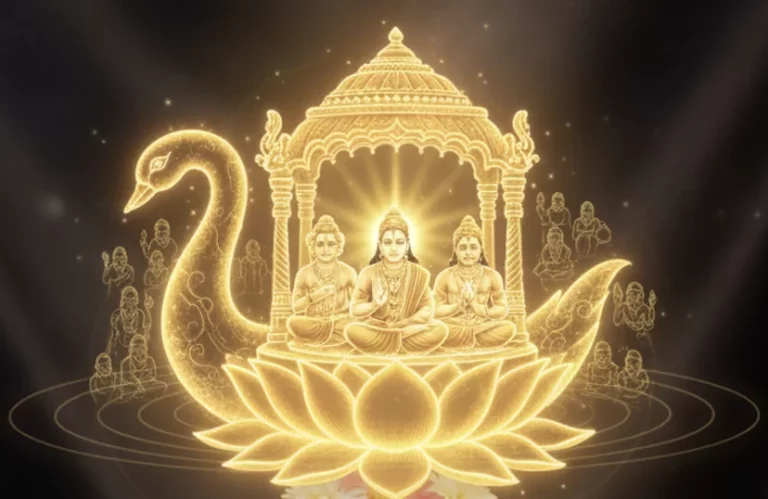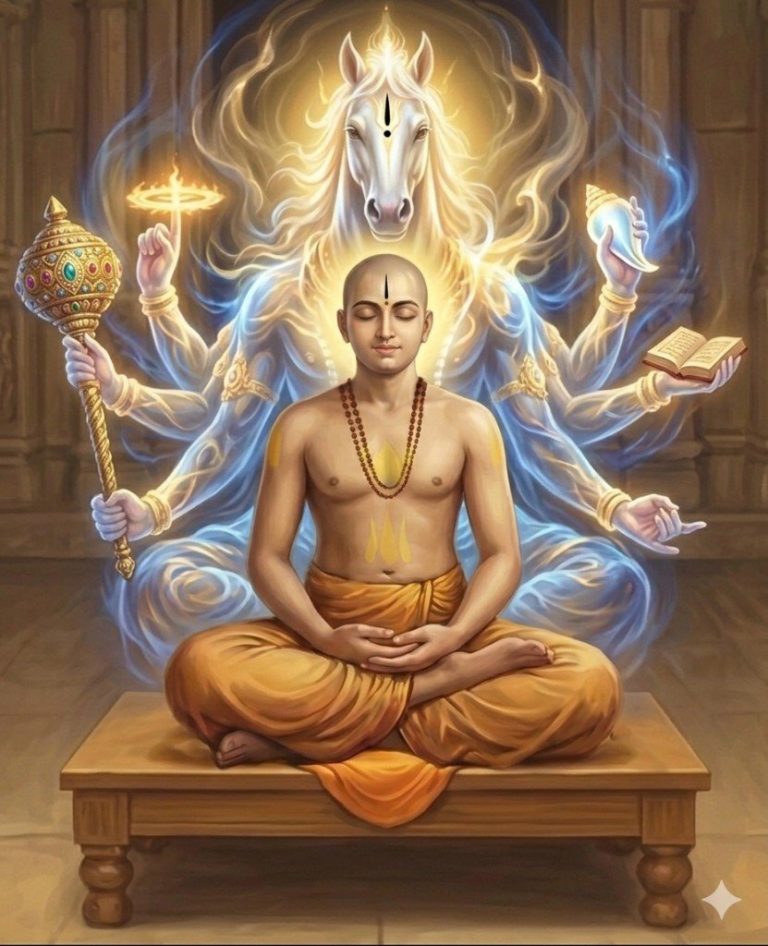
The Devi Mahatmya, also called the Durga Saptashati or Chandi Path, is a 700-verse text from the Markandeya Purana. In thirteen chapters it tells how the Divine Mother destroyed Madhu and Kaitabha, Mahishasura, and Shumbha and Nishumbha. It is recited across India during Navaratri. Its central teaching is simple: the same Mother who binds us through attachment is the one who sets us free when she is pleased.
Most of us have heard the Saptashati chanted at a Durga Namaskara or a Chandika Homa. Far fewer of us know what it actually says. This guide walks through the whole text, from its opening question to the boons at the end. It draws on a nine-part Kannada pravachana, Devi Mahatme (Saptashati), by Ananthakrishna Acharya, which reads the text in the light of the Madhwa tradition, the Pancharatra Lakshmi Tantra and the Vedic Ambhrini Sukta. Where that reading differs from other traditions, we say so.
Devi Mahatmya at a glance
- Source: Markandeya Purana (chapters 81 to 93 in most editions)
- Length: about 700 verses (sapta-shati means “seven hundred”), arranged in 13 chapters
- Narrators: Sage Markandeya to his disciple Kraushtuki; inside that frame, Sage Sumedha to King Suratha and the merchant Samadhi
- Three parts: Prathama Charitra (chapter 1), Madhyama Charitra (chapters 2 to 4), Uttama Charitra (chapters 5 to 13)
- Forms of the Mother: Mahakali, Mahalakshmi and Mahasaraswati
- When it is read: above all in Sharad Navaratri, and in Durga Namaskara, Chandika Homa and daily parayana
Why is it called the Durga Saptashati?
The text’s own name is Devi Mahatmya, “the greatness of the Goddess” (ದೇವೀ ಮಹಾತ್ಮೆ in Kannada). Saptashati is a count: tradition numbers its mantras at seven hundred. In North India it is often called Chandi Path, after Chandika, the name the text uses most often for the Mother in battle. All three names refer to the same text.
The Acharya opened the series with a gentle warning. We use the Saptashati in many ways during Navaratri: as parayana, archana and homa. But reciting it without knowing what it says is like a boy who walks to the same school every day and never learns anything. The blessing of the text grows when it is understood.
Where the story begins: a king, a merchant and one question
The Devi Mahatmya sits inside a larger account of the Manus, the rulers who uphold dharma in each age of the world. Each age, or manvantara, lasts about 71 cycles of the four yugas, and a single cycle runs to 4,320,000 years. We live in the seventh, the Vaivasvata manvantara. The eighth Manu will be Savarni, a son of Surya, and the Devi Mahatmya is the story of how he earned that place through the grace of Mahamaya.
The events take place long ago, in the second manvantara. King Suratha of the Chaitra dynasty cared for his people like his own children. Enemy kings defeated him, and his own ministers turned on him and seized his treasury. He rode alone into the forest and found the ashrama of Sage Sumedha. Even there he could not stop worrying. Were his elephants being fed? Was his treasure being wasted?
In the same forest he met Samadhi, a merchant whose wife and sons had thrown him out for his money. Samadhi’s mind kept going back to them: were they well, did they have enough? The two men brought one question to the sage: We know these people wronged us. Why can’t our minds let them go?
Sumedha’s answer begins: jñānam asti samastasya jantor viṣaya-gocare, “every creature has knowledge of the world of the senses.” Animals know what to eat and when to run. Some see by day and some, like owls, only by night. Birds feed their chicks even when they are hungry themselves. Knowing is not what sets us apart. The Acharya gave examples from ordinary life: parents waiting years for a son abroad who rarely calls, and a mother who forgets the pain of childbirth the moment she sees her baby. That pull, which no amount of knowing can switch off, is the work of Mahamaya.
jñāninām api cetāṃsi devī bhagavatī hi sā
balād ākṛṣya mohāya mahāmāyā prayacchati“Even the minds of the wise are drawn by force into delusion by the Devi, the Bhagavati, Mahamaya.”
But the sage does not stop there. Saiṣā prasannā varadā nṛṇāṃ bhavati muktaye: when she is pleased, the same Mother grants freedom. She is the cause of bondage and also sā vidyā paramā mukter hetubhūtā sanātanī, the eternal, supreme knowledge that leads to liberation.
Who is Mahamaya in the Devi Mahatmya?
Mahamaya is the Divine Mother as the power that binds beings to samsara through attachment and releases them when she is pleased. The text says she is eternal (nityaiva sā jagan-mūrtiḥ) and pervades the whole world. Even so, she “appears” whenever the devas need her, much as Vishnu appears as Rama and Krishna without ever being born as we are.
Before answering the king’s question about who she is, the Acharya asked listeners to set aside what they already imagine about the Devi. A clear picture needs an empty mind, and it needs to be checked against the rest of scripture rather than read in isolation.
He traced the root of every Devi Mahatmya to the Ambhrini Sukta (the Devi Sukta of the Rigveda, 10.125), in which Vak, the daughter of the sage Ambhrina, speaks about herself:
- ahaṃ rudrebhir vasubhiś carāmi: “I move with the Rudras, the Vasus and the Adityas.”
- mayā so annam atti yo vipaśyati: “whoever eats, sees, breathes and hears does so through me.”
- yaṃ kāmaye taṃ tam ugraṃ kṛṇomi taṃ brahmāṇaṃ tam ṛṣiṃ taṃ sumedhām: “whomever I love, I make mighty, a Brahma, a rishi, a sage.”
- mama yonir apsv antaḥ samudre: “my source is in the waters, within the ocean.”
The Acharya read that last line as pointing to Narayana, who rests on the waters. By her own statement, her power comes from him. The Harivamsha says the same: Vishnu sends the Devi to take birth, and those who worship her knowing his greatness are fully blessed. This is why the Saptashati calls her Vishnumaya (yā devī sarvabhūteṣu viṣṇumāyeti śabditā) and why its most famous hymn calls her Narayani. It also fits the Madhwa understanding of Taratamya, in which Lakshmi is the foremost of all beings after Vishnu and wholly devoted to him.
The first chapter makes the point in a striking scene. At the end of a cosmic cycle Vishnu lies in Yoga Nidra on the waters. Two asuras, Madhu and Kaitabha, rise to attack Brahma, and Brahma praises Yoga Nidra as hari-netra-kṛtālayā, “she who dwells in the eyes of Hari.” The Acharya explained that this is not ordinary sleep, which comes from tamas. The Bhagavata describes the Lord’s eyes closing at the dissolution with Lakshmi present, so in this reading Yoga Nidra is Lakshmi herself. The Lakshmi Tantra names this form Mahakali.
Shakta traditions read the Devi Mahatmya as describing an Adi Parashakti above Brahma, Vishnu and Shiva. The Acharya argued that the text itself does not support this, because Vishnu is already present at the dissolution before anything is created. Readers will meet both readings. This article follows the Madhwa one.
The three stories of the Devi Mahatmya
The Saptashati is built from three stories, each centred on one form of the Mother.
| Part | Chapters | Form of the Mother | Asuras defeated | What it shows |
|---|---|---|---|---|
| Prathama Charitra | 1 | Mahakali (Yoga Nidra) | Madhu and Kaitabha | Even the asuras’ pride is her delusion |
| Madhyama Charitra | 2 to 4 | Mahalakshmi (Mahishasuramardini) | Mahishasura and his generals | She fights for her devotees, without effort |
| Uttama Charitra | 5 to 13 | Mahasaraswati (Kaushiki, with Kali and the Matrikas) | Shumbha, Nishumbha, Chanda, Munda, Raktabija | Every power is hers, and in the end she alone remains |
The Acharya stressed that these are not three separate goddesses, and not simply the consort forms we know from temple images. In the Lakshmi Tantra, all three are forms in which Lakshmi appears as Durga.
The first story: Madhu and Kaitabha (chapter 1)
Brahma’s hymn to Yoga Nidra is one of the richest passages in the text. He praises her as viśveśvarīṃ jagaddhātrīṃ, the ruler and sustainer of the world, and says tvaṃ svāhā tvaṃ svadhā: “you are Svaha, you are Svadha.” The Acharya used this line to explain a familiar practice. In japa we say namah, in a yajna we say svaha, and when offering to our ancestors we say svadha. The words carry power because she is present in them. The same is true of every syllable of a mantra, which is why the short, long and extended vowels (hrasva, dirgha, pluta) have to be pronounced correctly.
Brahma also calls her saumyā saumyatarāśeṣa-saumyebhyas tv atisundarī, gentler than everything gentle and more beautiful than all beauty, and in the same breath kālarātri, the dreadful night of dissolution. Both are true of her.
Vishnu wakes and fights the two asuras for five thousand years, as play rather than struggle. Then the Mother clouds their minds with pride. Thinking themselves greater than the Lord, they offer him a boon, and he asks that they become killable by him. The Acharya drew the lesson plainly: the thought “I am greater than God” is itself her delusion.
The second story: Mahishasura (chapters 2 to 4)
Mahishasura defeats the devas and takes over the posts of Surya, Chandra, Agni and Indra. The Acharya saw a present-day picture in this. When every pure thing in the world is occupied by an asuric force, it shows up as pollution and disorder.
The devas go to Vishnu, with Brahma and Shiva. A great light pours out of Vishnu, Shiva, Brahma, Indra and the other gods and gathers into a radiant woman. It is often read as the gods pooling their powers. The Acharya, following the Lakshmi Tantra, read it differently. The Mother was already seated within every deva, and what came out of them was her own presence gathering into one form. Nothing was taken from the gods. In the same way, each weapon they hand her, from Shiva’s trishula to Vishnu’s Sudarshana chakra, was powerful in the first place because she dwelt in it. The ocean gives her jewels and garments, Vishwakarma gives armour, Himavan gives the lion and Kubera a cup, much like the offerings of a puja.
Mahishasura’s generals, Chikshura, Chamara, Udagra, Bashkala, Bidala and others, come at her with armies beyond counting. She destroys them as if at play, and even her lion fights. The Acharya’s point was that she does not fight for herself. She stands as a warrior for her devotees.
Mahishasura keeps changing shape, from buffalo to lion, to a man with a sword, to an elephant and back to a buffalo. Before the end she says, garja garja kṣaṇaṃ mūḍha: “roar, roar for a moment, fool.” The Acharya cautioned against reading this scene as intoxication. Her reddened eyes are the anger of the Mother of the world at adharma, and her words are those of someone entirely unthreatened. She pins him under her foot and ends him with her sword.
The devas’ hymn that follows, the Shakradi Stuti of chapter 4, contains some of the best-loved verses in the Saptashati:
yā śrīḥ svayaṃ sukṛtināṃ bhavaneṣv alakṣmīḥ
pāpātmanāṃ kṛtadhiyāṃ hṛdayeṣu buddhiḥ
śraddhā satāṃ kula-jana-prabhavasya lajjā
tāṃ tvāṃ natāḥ sma paripālaya devi viśvam“You are prosperity in the homes of the virtuous and misfortune in the homes of the wicked; good judgement in the hearts of the wise, faith in the good, and modesty in the well-born. We bow to you. Protect the world, O Devi.”
The Acharya noted that this verse measures a person by their buddhi, not their bank balance. A rich man with a crooked mind is not a good man, and a poor man with a clear one is.
The hymn also marvels at her compassion for her enemies. She could burn them to ash with a glance, yet she strikes them with weapons so that, purified, even they reach higher worlds: citte kṛpā samara-niṣṭhuratā ca dṛṣṭā, “mercy in the heart and severity in battle.” He compared it to a mother who scolds a child on the outside and melts on the inside. In the same way, she accepts a single flower offered with devotion by a good person, and does not accept wealth gained by wrong means, however large the offering.
The third story: Shumbha and Nishumbha (chapters 5 to 13)
Two brothers, Shumbha and Nishumbha, seize the worlds of the devas. On Brihaspati’s advice the devas go to the Himalaya and sing namo devyai mahādevyai śivāyai satataṃ namaḥ, followed by the Ya Devi Sarva Bhuteshu verses explained in the next section.
Parvati, passing by, asks whom they are praising. From the sheath (kosha) of her body comes the answer: Ambika herself, who is therefore called Kaushiki. The Acharya drew on the Padma and Vamana Puranas to explain that Parvati is present, and that the Durga who appears through her, with three eyes, trishula and bell, is Vishnumaya. She appears as a kanya, a maiden. This, he said, is why worship of young girls (kanya puja) holds such a special place in Navaratri.
Chanda and Munda see her and tell Shumbha. He sends the messenger Sugriva to say that every gem in the three worlds belongs to the asuras, and she is a gem among women. She answers with her vow: whoever defeats her in battle and breaks her pride will be her husband. Dhumralochana comes with sixty thousand soldiers to drag her away and is turned to ash by a single “hum.”
When Chanda and Munda attack, Kali springs from her furrowed brow, with sword and noose, a garland of skulls and a tiger skin. Kali devours their army, takes both their heads and brings them to the Devi, who blesses her: cāmuṇḍeti tato loke khyātā devī bhaviṣyasi, “you will be famed in the world as Chamunda.” This is the form honoured as Chamundeshwari, and in the fierce village forms of the Mother across Karnataka.
Then come the Saptamatrikas: Brahmani on a swan with her kamandalu, Maheshwari on a bull with the trishula, Kaumari on a peacock with a spear, Vaishnavi on Garuda with the chakra, Varahi, Narasimhi, and Aindri on an elephant with the vajra. The Acharya asked a sharp question. If the gods’ own power had left their bodies, would they not have collapsed? His answer was that the Mother who governs the power within each god comes out in that god’s form, the way a good teacher draws out an ability the student already has. Varahi and Narasimhi follow the two avatars of Vishnu meant purely for destroying evil, and Lakshmi accompanies him there too. The Devi even sends Shiva as her messenger, which is why she is called Shivaduti.
Raktabija is the hardest enemy: every drop of his blood that touches the ground becomes another asura. The Acharya compared him to a virus that multiplies faster than it can be fought. The Devi tells Chamunda to open her mouth wide and take each drop before it lands, and Raktabija falls.
After Nishumbha is killed, Shumbha taunts her for fighting with other people’s strength. She answers:
ekaivāhaṃ jagaty atra dvitīyā kā mamāparā
paśyaitā duṣṭa mayy eva viśantyo mad-vibhūtayaḥ“I alone exist here in the world. Who else is there besides me? See, wicked one, these are my own powers, entering back into me.”
Every Matrika merges into her, and she ends Shumbha alone with her trishula. Then, the text says, the rivers flowed in their courses, the sun shone clearly, the winds blew gently and the sacrificial fires burned calmly. The Acharya’s reading was that disorder in nature is not random. Where adharma rules, nature itself is disturbed.
The devas then sing the Narayani Stuti of chapter 11, which contains sarva-maṅgala-māṅgalye and many verses recited daily in Karnataka homes. “Narayani,” the Acharya explained, means the one who belongs to Narayana. The hymn says vidyāḥ samastās tava devi bhedāḥ striyaḥ samastāḥ sakalā jagatsu: all branches of learning, and all women everywhere, are her forms. He added a warning for scholars: learning that feeds the ego instead of humility has missed the point. The hymn ends by saying that wherever there are demons, deadly snakes, enemies, robbers, forest fire or the open sea, she is there protecting the world.
In return, the Mother promises to come again. She will be born to Nanda and Yashoda and live on the Vindhya mountains as Vindhyavasini. In a long famine she will feed the rishis with vegetables as Shakambhari, look on them with a hundred eyes as Shatakshi, slay the asura Durgama and be called Durga, and appear as Bhima on the Himalaya and Bhramari among the bees.
What does “Ya Devi Sarva Bhuteshu” mean, and why is “namas tasyai” said three times?
Yā devī sarva-bhūteṣu … rūpeṇa saṃsthitā, namas tasyai namas tasyai namas tasyai namo namaḥ means “To the Devi who dwells in all beings in the form of ___, salutations to her, salutations to her, salutations to her, again and again.” The devas sing it on the Himalaya in chapter 5. It names more than twenty forms in which she lives in every creature, among them consciousness, intelligence, sleep, hunger, strength, forbearance, faith, memory, compassion and mother.
The most memorable teaching of the whole series was the Acharya’s explanation of the triple salutation. Every one of these qualities exists in three forms, sattvic, rajasic and tamasic, and she governs all three. So each namas tasyai greets her in one of them. With the first, we ask that the sattvic form grow in us. With the second, we ask that the rajasic stay within measure. With the third, we ask that the tamasic leave us. As the Bhagavad Gita says, daivī hy eṣā guṇamayī mama māyā duratyayā (7.14): this divine maya made of the three gunas is hard to cross.
| She dwells as | Sattvic form (pray for it) | Rajasic form (keep it in measure) | Tamasic form (ask her to remove it) |
|---|---|---|---|
| Vishnumaya (attachment) | Love and respect for good people, even when we want nothing from them | Attachment to spouse, children and home | Fixation on people we dislike, like fretting for an hour over an unwanted guest |
| Chetana (consciousness, memory) | Remembering good teachings for years | A mind full of worldly plans | Replaying old hurts and griefs again and again |
| Buddhi (intelligence) | Clear, settled judgement about what to do | Confusion, always asking others what to do | Doing the very thing we know we shouldn’t |
| Nidra (sleep) | Timely, sound sleep (yukta-svapnāvabodha, Gita 6.17) | Sleep that neither helps nor harms | Sleeping at dusk, oversleeping, dozing through a pravachana |
| Kshudha (hunger) | Hunger at the right time for wholesome food | Eating whatever comes, whenever | Craving stale or harmful food (Gita 17.10) |
| Shakti (strength) | Knowing, willing and acting for worship and good work | Energy to build a home and a livelihood | Energy spent on harming others |
| Kshanti (forbearance) | Staying calm even when blamed, out of understanding | Patience only with our own people | A calm face that hides resentment |
| Matru (mother) | A mother who raises a good human being | A mother who wants her child to be first at everything | A mother who feeds rivalry, as Ravana’s mother did |
The Acharya suggested praying this way for the rest of Navaratri: slowly, one form at a time, asking for the right version of each quality in your own life.
Navaratri day-wise verses from the Durga Saptashati
If you cannot read all thirteen chapters, carry one verse through each day of Navaratri. Each verse below comes from the Saptashati, with its chapter and verse number, a plain meaning and one way to live it that day.
Day 1, Pratipada: even the wise are caught (Saptashati 1.55–57)
ಜ್ಞಾನಿನಾಮಪಿ ಚೇತಾಂಸಿ ದೇವೀ ಭಗವತೀ ಹಿ ಸಾ । ಬಲಾದಾಕೃಷ್ಯ ಮೋಹಾಯ ಮಹಾಮಾಯಾ ಪ್ರಯಚ್ಛತಿ ॥ … ಸೈಷಾ ಪ್ರಸನ್ನಾ ವರದಾ ನೃಣಾಂ ಭವತಿ ಮುಕ್ತಯೇ ॥
jñāninām api cetāṃsi devī bhagavatī hi sā … saiṣā prasannā varadā nṛṇāṃ bhavati muktaye
Meaning: Even the wisest get caught up in worldly attachments. When the Divine Mother is pleased, she blesses us and sets us free.
Today: Begin Navaratri with one act of seva that asks for nothing back.
Day 2, Dwitiya: Devi as hunger (Saptashati 5.26–28)
ಯಾ ದೇವೀ ಸರ್ವಭೂತೇಷು ಕ್ಷುಧಾರೂಪೇಣ ಸಂಸ್ಥಿತಾ । ನಮಸ್ತಸ್ಯೈ ನಮಸ್ತಸ್ಯೈ ನಮಸ್ತಸ್ಯೈ ನಮೋ ನಮಃ ॥
yā devī sarva-bhūteṣu kṣudhā-rūpeṇa saṃsthitā
Meaning: To the Devi who lives in every being as hunger, we bow again and again.
Today: Feed someone who is hungry, a person or an animal, and you honour her.
Day 3, Tritiya: Devi as mother (Saptashati 5.71–73)
ಯಾ ದೇವೀ ಸರ್ವಭೂತೇಷು ಮಾತೃರೂಪೇಣ ಸಂಸ್ಥಿತಾ । ನಮಸ್ತಸ್ಯೈ ನಮಸ್ತಸ್ಯೈ ನಮಸ್ತಸ್ಯೈ ನಮೋ ನಮಃ ॥
yā devī sarva-bhūteṣu mātṛ-rūpeṇa saṃsthitā
Meaning: To the Devi who lives in every being as a mother, we bow again and again.
Today: Thank your mother, and care for Gau Mata, whom the tradition also calls mother.
Day 4, Chaturthi: she removes fear (Saptashati 4.17)
ದುರ್ಗೇ ಸ್ಮೃತಾ ಹರಸಿ ಭೀತಿಮಶೇಷಜಂತೋಃ । ಸ್ವಸ್ಥೈಃ ಸ್ಮೃತಾ ಮತಿಮತೀವ ಶುಭಾಂ ದದಾಸಿ ॥
durge smṛtā harasi bhītim aśeṣa-jantoḥ, svasthaiḥ smṛtā matim atīva śubhāṃ dadāsi
Meaning: O Durga, when anyone remembers you in fear, you take that fear away. When people remember you in good times, you give them a pure and good mind.
Today: Remember her when things are going well, not only when they are hard.
Day 5, Panchami: Devi as compassion (Saptashati 5.65–67)
ಯಾ ದೇವೀ ಸರ್ವಭೂತೇಷು ದಯಾರೂಪೇಣ ಸಂಸ್ಥಿತಾ । ನಮಸ್ತಸ್ಯೈ ನಮಸ್ತಸ್ಯೈ ನಮಸ್ತಸ್ಯೈ ನಮೋ ನಮಃ ॥
yā devī sarva-bhūteṣu dayā-rūpeṇa saṃsthitā
Meaning: To the Devi who lives in every being as compassion, we bow again and again.
Today: Compassion is the Devi at work in us. Let it reach someone who cannot ask for it.
Day 6, Shashthi: Devi as Lakshmi (Saptashati 5.56–58)
ಯಾ ದೇವೀ ಸರ್ವಭೂತೇಷು ಲಕ್ಷ್ಮೀರೂಪೇಣ ಸಂಸ್ಥಿತಾ । ನಮಸ್ತಸ್ಯೈ ನಮಸ್ತಸ್ಯೈ ನಮಸ್ತಸ್ಯೈ ನಮೋ ನಮಃ ॥
yā devī sarva-bhūteṣu lakṣmī-rūpeṇa saṃsthitā
Meaning: To the Devi who lives in every being as Lakshmi, the wealth and goodness of life, we bow again and again.
Today: Wealth shared in seva becomes Lakshmi’s blessing. Many families offer Lakshmi Kumkumarchane during Navaratri.
Day 7, Saptami: Sarva Mangala, the Narayani verse (Saptashati 11.10)
ಸರ್ವಮಂಗಲಮಾಂಗಲ್ಯೇ ಶಿವೇ ಸರ್ವಾರ್ಥಸಾಧಿಕೇ । ಶರಣ್ಯೇ ತ್ರ್ಯಂಬಕೇ ಗೌರಿ ನಾರಾಯಣಿ ನಮೋಽಸ್ತು ತೇ ॥
sarva-maṅgala-māṅgalye śive sarvārtha-sādhike, śaraṇye tryambake gauri nārāyaṇi namo ‘stu te
Meaning: You are the auspiciousness in everything that is good. You fulfil every worthy wish and you are our refuge. O Narayani, beloved of Narayana, we bow to you.
Today: Every good work begins with her blessing. Begin one today in her name.
Day 8, Ashtami: calm every trouble (Saptashati 11.39)
ಸರ್ವಾಬಾಧಾಪ್ರಶಮನಂ ತ್ರೈಲೋಕ್ಯಸ್ಯಾಖಿಲೇಶ್ವರಿ । ಏವಮೇವ ತ್ವಯಾ ಕಾರ್ಯಮಸ್ಮದ್ವೈರಿವಿನಾಶನಮ್ ॥
sarvābādhā-praśamanaṃ trailokyasyākhileśvari, evam eva tvayā kāryam asmad-vairi-vināśanam
Meaning: O Queen of all, calm every trouble in the three worlds, and in the same way remove everything that harms us.
Today: Ashtami is one of the days the text names for hearing the Devi Mahatmya. Pray for an end to suffering, and ease one creature’s suffering yourself.
Day 9, Navami: protect us from every fear (Saptashati 11.24)
ಸರ್ವಸ್ವರೂಪೇ ಸರ್ವೇಶೇ ಸರ್ವಶಕ್ತಿಸಮನ್ವಿತೇ । ಭಯೇಭ್ಯಸ್ತ್ರಾಹಿ ನೋ ದೇವಿ ದುರ್ಗೇ ದೇವಿ ನಮೋಽಸ್ತು ತೇ ॥
sarva-svarūpe sarveśe sarva-śakti-samanvite, bhayebhyas trāhi no devi durge devi namo ‘stu te
Meaning: You are present in all things, you rule over all, and you hold every power. O Devi, protect us from every fear. O Durga, we bow to you.
Today: As Navaratri completes, offer your seva at her feet, in dedication to Sri Narayana.
How to read the Durga Saptashati at home during Navaratri
- Understand before you recite. Read the meaning of a chapter, or listen to a pravachana on it, before you chant it.
- Plan the time. The Acharya estimated that a full parayana takes about two and a half hours. If that is not possible, many families read a few chapters each day so the whole text is completed within Navaratri.
- Keep the days the text names. In chapter 12 the Devi singles out Ashtami, Navami and Chaturdashi (aṣṭamyāṃ ca caturdaśyāṃ navamyāṃ caika-cetasaḥ), and the great annual worship in autumn (śarat-kāle mahā-pūjā), which is Sharad Navaratri.
- Read with one mind. The text asks for devotion (bhakti) and a single-pointed mind (eka-cetas), not speed.
- Use it to complete other worship. The Devi says her Mahatmya should be recited at every puja, homa and festival. Tradition holds that it completes the worship and covers mistakes made knowingly or unknowingly.
- Keep the offerings sattvic. Flowers, incense, a lamp and naivedya are enough. When Suratha and Samadhi offered naivedya sprinkled with their own blood, the Acharya read it as an offering of the self: “this body is yours.” He cited the Padma Purana, where the Devi says that sacrificing animals brings sin to the one who offers.
- Offer it onward. In this tradition the worship of the Mother is completed by offering it to the Lord she serves: Sri Narayanarpanamastu.
What the Devi Mahatmya promises: the phala shruti
In chapter 12 the Devi herself describes what comes to those who hear this account with devotion: no fear of enemies, thieves, rulers, weapons, fire or floods; relief from the three kinds of suffering (from one’s own body and mind, from other beings, and from natural forces); and her protection when she is remembered in a forest, at sea, in battle or in captivity. The Acharya mentioned that fishermen on the coast still pray to the Devi before they set out to sea. These are the text’s own promises, held in faith. They are not guarantees of a particular outcome.
The line the Acharya called most important comes near the end of the chapter:
stutā sampūjitā puṣpair gandha-dhūpādibhis tathā
dadāti vittaṃ putrāṃś ca matiṃ dharme gatiṃ śubhām“Praised and worshipped with flowers, incense and fragrance, she gives wealth and children, and above all a mind set on dharma and a good destiny.”
How the story ends: what the king and the merchant asked for
Suratha and Samadhi make a clay image of the Devi on a riverbank and worship her for three years with the Devi Sukta, fasting and holding the mind steady. The Acharya explained that fasting here is a means of concentration, not an end in itself. The Mother appears and offers them a boon.
Suratha asks for his kingdom back, free of enemies, in this life and the next. He receives it, and in a future birth as a son of Surya he becomes Savarni, the eighth Manu. Samadhi has lost his taste for the world by now. He asks only for the knowledge that cuts through “I” and “mine,” and the Devi gives it to him, the knowledge that leads to liberation.
The Acharya’s comment was simple: you can ask a king for money, but ask the Mother for what only she can give. He tied it back to the Gita: mām eva ye prapadyante māyām etāṃ taranti te, “those who take refuge in me cross this maya” (7.14). There is no contradiction between the two. The Mother frees those who turn to the Lord, and worshipping her and the Lord within her go together.
So the Devi Mahatmya ends where it began. It opened with two men asking why they could not let go, and it closes with the one who asked for knowledge being given the power to do exactly that.
Navaratri seva: honour the Mother in every being
The Ya Devi hymn asks us to see the Mother in every creature: in its hunger, in motherhood, in compassion. At the Ruju Yogi Gaushale in Thinakallu, Chintamani, that becomes very practical. ₹500 feeds one Gau Mata for a full day. You can offer it as Navaratri seva in your family’s name: after paying, send your name, gotra, nakshatra and transaction ID on WhatsApp to +91 99001 08151 so the sankalpa can be made at Shri Ruju Yogi Vadiraja Mandira. To learn more about why cow seva matters, read Go Seva: Why Cow Service Is Sacred, and for other festival dates see the Madhwa Festival Calendar.
ಶ್ರೀ ನಾರಾಯಣಾರ್ಪಣಮಸ್ತು
Sources and further listening
This article is based on the nine-part Kannada pravachana ದೇವೀ ಮಹಾತ್ಮೆ (ಸಪ್ತಶತಿ) ಪ್ರವಚನ by Ananthakrishna Acharya, published on the Akshay Acharya YouTube channel:
- Part 1: Suratha, Samadhi, Mahamaya and the Ambhrini Sukta
- Part 2: Yoga Nidra and Brahma’s hymn
- Part 3: Madhu and Kaitabha, and the appearance of Mahalakshmi
- Part 4: The end of Mahishasura and the Shakradi Stuti
- Part 5: Ya Devi Sarva Bhuteshu and the three forms of each quality
- Part 6: Devi as mother, Kaushiki, Dhumralochana and Chamunda
- Part 7: The Saptamatrikas, Raktabija and Nishumbha
- Part 8: Shumbha, the Narayani Stuti and the Devi’s future forms
- Part 9: The phala shruti and the boons to Suratha and Samadhi
Texts cited in the pravachana include the Markandeya Purana (Devi Mahatmya), Rigveda 10.125 (Ambhrini or Devi Sukta), the Lakshmi Tantra, the Bhagavad Gita (4.6, 6.17, 7.14, 17.10), the Harivamsha, and the Bhagavata, Padma and Vamana Puranas. Verse wording and numbering were checked against the proofread Durga Saptashati text at sanskritdocuments.org and the Markandeya Purana text in the GRETIL library. Printed editions differ in small details, so for chanting follow the text your family uses.
Frequently asked questions
What is the difference between the Devi Mahatmya and the Durga Saptashati?
There is no difference. Devi Mahatmya (“the greatness of the Goddess”) is the text’s own name. Durga Saptashati refers to its traditional count of 700 verses, and Chandi Path is the name used in much of North India. All three refer to the same thirteen chapters of the Markandeya Purana.
How many chapters and verses are in the Durga Saptashati?
The Durga Saptashati has 13 chapters and about 700 verses. They fall into three parts: the Prathama Charitra (chapter 1, Mahakali), the Madhyama Charitra (chapters 2 to 4, Mahalakshmi) and the Uttama Charitra (chapters 5 to 13, Mahasaraswati).
Who wrote the Devi Mahatmya?
The Devi Mahatmya is part of the Markandeya Purana, which tradition attributes, like all the Puranas, to Vedavyasa. Inside the text, Sage Markandeya narrates it to his disciple Kraushtuki, and within that story Sage Sumedha tells it to King Suratha and the merchant Samadhi.
Who are Mahakali, Mahalakshmi and Mahasaraswati in the Durga Saptashati?
They are the forms of the Mother at the centre of the three stories: Mahakali as Yoga Nidra in the battle with Madhu and Kaitabha, Mahalakshmi as Mahishasuramardini, and Mahasaraswati as Kaushiki against Shumbha and Nishumbha. In the Madhwa reading based on the Lakshmi Tantra, all three are forms in which Lakshmi appears as Durga, not three separate goddesses.
What does “Ya Devi Sarva Bhuteshu” mean?
It means “the Devi who dwells in all beings.” The full refrain, “ya devi sarva-bhuteshu … rupena samsthita, namas tasyai namas tasyai namas tasyai namo namah,” salutes the Mother as she lives in every creature in a particular form, such as consciousness, intelligence, sleep, hunger, strength, forbearance, compassion or mother. The hymn is sung by the devas in chapter 5.
Why is “namas tasyai” said three times?
In the pravachana this article follows, each salutation greets the Devi in one of the three gunas, because every quality she dwells in has a sattvic, rajasic and tamasic form. With the three salutations we ask that the sattvic form grow, that the rajasic stay within measure, and that the tamasic leave us.
Is the Devi in the Devi Mahatmya Parvati or Lakshmi?
Readings differ by tradition. In the Madhwa reading, the Mahamaya, Yoga Nidra and Mahishasuramardini of the text are Lakshmi, called Vishnumaya and Narayani, and the Kaushiki who slays Shumbha appears through Parvati’s body, with Narayani present within. Shakta traditions instead see an Adi Parashakti above the Trimurti.
Which days of Navaratri are best for reading the Durga Saptashati?
The text itself names Ashtami, Navami and Chaturdashi, and the great annual worship in autumn, which is Sharad Navaratri. Many families read a few chapters each day so the whole Saptashati is completed by Navami, with Ashtami and Navami given special importance.
Can I read the Durga Saptashati at home?
Many families read the Durga Saptashati at home during Navaratri. The text asks above all for devotion and a focused mind. If you are new to it, start by reading or listening to its meaning, keep the offerings simple and sattvic, and ask your family priest or archaka about any formal homa or sankalpa.
Did Durga drink wine before killing Mahishasura?
The text has the Devi tell Mahishasura to roar for a moment while she drinks, before she slays him. Ananthakrishna Acharya cautioned against reading this as intoxication: her reddened eyes show the anger of the Mother of the world at adharma, and her words show that she is entirely unthreatened by him.
How is Gau Seva connected to Navaratri?
The Ya Devi hymn honours the Mother as she lives in every being, as hunger, as mother and as compassion, so feeding a cow is a natural Navaratri seva. At Ruju Yogi Gaushale in Chintamani, ₹500 feeds one Gau Mata for a full day, and you can offer it in your family’s name at rujuyogi.org/donate/cow-fodder/.