In the spiritual vocabulary of the Madhwa tradition, some words carry an extraordinary depth of meaning. One such term is Ruju. For devotees, students of Tattvavada, and readers exploring the divine hierarchy explained in Madhwa philosophy, the subject of the Rujus opens a doorway into a profound understanding of spiritual gradation, purity, and divine service.
The Rujus are not described as ordinary souls. They are remembered in traditional sources as the highest class of jivas, occupying an exalted position in the cosmic order. They are associated with unswerving devotion to Shri Hari, perfect spiritual refinement, and the fitness to occupy the loftiest posts in creation. To understand the Rujus is therefore to understand an important dimension of Taratamya, the graded order that lies at the heart of Dvaita Vedanta.
This article explores the meaning of the Rujus, their place in Madhwa theology, the tradition of the hundred Rujus, and why the name Latavya holds special devotional importance for followers of Sri Vadiraja and Sri Bhaavi Sameera. For related reading, see Taratamya: The Divine Hierarchy in Madhwa Theology, Dvaita Vedanta Explained: Madhwacharya’s Philosophy of Dualism, Rujutva of Sri Vadirajaru: Scriptural Foundations of Sri Bhaavi Sameera, and Life and Teachings of Sri Vadiraja Tirtha. You can book a seva or donate to support Shri Bhaavi Sameera Vadiraja Mandira.
What Does “Ruju” Mean?
The word “Ruju” broadly conveys the idea of straightness, purity, and inner correctness. In the theological context of Madhwa philosophy, it refers to a class of souls whose nature is utterly free from crookedness or corruption. They are described in traditional material as beings untouched by defect, unwavering in their devotion, and endowed with extraordinary spiritual worthiness.
This is why the term Rujugana is often used. It does not point to one isolated soul alone, but to a sacred group or class of highly evolved jivas whose spiritual status is far above ordinary beings.
In devotional understanding, the Ruju is not merely “good” in a moral sense. A Ruju represents a soul that is intrinsically fitted for divine service, right knowledge, and higher responsibility in the cosmic order.
The Place of the Rujus in Taratamya
One of the defining teachings of Madhwa philosophy is that all beings do not stand on the same spiritual level. Reality is structured, ordered, and meaningful. This doctrine of gradation is called Taratamya.
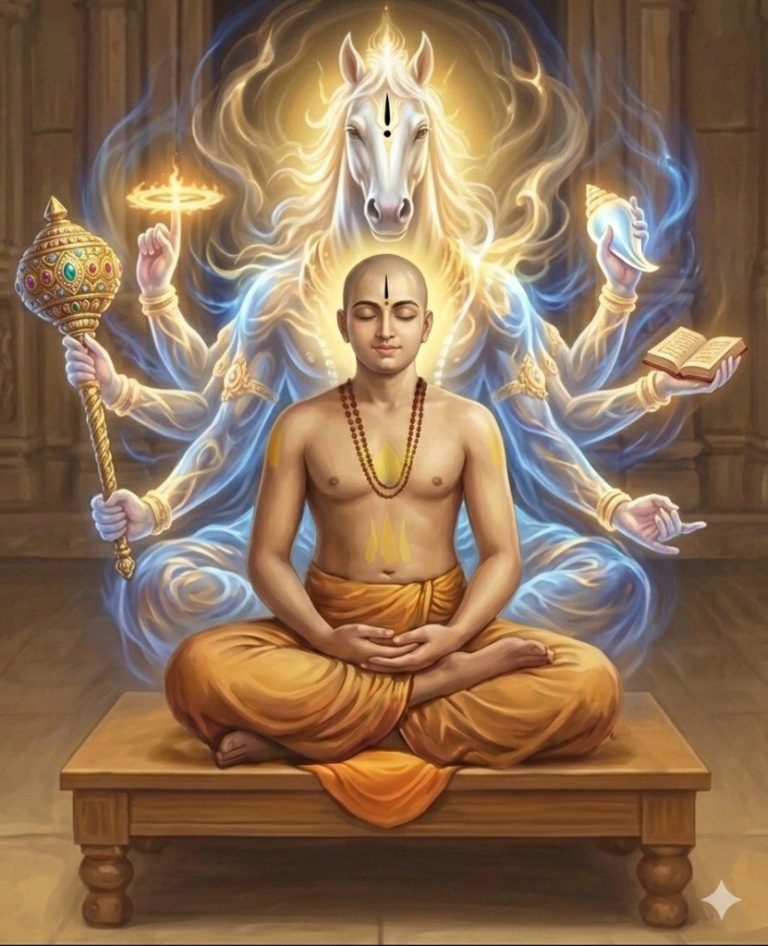
Within that framework, the Rujus are given an exceptionally high place. Traditional descriptions say they stand immediately after Sri Lakshmi in the hierarchy of jivas. Brahma and Vayu themselves are counted among the Rujus. This shows just how elevated the category is.
That position is not symbolic poetry alone. It communicates a theological truth: the Rujus are those souls uniquely fitted for the highest offices in the chain of divine administration. In this understanding, the posts of Brahma and Vayu are not casually occupied, nor are they available to any soul whatsoever. They belong only within the Ruju order.
This is one of the most striking insights in the tradition. The cosmic structure is not random. Spiritual office corresponds to intrinsic spiritual fitness.
Why the Rujus Are Considered Extraordinary
Traditional descriptions of the Rujus emphasize several qualities that make them unique:
1. Freedom from doshas
The Rujus are described as free from defects. This does not merely mean that they are morally disciplined. It means that their nature is not distorted by the inner faults and limitations that affect ordinary jivas.
2. Uncompromised devotion to Vishnu
Their bhakti is unwavering. They are presented as souls whose devotion to Shri Hari is pure, constant, and without deviation.
3. Unaffected by the distortions of the gunas
One traditional account explains that the Rujus are not troubled by the ordinary corrupting modifications associated with the three gunas. This marks them out as spiritually exceptional.
4. Fitness for the highest cosmic roles
The tradition states that only Rujus are qualified to hold the positions of Brahma and Vayu. This is an extraordinary theological claim and places the Rujus among the most elevated beings in creation.
5. Spiritual steadiness even in avatara-like descent
Traditional descriptions also state that even when such beings take birth, their essential purity is not compromised.
Taken together, these features show why the Rujus occupy such a revered place in Madhwa thought. They are not simply advanced aspirants; they are a distinct and exalted spiritual category.
One hundred Rujus and the broader Ruju order
This is a point that deserves careful explanation.
One of the traditional source pages says there are infinite Rujus, while another says that at any given time they are spoken of as one hundred, and then provides a traditional list of names. These two statements can be read together as describing the Ruju order from two angles: a larger cosmic continuity, and a specific functional set of one hundred in the active hierarchy.
For practical devotional and scriptural discussion, the tradition often refers to the 100 Rujus. These are presented as a sacred sequence beginning with Brahma and Vayu and continuing through other exalted names such as Latavya, Gavya, Vaktavya, Jnatavya, Bhavya, Sevya, Smartavya, and finally Kalki in that ordered listing.
For an article intended for spiritual readers, the most important point is this: the Rujus are not an abstract theory. They are remembered as a real, ordered class of divine souls within the Madhwa understanding of creation.
The Spiritual Progression of the Rujus
The traditional narrative surrounding the Rujus is deeply fascinating. It describes a long and majestic progression in which a Ruju, through vast stretches of sadhana measured in kalpas, rises step by step in the hierarchy.
One source explains that after prolonged spiritual discipline, a Ruju reaches the post called Kalki in this Ruju sequence, then continues to ascend until reaching the position of Vayu, and ultimately the post of Brahma.
Another source explains the sequence in terms of succession: when Brahma’s term is complete, the next Ruju rises into that office; Vayu in turn advances; and the next Ruju after Vayu rises correspondingly.
What this communicates is the grandeur of the Madhwa vision of time, spiritual qualification, and divine order. Creation is not merely material movement. It is also a stage on which souls, according to their nature and divine will, fulfill distinct roles across immense spans of cosmic time.
The Traditional List of the Hundred Rujus
The supplied sources preserve a traditional list of 100 Ruju names. The sequence begins with Brahma and Vayu and continues through Latavya, Gavya, and the rest in order. The first ten are:
- Brahma
- Vayu
- Latavya
- Gavya
- Vaktavya
- Jnatavya
- Bhaavya
- Svargavya
- Subhavya
- Sevya
The full list concludes with Kalki in the hundredth place. Because spellings vary slightly across transliteration traditions, one consistent style is used below. Some traditional enumerations list Sukarta twice in succession (after Sukaalagna and again after Yajvi); both positions are included in the numbered list.
Traditional sources enumerate one hundred Rujus in a fixed order.
This keeps the article readable on small screens while the complete sequence stays available for study and recitation.
Why Knowledge of the Rujus Matters for Devotees
Some may ask: why should an ordinary devotee learn about such exalted beings?
The answer lies in the structure of Madhwa spirituality itself. In this tradition, right understanding is not optional. Knowledge of the divine order helps the devotee approach the Supreme with humility, correctness, and reverence.
The traditional account you shared makes an especially important point: if one seeks the grace of Shri Hari, one must receive true understanding through those beings who know Him best. The Rujus, being flawless and spiritually perfect in the traditional description, are seen as capable of transmitting pure knowledge.
This is why the doctrine is not merely philosophical. It is devotional. It teaches the seeker to appreciate:
- the greatness of Shri Hari,
- the unique position of Sri Lakshmi,
- the divine offices of Brahma and Vayu,
- and the sanctity of the Ruju order.
In other words, reflection on the Rujus deepens reverence for the entire spiritual architecture of Tattvavada.
Latavya: A Name of Special Importance
Among the hundred Rujus, Latavya has special importance in the devotional memory preserved in the sources you shared.
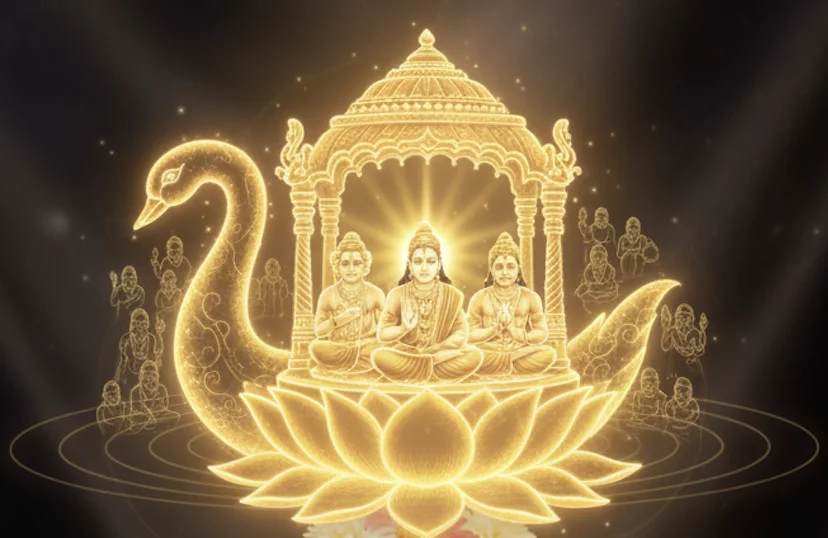
One traditional account identifies Latavya with Sudeva, the Brahmin who carried Rukmini’s message to Shri Krishna. This episode is treated not as a casual anecdote, but as a revelation of the greatness of that soul. Sudeva is portrayed as one blessed with remarkable purity, fitness, and divine favor.
That same traditional narrative then extends further: it presents Latavya as taking birth later in connection with the sacred history of Sri Vadiraja Tirtha. This is why the discussion of Rujus becomes especially meaningful in the Ruju Yogi context, where devotion to Sri Bhaavi Sameera Vadiraja is central.
For readers of rujuyogi.org, this is one of the most spiritually resonant dimensions of the topic. The doctrine of the Rujus does not remain distant or abstract. It becomes intimately connected to a living line of reverence centered on Sri Vadiraja.
The Devotional Link Between Rujus and Sri Vadiraja
The traditional material you shared suggests that Sri Vadiraja is remembered not merely as a saint, scholar, and pontiff, but in association with the exalted Ruju identity of Latavya. This is part of the theological and devotional foundation behind the reverence for him as Sri Bhaavi Sameera.
To a modern reader, this may seem like an advanced doctrinal subject. But within the devotional tradition, it carries immense significance. It tells the devotee that certain saintly figures are to be approached not only as teachers, but as beings whose very spiritual status is extraordinary.
This helps explain why Sri Vadiraja occupies such a luminous place in Madhwa memory:
- as a saint of towering wisdom,
- as a poet and teacher,
- as a revealer of devotion,
- and as one whose greatness is understood through scriptural and traditional testimony.
A Contemplative Way to Read the Doctrine of Rujus
The subject of the Rujus should not be approached merely as a catalog of names. It is best understood as an invitation to meditate on the perfection of divine order.
When devotees read about the Rujus, several contemplations arise naturally:
- The universe is governed with purpose, not chaos.
- Spiritual hierarchy is real, meaningful, and sacred.
- Great souls are instruments of Shri Hari’s will.
- Right knowledge flows through worthy channels.
- Humility grows when one sees the vastness of the divine order.
This contemplative dimension makes the doctrine spiritually nourishing. It is not only for scholars. It can enrich the devotion of anyone who seeks a deeper appreciation of Madhwa siddhanta.
Rujus in Madhwa Philosophy: A Living Subject, Not a Forgotten One
The continued interest in the Rujus shows that this topic remains alive in the devotional and philosophical world of Madhwa tradition. It appears in discussions of Taratamya, in scriptural reflection, in the sacred memory of Sri Vadiraja, and in the broader effort to understand how divine order operates in creation.
For a platform like Ruju Yogi Foundation, this topic is especially meaningful. The very name “Ruju Yogi” invites reflection on spiritual straightness, purity, and elevated devotion. An article on the Rujus therefore fits naturally into the site’s larger mission of preserving Madhwa tradition, explaining philosophy in a devotional way, and helping seekers approach sacred knowledge with clarity.
Conclusion
The Rujus occupy a rare and exalted place in Madhwa philosophy. They are remembered as the highest class of jivas after Sri Lakshmi, as souls of flawless devotion, and as the only beings fit to ascend to the loftiest posts such as Brahma and Vayu. Traditional sources speak of a hundred Rujus in ordered sequence, while also presenting the Ruju order as part of a larger cosmic reality.
Among them, Latavya holds a special devotional place because of the traditional association with Sudeva, the messenger of Rukmini, and later with Sri Vadiraja. This makes the doctrine not only a philosophical topic, but a living bridge between scriptural thought and devotional reverence.
To study the Rujus is to glimpse the grandeur of Taratamya. To reflect on them is to appreciate more deeply the precision, beauty, and sacred order of the Madhwa vision of reality.
Frequently asked questions
What are the Rujus in Madhwa philosophy?
The Rujus are an exalted class of jivas described in traditional Madhwa sources as spiritually flawless, deeply devoted to Shri Hari, and uniquely fit for the highest cosmic responsibilities.
Where do the Rujus stand in Taratamya?
The Rujus are placed immediately after Sri Lakshmi in the hierarchy of jivas. Brahma and Vayu are themselves counted within the Ruju order.
How many Rujus are there?
Traditional material associated with this topic speaks of one hundred Rujus in the active hierarchy and also presents the Ruju order in a broader cosmic sense. In practical theological discussion, the “100 Rujus” are commonly referenced.
Why are Brahma and Vayu connected to the Rujus?
According to traditional explanations, only Rujus are qualified to occupy the posts of Brahma and Vayu. This shows the exalted nature of the Ruju order.
Who is Latavya among the Rujus?
Latavya is traditionally listed as the third Ruju after Brahma and Vayu. In the sources associated with this topic, Latavya is linked with Sudeva, the messenger of Rukmini, and later with Sri Vadiraja in the devotional tradition.
Why is this topic important for devotees of Sri Vadiraja?
Because the traditional narrative connects Latavya Ruju with Sri Vadiraja, the doctrine of the Rujus helps devotees understand the spiritual greatness attributed to Sri Vadiraja and the reverence associated with Sri Bhaavi Sameera.