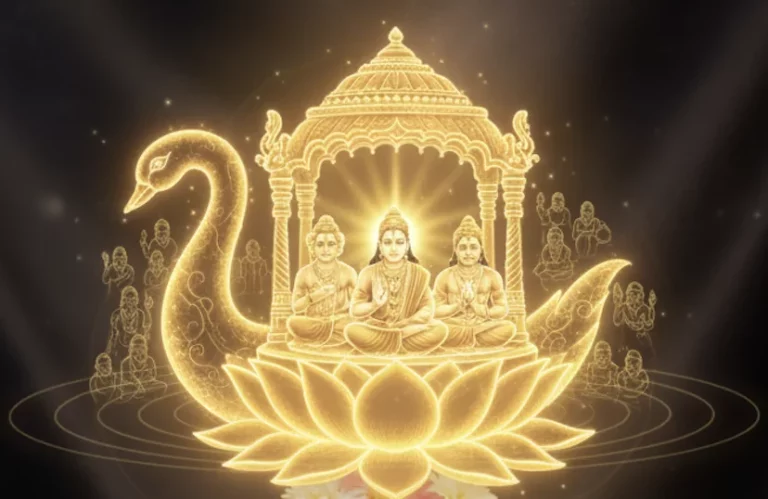

Sri Vadirajaru occupies a place of rare reverence in the Madhwa tradition. He is remembered not only as an acharya, poet, philosopher, and defender of siddhanta, but also as a saint whose presence did not end with his physical entry into Brindavana. In the traditional source behind this article, Anu Vrundavana Akhyana is presented as a condensed and memorable devotional gateway into that larger sacred mystery. It gathers key ideas from the broader Akhyana and helps devotees recollect the glory of Sri Vadirajaru, his Panchavrundavana, and the grace associated with his worship.
Unlike a dry theological summary, this work carries devotion, wonder, and intimacy. It does not speak of Sri Vadirajaru merely as a historical monk of the past. It presents him as a living spiritual force whose Brindavana is filled with divine presence, whose remembrance purifies, and whose grace continues to protect those who approach with bhakti. That devotional tone fits naturally with the style of Ruju Yogi’s long-form spiritual articles, which combine doctrine, saintly tradition, and reader-friendly explanation.
For broader context, read Life and Teachings of Sri Vadiraja Tirtha, Rujutva of Sri Vadirajaru: Scriptural Foundations of Sri Bhaavi Sameera, and Dvaita Vedanta Explained: Madhwacharya’s Philosophy. The Panchami Archana article connects with the Svapna Vrundavana Akhyana tradition. Visit Shri Bhaavi Sameera Vadiraja Mandira, Chintamani and explore Madhwa sevas offered there.
What is Anu Vrundavana Akhyana?
According to the source tradition, the larger Svapna Vrundavana Akhyana came through a remarkable chain of grace: some decades after Sri Vadirajaru’s entry into Brindavana, a deaf and mute Brahmin who had served him began receiving verses in dreams and reciting them before Sri Vedanidhi Tirtharu, who had them written down. The same source further explains that the later propagation and clearer understanding of the Akhyana became associated with the saint remembered as Vrundavanacharya. Anu Vrundavana Akhyana is described there as a compact collection of key verses meant to help devotees easily recite and remember the core teachings of that sacred work.
That makes Anu Vrundavana Akhyana special in a practical sense. It is not merely a text to be admired from a distance. It is a text meant to be carried in memory, recited with reverence, and used as a spiritual aid. It compresses majesty into devotion, theology into song-like remembrance, and saintly glory into living prayer. In that sense, it speaks beautifully to temple readers and household devotees alike.
The sacred background behind the text
The source page explains that Sri Vadirajaru’s Panchavrundavana at Sode is central to understanding the opening movement of the Akhyana. It notes that the five Brindavanas are arranged with a central one and surrounding ones, and that the earliest verses function like a mangalacharana while also identifying the divine forms present there. The same source repeatedly returns to a striking theme: Sri Vadirajaru is not presented as absent from the Brindavana, but as spiritually present, worship-worthy, and connected to an exalted divine order.
This is why the text feels so different from ordinary praise poetry. It is not only admiration for a saint’s character. It is also a guided spiritual vision of place: Sode as kshetra, Brindavana as presence, darshana as purification, and seva as a bridge between the devotee and grace. The source even frames the Brindavana not as one sacred shrine among many, but as uniquely filled with divine significance.
Why Sri Vadirajaru’s Panchavrundavana is unique
One of the strongest themes in the source is the repeated emphasis on five: five Brindavanas, five forms, five sacred worship periods, five-fold offerings. The verse explanations connect this sacred pattern to the divine presence of Hari in five forms and to the extraordinary nature of Sri Vadirajaru’s Brindavana. The source also states that no other saintly Brindavana is described in quite this way, with such a distinctive Panchavrundavana identity.
The source further explains that Sode is praised as supremely holy and that worship there yields immense benefit. It highlights five daily parva times for worship and explains that even simple, sincere darshana during those times is spiritually meaningful. It also gives a traditional list of worship materials: dhupa, dipa, garland, sandal paste, durva, akshata, panchabhakshya, panchamrita, and pancha kharjura as naivedya.
For Ruju Yogi readers, this theme is especially meaningful because the live site already connects Sri Vadirajaru’s legacy with temple-based seva, daily worship, and the living remembrance of Bhaavi Sameera. An article on Anu Vrundavana Akhyana therefore fits naturally alongside the site’s current articles on Sri Vadirajaru’s life, rujutva, and the living spiritual tradition around his worship.
What the Akhyana teaches devotees
Read as a whole, the source suggests that Anu Vrundavana Akhyana teaches five major devotional truths. First, Lord Hayagriva stands at the center of Sri Vadirajaru’s spiritual world. Second, Sri Vadirajaru is to be approached not merely as a departed acharya, but as a present and compassionate guru. Third, the Panchavrundavana is not symbolic alone; it is spiritually potent. Fourth, seva and darshana both matter. Fifth, the right culmination of all this knowledge is surrender.
That final movement is especially beautiful. After describing glory, place, worship, and benefit, the source closes not with argument but with dependence. Sri Vadirajaru becomes mother, father, companion, refuge, and the one whose compassion is sought above all. In devotional writing, this is often the true sign of authenticity: knowledge that ripens into surrender.
Selected references from Anu Vrundavana Akhyana
Below are selected references presented in a Ruju Yogi-friendly format. Under each verse table, a source-faithful English block follows the original text, then a brief meaning and narration. The source presents these verses within a broader explanation of Sri Vadirajaru, Panchavrundavana, worship, and surrender.
1) Invocation to Lord Hayagriva and the sanctity of the Brindavana
| Language | Text |
|---|---|
| English transliteration | Hayagrivam chidanandavigraham sadanugraham Dashagrivacchidam shapān manigriva vimochanam Svanamagrahanadeva nirastagraha vigraham Vrundavanagatam vande brahmarudrendra vanditam |
| Devanagari | हयग्रीवं चिदानन्दविग्रहं सदनुग्रहम् । दशग्रीवच्छिदं शापान्मणिग्रीव विमोचनम् ॥१॥ स्वनामग्रहणादेव निरस्तग्रह विग्रहम् । वृन्दावनगतं वन्दे ब्रह्मरुद्रेन्द्र वन्दितम् ॥२॥ |
| Kannada | ಹಯಗ್ರೀವಂ ಚಿದಾನಂದವಿಗ್ರಹಂ ಸದನುಗ್ರಹಮ್ । ದಶಗ್ರೀವಚ್ಚಿದಂ ಶಾಪಾನ್ಮಣಿಗ್ರೀವ ವಿಮೋಚನಮ್ ॥೧॥ ಸ್ವನಾಮಗ್ರಹಣಾದೇವ ನಿರಸ್ತಗ್ರಹ ವಿಗ್ರಹಮ್ । ವೃಂದಾವನಗತಂ ವಂದೇ ಬ್ರಹ್ಮರುದ್ರೇಂದ್ರ ವಂದಿತಮ್ ॥೨॥ |
Source-faithful English (verses 1–2)
I bow in devotion to Sri Hayagriva,
the Lord whose form is pure consciousness and bliss,
who showers grace upon the worthy,
who as Rama destroyed ten-headed Ravana,
who as Krishna released Nalakuvara and Manigriva from their curse,
who as Vedavyasa frees devotees from bondage through the very utterance of His name,
and who abides in the five Brindavanas, worshipped by Brahma, Rudra, Indra, and the other celestials.
Meaning The opening remembrance bows to Lord Hayagriva as the blissful and conscious divine form who destroys evil, releases souls from bondage, and is worshipped even in the Brindavana by exalted celestial beings.
These opening verses do more than praise Hayagriva. They place the devotee inside the sacred atmosphere of Sri Vadirajaru’s world. The Brindavana is introduced not as stone and structure alone, but as a space vibrant with divine presence. The devotional vision here is clear: whoever approaches Sri Vadirajaru must first understand the Lord whom he served with complete, unbroken love.
2) The blessed devotee who recognizes Sri Vadirajaru’s true stature
| Language | Text |
|---|---|
| English transliteration | Yo mam devam vijanati rujushtam punyakrun narah Sa yati nilayam punyam yadgatva na nivartate |
| Devanagari | यो मां देवं विजानाति रुजुस्थं पुण्यकृन्नरः । स याति निलयं पुण्यं यद्गत्वा न निवर्तते ॥३॥ |
| Kannada | ಯೋ ಮಾಂ ದೇವಂ ವಿಜಾನಾತಿ ರುಜುಸ್ಥಂ ಪುಣ್ಯಕೃನ್ನರಃ । ಸ ಯಾತಿ ನಿಲಯಂ ಪುಣ್ಯಂ ಯದ್ಗತ್ವಾ ನ ನಿವರ್ತತೇ ॥೩॥ |
Source-faithful English (verse 3)
Blessed souls who truly know me as a Riju Yogi attain that holy abode from which there is no return – the state beyond repeated birth and death.
Meaning The one who truly understands the exalted spiritual nature of Sri Vadirajaru is led toward that blessed state from which there is no return.
This is not a call for superficial admiration. It is a call for recognition born of purity, faith, and inner maturity. The verse suggests that spiritual knowledge is itself grace. To know a mahapurusha rightly is not ordinary information; it is transformative insight. In a temple context, this verse reminds devotees that darshana deepens when reverence deepens.
3) The mystery of the Panchavrundavana
| Language | Text |
|---|---|
| English transliteration | Panchavrundavane punye pancharupatmako harih Panchikritya svarupani nityam sannihitah svayam |
| Devanagari | पञ्चवृन्दावने पुण्ये पञ्चरूपात्मको हरिः । पञ्चीकृत्य स्वरूपाणि नित्यं सन्निहितः स्वयम् ॥५॥ |
| Kannada | ಪಂಚವೃಂದಾವನೇ ಪುಣ್ಯೇ ಪಂಚರೂಪಾತ್ಮಕೋ ಹರಿಃ । ಪಂಚೀಕೃತ್ಯ ಸ್ವರೂಪಾಣಿ ನಿತ್ಯಂ ಸನ್ನಿಹಿತಃ ಸ್ವಯಮ್ ॥೫॥ |
Source-faithful English (verse 5)
Lord Hari, who is of fivefold form, has assumed five manifestations and has established His eternal presence in these five sacred Brindavanas.
Meaning In the holy Panchavrundavana, Lord Hari is eternally present in a fivefold manifestation.
This verse is one of the theological jewels of the Akhyana. It explains why Sri Vadirajaru’s Brindavana is remembered as singularly sacred. The number five is not decorative here; it is revelatory. The verse tells the devotee that the Panchavrundavana is a living field of divine presence. Worship offered there is therefore never empty ritual. It is encounter.
4) The unsurpassed holiness of the Brindavana
| Language | Text |
|---|---|
| English transliteration | Tirthanam uttamam tirtham vananam uttamam vanam Kshetranam uttamam kshetram mama vrundavanam dvijah |
| Devanagari | तीर्थानामुत्तमं तीर्थं वनानामुत्तमं वनम् । क्षेत्राणामुत्तमं क्षेत्रं मम वृन्दावनं द्विजः ॥९॥ |
| Kannada | ತೀರ್ಥಾನಾಮುತ್ತಮಂ ತೀರ್ಥಂ ವನಾನಾಮುತ್ತಮಂ ವನಮ್ । ಕ್ಷೇತ್ರಾಣಾಮುತ್ತಮಂ ಕ್ಷೇತ್ರಂ ಮಮ ವೃಂದಾವನಂ ದ್ವಿಜಃ ॥೯॥ |
Source-faithful English (verse 9)
My Brindavana is the foremost among sacred shrines,
the highest among holy groves,
and the most exalted among all sacred waters and tirthas.
Meaning Among sacred waters, forests, and kshetras, this Brindavana is declared supremely holy.
The force of this verse lies in its confidence. It does not timidly place Sri Vadirajaru’s Brindavana alongside other holy places. It proclaims its greatness directly. For the devotee, that is not a statement of rivalry but of assurance: one need not feel spiritually distant when standing before the Brindavana. One is standing at a place already sanctified by divine presence, guru-anugraha, and accumulated devotion.
5) The traditional mode of worship
| Language | Text |
|---|---|
| English transliteration | Dhupair dipais tatha malyair gandhair durvakshatadibhih Panchabhakshya samayuktam panchamruta samanvitam Panchakharjura samyuktam naivedyam vinivedayet Evam sampujyamano’ham dadyam varam anuttamam |
| Devanagari | धूपैर्दीपैस्तथा माल्यैर्गन्धैर्दूर्वाक्षतादिभिः । पञ्चभक्ष्यसमायुक्तं पञ्चामृतसमन्वितम् ॥१२॥ पञ्चखर्जूरसंयुक्तं नैवेद्यं विनिवेदयेत् । एवं सम्पूज्यमानोऽहं दद्यां वरमनुत्तमम् ॥१३॥ |
| Kannada | ಧೂಪೈರ್ದೀಪೈಸ್ತಥಾ ಮಾಲ್ಯೈರ್ಗಂಧೈರ್ದೂರ್ವಾಕ್ಷತಾದಿಭಿಃ । ಪಂಚಭಕ್ಷ್ಯಸಮಾಯುಕ್ತಂ ಪಂಚಾಮೃತಸಮನ್ವಿತಮ್ ॥೧೨॥ ಪಂಚಖರ್ಜೂರಸಂಯುಕ್ತಂ ನೈವೇದ್ಯಂ ವಿನಿವೇದಯೇತ್ । ಏವಂ ಸಂಪೂಜ್ಯಮಾನೋಽಹಂ ದದ್ಯಾಂ ವರಮನುತ್ತಮಮ್ ॥೧೩॥ |
Source-faithful English (verses 12–13)
Worship should be offered in the traditional way with incense, lamps, garlands, sandal paste, durva, akshata, offerings of five delicacies, panchamrita, and naivedya prepared with five dry fruits – grapes, almonds, dates, figs, and sakkare badami. When I am worshipped in this manner with devotion, I bestow unsurpassed blessings.
Meaning The devotee is instructed to worship with the traditional upacharas and sacred offerings; such worship, performed with sincerity, draws extraordinary blessing.
This pair of verses is precious for temple life because it joins devotion with discipline. Love must take form. Reverence must become offering. Fragrance, light, flowers, consecrated rice, sacred food, and naivedya are not outer additions to bhakti; they are its visible language. These verses also resonate strongly with Ruju Yogi’s seva culture, where worship is not abstract thought but a lovingly offered act.
6) Total surrender and the final prayer
| Language | Text |
|---|---|
| English transliteration | Mata raja matpita Vadirajo bhrata raja matsakha Vadirajah Sarvasvam me Vadirajo dayalur nanyad daivam naiva jane na jane Haribhakti dayambodhi tarala kridanotsukah Guravo Vadirajaryah karunam vitarantu me |
| Devanagari | माता राजा मत्पिता वादिराजो भ्राता राजा मत्सखा वादिराजः । सर्वस्वं मे वादिराजो दयालुर्नान्यद्दैवं नैव जाने न जाने ॥१७॥ हरिभक्तिदयाम्भोधितरलाक्रीडनोत्सुकाः । गुरवो वादिराजार्याः करुणां वितरन्तु मे ॥१८॥ |
| Kannada | ಮಾತಾ ರಾಜಾ ಮತ್ಪಿತಾ ವಾದಿರಾಜೋ ಭ್ರಾತಾ ರಾಜಾ ಮತ್ಸಖಾ ವಾದಿರಾಜಃ । ಸರ್ವಸ್ವಂ ಮೇ ವಾದಿರಾಜೋ ದಯಾಲುರ್ ನಾನ್ಯದ್ದೈವಂ ನೈವ ಜಾನೆ ನ ಜಾನೆ ॥೧೭॥ ಹರಿಭಕ್ತಿದಯಾಂಭೋಧಿತರಲಾಕ್ರೀಡನೋತ್ಸುಕಾಃ । ಗುರವೋ ವಾದಿರಾಜಾರ್ಯಾಃ ಕರುಣಾಂ ವಿತರಂತು ಮೇ ॥೧೮॥ |
Source-faithful English (verses 17–18)
Sri Vadiraja is my mother, my father, my brother, and my companion. He is my everything. I know of no deity now, nor shall I ever know of one, who is as compassionate as Sri Vadiraja.
May Guru Vadiraja, ever delighting in the waves of the ocean of devotion to Lord Hari and boundless compassion, shower His mercy upon me and protect me with grace.
Meaning Sri Vadirajaru is remembered as everything to the devotee, and the text closes with a heartfelt prayer for his compassion and protection.
This is the emotional summit of the Akhyana. After vision, praise, theology, place, and ritual, the devotee arrives at dependence. Sri Vadirajaru is no longer merely described; he is embraced as refuge. The final prayer is simple in feeling yet immense in force. It teaches that the highest reading of sacred poetry is not admiration but surrender.
Kannada PDFs: Anu Vrundavana Akhyana and sankalpa
For readers who wish to study or recite from the original Kannada text, these PDFs are available on Ruju Yogi:
- Anu Vrundavana Akhyana (Kannada): Download PDF – Anu Vrundavana Akhyana in Kannada
- Sankalpa (Kannada): Download PDF – sankalpa for Anu Vrundavana Akhyana in Kannada
These resources complement the overview above and support disciplined, reverent recitation in line with temple and home worship.
Why this matters for devotees today
For modern readers, Anu Vrundavana Akhyana is valuable because it bridges three needs at once. It gives theological depth to those who seek meaning. It gives devotional warmth to those who seek refuge. And it gives practical direction to those who wish to worship in the traditional way. The source repeatedly connects darshana, remembrance, seva, and grace; that combination makes the Akhyana especially suitable for a temple audience.
It also fits beautifully beside Ruju Yogi’s existing content on Sri Vadirajaru. The article on his rujutva explains why devotees revere him as Bhaavi Sameera, while the life-and-teachings article presents his historical and spiritual stature. This article completes that arc by bringing readers closer to how he is remembered in living devotion, recitation, and sacred place.
Conclusion
Anu Vrundavana Akhyana is not merely a shorter devotional composition. It is a concentrated stream of remembrance flowing from the larger sacred tradition around Sri Vadirajaru. It teaches that his Panchavrundavana is holy, that Lord Hari’s presence there is profound, that seva offered with devotion bears fruit, and that the journey of understanding must end in surrender. According to the source tradition, even the study and recitation of this Akhyana are treated as spiritually powerful.
For devotees, that is its lasting gift. It does not ask us only to learn about Sri Vadirajaru. It invites us to draw nearer to him – through reverence, through recitation, through seva, and through trust in his compassion. May Sri Bhaavi Sameera Vadirajaru bless all devotees with bhakti, jnana, humility, and steadfast devotion to Sri Hari.
॥ श्रीकृष्णार्पणमस्तु ॥
॥ ಶ್ರೀಕೃಷ್ಣಾರ್ಪಣಮಸ್ತು ॥
Frequently asked questions
What is Anu Vrundavana Akhyana?
According to the source tradition, it is a shorter collection of key verses from the larger Svapna Vrundavana Akhyana, composed so devotees can recite and remember its main teachings more easily. It condenses the glory of Sri Vadirajaru, the sanctity of Sode’s Panchavrundavana, and the spirit of surrender into a form suitable for daily remembrance.
Why is Anu Vrundavana Akhyana important in the Sri Vadirajaru tradition?
It combines the glory of Sri Vadirajaru, the sanctity of Panchavrundavana, the method of worship, and the spirit of surrender in a compact and memorable form – making it a practical bridge between doctrine and lived bhakti for temple and home devotees.
What makes the Panchavrundavana at Sode so special?
The source explains it through a repeated fivefold sacred pattern (forms, worship periods, offerings) and presents it as a uniquely holy seat of divine presence associated with Sri Vadirajaru – not as mere symbolism, but as a spiritually potent kshetra for darshana and seva.
Does Anu Vrundavana Akhyana speak only about philosophy?
No. It also speaks about devotion, darshana, sacred place, practical worship, and the grace that flows through guru-bhakti. Its language moves from vision and praise to ritual detail and finally to complete surrender.
Where can I read the Anu Vrundavana Akhyana in Kannada?
You can open or download the Kannada PDF here: Anu Vrundavana Akhyana – Kannada PDF. It is useful for accurate reading alongside the transliterated and Devanagari references in this article.
What is the sankalpa for reciting Anu Vrundavana Akhyana?
The traditional sankalpa text in Kannada is available as a separate PDF: Anu Vrundavana Akhyana sankalpa – Kannada PDF. Use it as guided by your guru or temple practice when undertaking formal recitation.