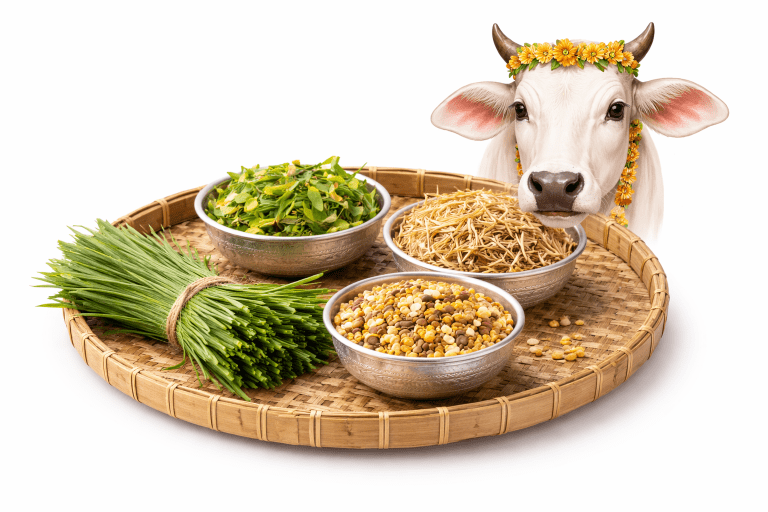
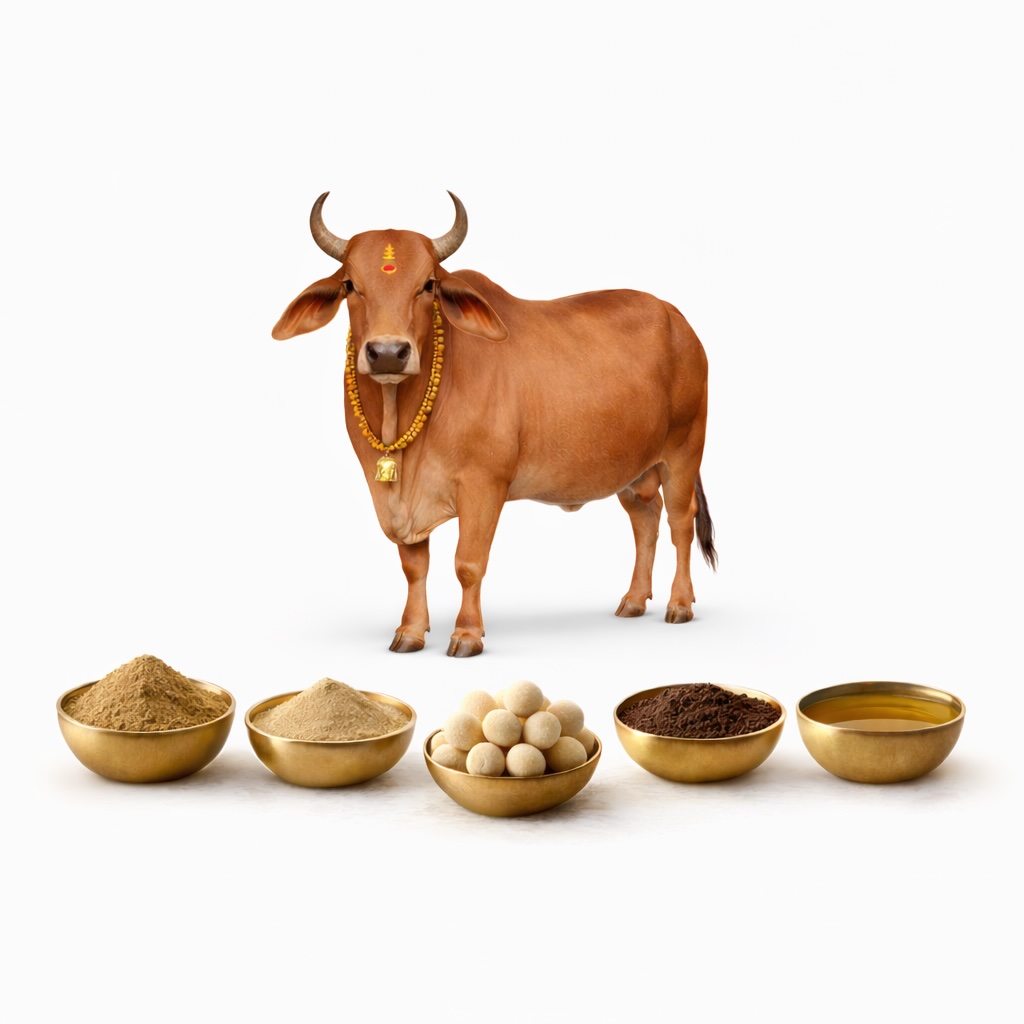
Gau Pooja Seva at Shri Vadiraja Mandira, Chintamani is a form of worship that honours the cow as a living embodiment of divine grace – one of the most ancient and universally practiced acts of reverence in the Vedic tradition. This seva encompasses the formal ritual pooja of the sacred cow and, uniquely, includes the preparation and distribution of Gau Mrittika as Prasada – a sacred preparation made from Gomaya (cow dung), Gau Mutra (cow urine), and Gopi Chandan (sacred Dwaraka clay). In the Madhwa tradition, Gau Mrittika is applied on the forehead as Tilak and on the chest, shoulders, and body as Dwadasha Nama – the twelve sacred marks invoking Lord Vishnu’s names. It is one of the most powerful prasada items for spiritual protection, chakra healing, and aura cleansing.
The Rig Veda’s Gomati Sukta celebrates the cow as the embodiment of the divine mother, the sustainer of life, and the source of the earth’s fertility. The Atharvaveda’s cow hymns (particularly the Gosuktam) describe the cow as containing within her body all the gods: “Vishve devaa gavi pratishthaah” – “All the gods are established in the cow.” This teaching is not merely poetic – it reflects the Vedic understanding that the cow is a convergence point of multiple divine energies, making the act of worshipping and serving the cow equivalent to worshipping the divine in its most accessible living form.
The tradition of Saptaanga Gau Puja – the seven-part worship of the cow – is described in the Skanda Purana. The seven sacred parts of the cow that are worshipped in turn are: the face (Mukha), the hump (Kakuda), the tail (Puccha), the hooves (Khura), the horns (Shringa), the udder (Stana), and the dung-earth (Gomaya/Mrittika). Each of these seven parts is associated with specific divine energy and specific blessings for the devotee who worships them.
The Three Sacred Ingredients of Gau Mrittika
What makes Gau Mrittika uniquely potent is the combination of three sacred substances derived from the cow, each with its own scriptural authority and spiritual properties:
Gomaya (Cow Dung)
Gomaya is one of the five products of the cow (Panchagavya) and has been revered since Vedic times as a supreme purifier. The Charaka Samhita and Sushruta Samhita – the foundational texts of Ayurveda – describe Gomaya as a powerful antimicrobial and detoxifying agent. In Vedic ritual, cow dung is used to purify temple floors, prepare sacred fire altars, and sanctify spaces for worship. Its natural antimicrobial properties make it effective at cleansing both physical and subtle (energetic) impurities. In the Gau Mrittika preparation, Gomaya acts as the purifying base, drawing out negativity and preparing the body and environment to receive divine energy.
Gau Mutra (Cow Urine)
Gau Mutra is another of the five Panchagavya products and holds a sacred position in Hindu scripture. The Agni Purana calls it an “excellent destroyer of negativity” and prescribes it for spiritual purification, stating that it prevents bad dreams and destroys accumulated sins. The Srimad Bhagavatam describes Panchagavya products as essential for the installation and worship of deities. The Mahabharata emphasises that one should never feel repugnance towards cow urine and cow dung, for they are central to spiritual life. According to Hindu tradition, Goddess Lakshmi herself resides in cow urine, bestowing prosperity and auspiciousness. In Gau Mrittika, Gau Mutra acts as the energising and consecrating element, charging the preparation with protective spiritual force.
Gopi Chandan (Sacred Dwaraka Clay)
Gopi Chandan is the sacred mineral-rich clay sourced from the banks of Gopi Talab in Dwaraka, Gujarat – the land sanctified by Lord Krishna’s divine presence. The Padma Purana declares that when Krishna danced with the gopis, their sandalwood, saffron, musk, and other fragrant substances washed into the lake, spiritualising the clay at its bottom. This clay carries a golden hue said to resemble the complexion of Srimati Radha Devi. The Garga Samhita states that wearing Gopi Chandan tilak daily grants spiritual merit equivalent to bathing in all sacred rivers and performing thousands of sacred rituals. The Padma Purana further declares that Gopi Chandan protects the wearer from negative energies, evil influences, ghosts, bad dreams, and accidents. Its natural cooling and calming properties still the mind and promote concentration during meditation and japa. In Gau Mrittika, Gopi Chandan provides the divine connection to Lord Krishna, the cooling and calming effect on body and mind, and the protective shield against negative forces.
When these three sacred substances are combined and consecrated through Vedic Gau Pooja, the resulting Gau Mrittika carries the concentrated divine energy of Gau Mata – a preparation that is far more potent than any of its individual ingredients.
How Gau Mrittika Is Used – Tilak and Dwadasha Nama in the Madhwa Tradition
The primary use of Gau Mrittika is applying it on the body – not merely keeping it in the pooja room. In the Madhwa Sampradaya, as prescribed by Sri Madhwacharya and practised by great saints like Guru Raghavendra Swamy, Gau Mrittika (along with Gopi Chandan) is applied as Tilak on the forehead and on twelve specific points of the body as Dwadasha Nama – the twelve names of Lord Vishnu. This practice is part of Bahyadeekshe (external initiation) and is considered a daily spiritual discipline (nityakarma) for Madhwa devotees.
The Dwadasha Nama Mudra involves applying Gau Mrittika to twelve body locations while chanting the corresponding name of Lord Vishnu:
- Forehead – Om Keshavaya Namah
- Chest – Om Madhavaya Namah
- Throat – Om Govindaya Namah
- Right belly – Om Vishnave Namah
- Right arm – Om Madhusudanaya Namah
- Right shoulder – Om Trivikramaya Namah
- Left belly – Om Vamanaya Namah
- Left arm – Om Sridharaya Namah
- Left shoulder – Om Hrishikeshaya Namah
- Upper back – Om Padmanabhaya Namah
- Lower back – Om Damodaraya Namah
- Crown of head – Om Vasudevaya Namah
Each of these twelve names represents a specific aspect and quality of Lord Vishnu – from Keshava (the radiant one) on the forehead to Vasudeva (the all-pervading one) on the crown. By marking the body with Gau Mrittika at these twelve sacred points, the devotee transforms the physical body into a living temple of Lord Vishnu, invoking His protection, grace, and presence at every vital energy centre.
Spiritual Benefits: Protection, Healing, and Purification
The combined power of Gomaya, Gau Mutra, and Gopi Chandan – consecrated through Vedic Gau Pooja – makes Gau Mrittika a potent spiritual tool with multiple dimensions of benefit:
Drishti Dosha Nivaarana (Evil Eye Protection)
The evil eye (drishti dosha) – the negative energy transmitted through jealousy, ill-will, or excessive admiration – is recognised across Hindu tradition as a real and harmful force. Gau Mrittika, with the protective power of Gopi Chandan (declared by the Padma Purana as a shield against evil influences) combined with the purifying force of Gomaya and Gau Mutra, creates a powerful ward against drishti dosha. Regular application on the forehead and body is one of the most effective traditional remedies for those who feel affected by the evil eye.
Negative Energy Shielding
The Mahabharata and multiple Puranas describe the products of the cow as the most potent purifiers in creation. Gau Mrittika, applied as Tilak and Dwadasha Nama, creates a protective energy field around the wearer that repels negative energies, harmful vibrations, and disturbing influences from the environment. The Padma Purana specifically states that Gopi Chandan protects from ghosts, evil spirits, bad dreams, and accidents.
Chakra Healing and Activation
The twelve body locations of Dwadasha Nama correspond closely to the major energy centres (chakras) recognised in the yogic tradition. Applying Gau Mrittika on the forehead stimulates the Ajna Chakra (the seat of intuition, clarity, and spiritual vision). Application on the chest activates the Anahata Chakra (the heart centre – the seat of devotion, compassion, and emotional balance). Application on the throat engages the Vishuddha Chakra (the centre of truthful communication and self-expression). The full Dwadasha Nama application harmonises the entire subtle energy system, promoting balance and well-being at every level.
Aura Cleansing and Purification
Daily life – interactions with people, exposure to crowded environments, negative conversations, and stressful situations – accumulates subtle impurities in the auric field (the energy body that surrounds the physical body). Regular application of Gau Mrittika cleanses the aura, removing these accumulated impurities and restoring the natural radiance and strength of the devotee’s energy field. The cooling, calming properties of Gopi Chandan in particular are known for maintaining positive vibrations around the wearer throughout the day.
Concentration, Meditation, and Inner Peace
The natural cooling sensation of Gopi Chandan combined with the grounding, earthy energy of Gomaya creates an ideal state for meditation and japa. Devotees who apply Gau Mrittika before their daily meditation practice consistently report deeper concentration, reduced mental disturbance, and a stronger connection to the divine presence during prayer.
Additional Sacred Uses
Beyond the primary personal application as Tilak and Dwadasha Nama, Gau Mrittika serves several other traditional purposes:
- Griha Pravesha (Housewarming): Gau Mrittika is traditionally used during housewarming ceremonies to sanctify the new home and invite positive, divine energy into the living space.
- Pooja Room Sanctification: Placing Gau Mrittika in the home pooja room purifies the worship space and creates a sattvic environment for daily rituals.
- Bath Purification: A small amount dissolved in bath water is used by devotees preparing for major rituals, creating a deep purifying effect on the body and energy field.
- Home Protection: Placed at the entrance of the house, Gau Mrittika protects the dwelling from negative influences and invites the blessings of Gau Mata.
- Agricultural Blessing: Farmers traditionally apply Gau Mrittika to their fields before planting, invoking the cow’s blessing on the soil and the crop.
The Gaushala at Shri Vadiraja Mandira and How Gau Mrittika is Prepared
The temple’s Gaushala maintains indigenous Indian breeds, which the Vedic tradition specifically identifies as the most sacred cattle. Indigenous cows (Desi Gaay) – such as the Ongole, Gir, and Sahiwal breeds – are believed to emit a positive bio-energy field (described as Surya Ketu Naadi in Ayurvedic texts) that purifies the surrounding atmosphere. The Gomaya, Gau Mutra, and other sacred products of these specific indigenous breeds are considered most potent for ritual use.
The Gau Mrittika offered through the Gau Pooja Seva at Shri Vadiraja Mandira is carefully prepared by combining fresh Gomaya and Gau Mutra from these indigenous cows with consecrated Gopi Chandan. The mixture is prepared with specific prayers, shaped into pieces, dried naturally, and then consecrated through the Gau Pooja ritual before being packaged and sent as Prasada. The Gau Pooja itself – the formal worship of the cow – is performed by the temple priests with Vedic mantras specifically from the Gomati Sukta and the Gau Puja Vidhi (cow-worship procedure) of the Madhwa Agama tradition.
Book your Gau Pooja Seva and Gau Mrittika Prasada at Shri Vadiraja Mandira today. For the complementary seva of feeding the sacred cows, explore Gau Grasa Seva.
How often should Gau Pooja Seva be booked?
Gau Pooja Seva can be booked as a one-time offering or as a regular practice. Monthly booking is common among families who use Gau Mrittika daily for Tilak and Dwadasha Nama. Annual booking on Gopashtami (the traditional day for cow-worship, celebrated in November) is particularly recommended as a yearly act of reverence for the sacred cow.
What are the ingredients of Gau Mrittika?
Gau Mrittika is prepared from three sacred substances: Gomaya (cow dung) – a powerful purifier and antimicrobial agent described in the Charaka Samhita and Sushruta Samhita; Gau Mutra (cow urine) – prescribed by the Agni Purana as a destroyer of negativity and an essential Panchagavya product; and Gopi Chandan – the mineral-rich sacred clay from the banks of Gopi Talab in Dwaraka, praised in the Padma Purana and Garga Samhita for its protective, purifying, and devotional qualities. Together, these create a preparation of extraordinary spiritual potency.
Can Gau Pooja Seva be booked for Gopashtami?
Absolutely. Gopashtami (the eighth day of Kartika Shukla Paksha, usually in November) is the traditional day for the full celebration of cow-worship across India. At Shri Vadiraja Mandira, the Gau Pooja on Gopashtami is performed with special elaboration, and booking this seva for Gopashtami is highly recommended. Advance booking of at least 4 weeks before the festival date is advised.
Who benefits most from Gau Mrittika Prasada?
Gau Mrittika benefits all devotees, but certain groups find it particularly valuable: those who feel affected by evil eye or negative energies receive direct protective benefit; devotees seeking to deepen their meditation and japa practice benefit from its calming, focus-enhancing properties; pregnant women and new mothers receive the blessing of the divine maternal energy; children who are anxious or frequently unwell benefit from the protective and grounding energy; those experiencing Rahu-related challenges (disconnection, confusion, foreign influences) find Gau Mrittika’s grounding quality especially helpful; and farmers and those whose livelihood depends on the earth receive a direct blessing from the cow’s sacred connection to agricultural prosperity.
Honor the divine mother in her earthly form – book Gau Pooja Seva with Gau Mrittika Prasada at Shri Vadiraja Mandira, Chintamani.