Seva is a Sanskrit word meaning service — specifically, selfless, devoted service to God, to the Guru, and to all living beings as an expression of devotion to the Supreme. In the Madhwa tradition of Dvaita Vedanta, Seva is not merely charity or social work; it is Kainkaryam — devoted, personal service to Shri Hari, arising from the jiva’s innate and eternal relationship with God. Shri Madhwacharya’s Tattvavada establishes that the jiva (individual soul) is eternally paratantra — dependent on and subordinate to Bhagavan. Seva is the natural, joyful expression of this dependence: just as a river naturally flows toward the ocean, the jiva naturally serves Hari when ignorance is removed.
The Philosophical Foundation: Why Seva Is the Jiva’s Highest Purpose
In the Dvaita framework, five eternal and irreducible differences (Pancha-bheda) define the structure of reality: the difference between God and jiva, God and matter (jada), jiva and jiva, jiva and jada, and jada and jada. The jiva can never merge with or become God; liberation (moksha) is not dissolution of identity but the attainment of the jiva’s svarupa ananda — intrinsic bliss — experienced in the eternal service of the Lord in Vaikuntha.
This means that seva is not a temporary obligation to be shed upon liberation. It is the eternal activity of the liberated soul. Shri Jayatirtha explains in his Nyaya Sudha that even in Vaikuntha, the mukta jivas (liberated souls) serve Bhagavan in various forms — offering music, dance, worship, and companionship — and this service is their highest joy. Temple seva in the earthly realm, therefore, is a rehearsal for eternity. Every Abhisheka, every Archana, every lamp lit before the deity trains the jiva in the art of divine service that will continue without end.
Shri Vyasatirtha, in his magnum opus Nyayamruta, further clarifies that bhakti (devotion) is not a mere emotion or intellectual assent — it is expressed through action. Seva is bhakti made visible. A devotee who claims to love God but performs no seva is like a person who claims to be hungry but refuses to eat. The Madhwa tradition insists on the unity of jnana (knowledge), bhakti (devotion), and vairagya (detachment), with seva as the thread that binds all three.
Types of Seva in Temple Worship
Temple seva encompasses a wide range of offerings, each serving the Lord in a distinct way. At Shri Bhaavi Sameera Vadiraja Mandira, Chintamani, devotees can participate in the following categories of seva:
Abhisheka Seva
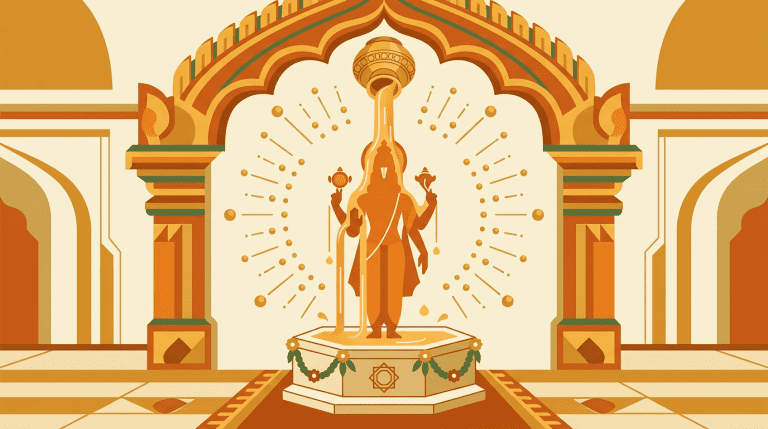
Abhisheka is the ceremonial bathing of the deity with sacred substances — milk, honey, ghee, Panchamruta, or water. It is the most direct physical service to the Lord’s Bimba (consecrated image). Each substance carries specific spiritual significance: Panchamruta Abhisheka offers five nectars for comprehensive blessings, Madhu Abhisheka invokes harmony, and Kanakabhisheka represents the surrender of material wealth. Read our detailed guide to Abhisheka for the full scriptural context.
Archana Seva
Archana is worship through the recitation of God’s divine names while offering flowers, Tulasi, or kumkuma. Tulasi Archane uses the plant most dear to Vishnu; Lakshmi Kumkumarchane invokes the blessings of the Goddess of prosperity; and Panchami Archana fulfils the prescription of Shri Vadiraja Tirtha for worship on the fifth lunar day. See our complete guide to Archana.
Deepa Seva
The offering of lamps is one of the most ancient and revered forms of seva. Taila Nanda Deepa (sesame oil lamp, 30 days) is recommended for ancestral healing, while Ghruta Nanda Deepa (ghee lamp, 30 days) is for prosperity and spiritual evolution. Deeparadhane sponsors the ritual waving of lamps during evening pooja. Our article on Deepa explains the full significance.
Alankara Seva
Alankara means decoration. Pushpalankara Seva adorns the deity with fresh flowers, while Sri Gandhalepana Seva applies sandalwood paste — both are acts of beautifying the Lord’s form as a devotional offering.
Annadana Seva
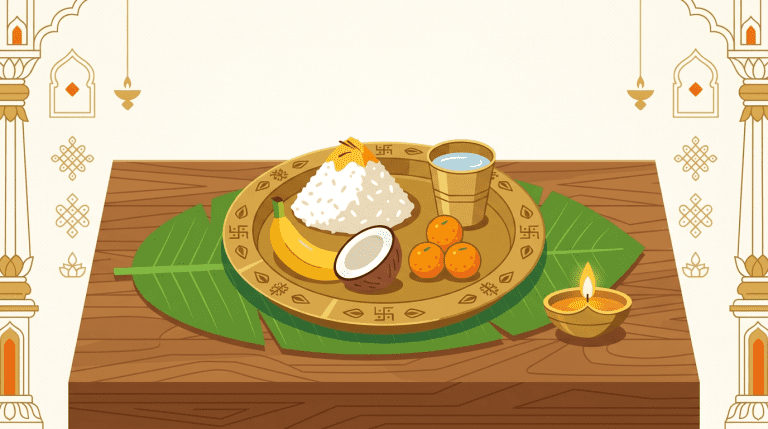
Annadana Seva is the sponsoring of food distribution at the temple. The Puranas describe Annadana as the highest form of daana (charity), because hunger is the most immediate human need and satisfying it is an act of serving the Lord who resides as Antaryami within every being.
Gau Seva
Service to the cow (Gau Mata) is considered equivalent to serving all deities, because the Puranas state that thirty-three crore devatas reside in the cow. Gau Grasa Seva feeds the sacred cows at the temple’s Gaushala, while Gau Pooja Seva includes worship of the cow and the receipt of Gau Mrittika Prasada.
Sarva Seva
For devotees who wish to offer comprehensive worship in a single booking, Sarva Seva combines the key sevas into one complete package — ideal for major life milestones such as housewarming, upanayana, or annual family observances.
Seva as a Spiritual Practice: Beyond the Transactional
A common misconception is that temple seva is transactional — “I offer X, I receive blessing Y.” The Madhwa tradition firmly rejects this view. Seva is not a bargain; it is an act of love. Shri Raghavendra Swami, the great saint of Mantralaya, taught that true seva is nishkama — performed without the expectation of a specific material reward. The devotee offers because offering is the jiva’s dharma; the blessings that follow are the Lord’s spontaneous response to sincere devotion, not a contractual payment.
That said, the Puranas do describe specific benefits for specific sevas — not to encourage a transactional mindset, but to inspire beginners on the path. As the devotee matures, the desire for personal gain gradually transforms into the desire to serve for the sheer joy of pleasing the Lord. This is the highest stage of bhakti, described by Shri Madhwacharya as Maithuna Bhakti — the love of God for God’s own sake, without any admixture of self-interest.
How to Participate in Temple Seva
Participating in seva at Shri Bhaavi Sameera Vadiraja Mandira is simple and accessible to devotees anywhere in the world:
- Browse available sevas on our Seva Booking page or read the Guide to Madhwa Sevas for detailed descriptions.
- Select a seva and date: Choose the seva that resonates with your intention and pick a preferred date.
- Provide your sankalpa details: Enter your name, gotra, and nakshatra so the priest can include your intention in the ritual.
- Complete the booking: Payment is processed securely online. The temple performs the seva on the specified date.
- Receive Prasada: After the seva, consecrated Prasada is carefully packed and dispatched to your registered address.
For devotees who wish to cover all bases in one offering, Sarva Seva provides the complete package of temple sevas in a single booking.
Frequently Asked Questions
What is the meaning of Kainkaryam in the context of Seva?
Kainkaryam is a Sanskrit term meaning devoted, personal service — the kind of attentive, loving service a trusted attendant offers to a beloved master. In Tattvavada, Kainkaryam describes the jiva’s eternal relationship with Bhagavan: the soul finds its deepest fulfilment not in independence but in joyful, selfless service to Hari. Every temple seva is an earthly practice of this eternal Kainkaryam.
How is Seva different from Daana (charity)?
Daana is the act of giving — money, food, clothes, or other resources — for the welfare of others. Seva is broader: it encompasses Daana but also includes direct worship of the deity (Abhisheka, Archana, Deepa), service to the Guru Parampara (Hastodaka), and service to sacred beings (Gau Seva). In the Madhwa understanding, all forms of Daana ultimately constitute Seva to Hari, because everything given in a righteous cause serves the Lord who pervades all.
Can I do Seva if I am not a Brahmin or a priest?
Absolutely. Seva is the birthright of every jiva, regardless of caste, gender, or social status. While certain elaborate rituals require a trained priest to perform the technical aspects, the devotion and intention behind the seva belong entirely to the sponsoring devotee. The Bhagavad Gita (9.26) makes this clear: the Lord accepts a leaf, a flower, a fruit, or water offered with devotion — He does not ask for credentials. Every human being can serve God through Archana, Deepa, Annadana, Gau Seva, or any other form of offering.
Why should I book Seva online instead of visiting the temple?
Visiting the temple in person is always a blessing. However, online seva booking ensures that devotees who live far from Chintamani — whether in other Indian cities or abroad — can still participate in the temple’s rituals and receive Prasada. The Agama Shastras sanction para-karma (rituals performed by a priest on one’s behalf), and the merit of the seva accrues fully to the sponsor regardless of physical presence.
Is there a single Seva that covers all rituals?
Yes. Sarva Seva at Shri Vadiraja Mandira is the all-in-one package that includes Abhisheka, Archana, Deepa, and other key offerings in a single booking. It is the most comprehensive way to participate in the temple’s worship and is ideal for special occasions and milestones.
Seva is the language the soul speaks to God — through water, fire, flowers, food, and humble service. Whatever form your seva takes, the Lord receives it with infinite grace. Book your Seva at Shri Bhaavi Sameera Vadiraja Mandira, Chintamani, and take the first step on the path of eternal Kainkaryam.
Explore all sacred sevas: Visit our Seva Booking page to discover the complete range of Abhishekas, Archanas, Deepa sevas, and more at Shri Vadiraja Mandira, Chintamani.