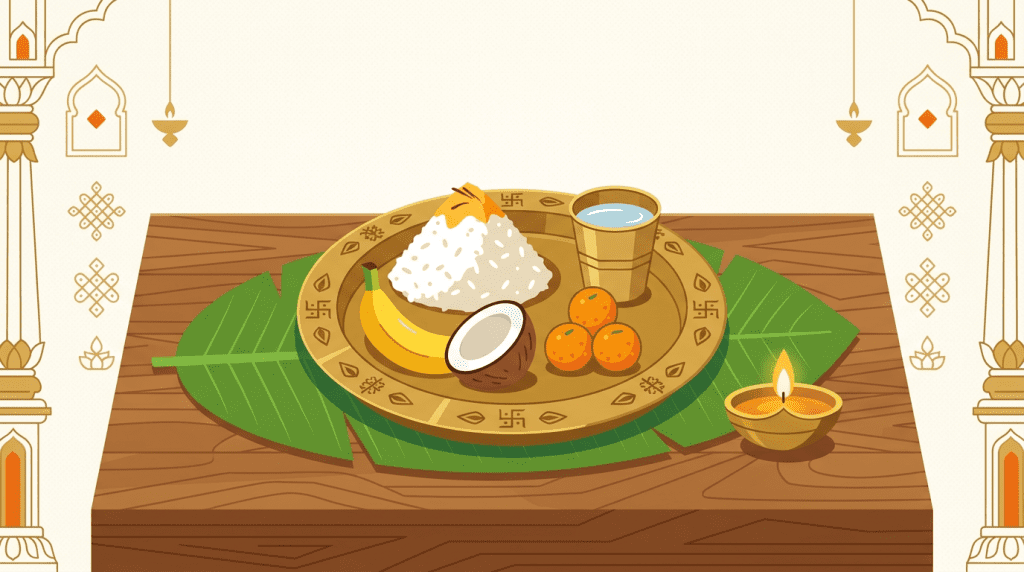
Naivedya (also written Neivedyam in South Indian usage) is the sacred offering of food to God before it is consumed by devotees. The Sanskrit word derives from nivedana, meaning “to present” or “to dedicate.” In the Madhwa tradition of Dvaita Vedanta, Naivedya is far more than a ritual formality: it is an act of acknowledging that everything we possess — including the food we eat — ultimately belongs to Shri Hari, the Supreme Independent Being, and must be offered to Him before we partake of it. This understanding transforms the simple act of eating into an expression of devotion and surrender.
Naivedya in the Dvaita Understanding: God Actually Accepts the Offering
A defining feature of the Madhwa philosophical position on Naivedya is the belief that Bhagavan actually accepts the food offered to Him. This is not a metaphor or a symbolic gesture. Shri Madhwacharya, in his commentary on the Brahma Sutras and in his Mahabharata Tatparya Nirnaya, establishes that the Lord is Sarva-bhokta — the ultimate enjoyer of all offerings. When food is placed before the consecrated deity (Bimba) with Vedic mantras and sincere devotion, the Lord, who resides within the Bimba, partakes of its essence (rasa).
The most celebrated illustration of this principle comes from the life of Shri Vadiraja Tirtha, the saint whose Vrundavana is the presiding presence at Shri Bhaavi Sameera Vadiraja Mandira, Chintamani. According to the Anu Vrundavana Akhyana and oral tradition preserved within the Sode Matha, Lord Hayagreeva — the horse-headed incarnation of Vishnu and the deity of supreme knowledge — would physically descend every day to accept the Neivedyam prepared by Shri Vadirajaru. This continued for the entire 120-year span of the saint’s earthly life. The story is not treated as allegory within the Madhwa tradition; it is understood as historical fact, demonstrating that when devotion is pure, the Lord responds with tangible presence.
Rules for Preparing Naivedya
The preparation of Naivedya is governed by strict rules of purity (madi / achara) in the Madhwa tradition, ensuring that the food is fit to be offered to the Lord.
- Cleanliness: The cook must have bathed and be in a state of ritual purity. The kitchen and utensils must be thoroughly cleaned. In traditional Madhwa households, the cooking area is treated as a sacred space during Naivedya preparation.
- Sattvic ingredients only: Onion, garlic, mushrooms, and other tamasic (spiritually dulling) or rajasic (agitation-promoting) ingredients are strictly excluded. The food is vegetarian, prepared with rice, dal, vegetables, ghee, jaggery, and other pure ingredients.
- No tasting before offering: The cook must not taste the food before it is offered to the deity. The first portion belongs entirely to the Lord.
- Dedicated utensils: The vessels used for Naivedya are kept separate from everyday utensils and are used exclusively for the Lord’s food.
- Mantra recitation: Before and during the offering, Vedic mantras — including the Brahmarpanam shloka from the Bhagavad Gita (4.24) — are recited to consecrate the food.
These rules are not arbitrary restrictions; they reflect the understanding that the Lord is a real and honoured guest who deserves the very best. In the Dvaita framework, the jiva is paratantra (eternally dependent on God), and serving the Lord with the finest offering one can prepare is an expression of this eternal relationship.
What Items Are Offered as Naivedya
The items offered vary based on the occasion, the deity, and regional tradition. Common Naivedya items in Madhwa temples include:
- Panchamruta: A blend of milk, curd, ghee, honey, and sugar — offered as a liquid Naivedya and also used in Abhisheka.
- Payasa (Kheer): Rice or vermicelli cooked in milk with sugar or jaggery. Payasa is considered one of the most auspicious Naivedya items.
- Chitranna varieties: Flavoured rice preparations such as Puliyogare (tamarind rice), Huggi (sweet pongal), and Bisi Bele Bath.
- Kosambari and Usli: Salads and steamed preparations from lentils and vegetables.
- Holige / Obbattu: Sweet flatbread filled with dal or coconut, offered especially during festivals like Ugadi and Rama Navami.
- Fruits and dry fruits: Bananas, coconut, dates, and Pancha Kharjura (five types of dried fruits) are standard offerings.
At Shri Vadiraja Mandira, the daily Naivedya follows the temple’s established tradition, incorporating items that align with the seasonal and festival calendar of the Madhwa Panchanga.
From Naivedya to Prasada: How God’s Grace Becomes Tangible
Once the Naivedya is offered and the Lord has partaken of its essence, the food is transformed into Prasada — literally, “that which flows from grace” (from the root pra-sad, to be gracious). Prasada is not leftover food; it is sanctified food, imbued with the Lord’s blessing. Consuming Prasada is itself an act of devotion — the devotee receives into their body what the Lord has touched, creating a tangible link between the human and the divine.
In the Madhwa tradition, Prasada is received with both hands and consumed with reverence. It is never wasted or treated casually. The Vishnu Purana states that one who eats food not first offered to the Lord eats sin, while one who partakes of Prasada destroys accumulated karma and moves closer to liberation.
Hastodaka: The Special Naivedya for Yatis
A unique form of Naivedya in the Madhwa tradition is Hastodaka — the food offering made specifically to the Vrundavanas (samadhis) of great Yatis (sannyasis) in the Madhwa parampara. Hasta means hand and udaka means water; the term refers to the practice of placing food and water before the Vrundavana as if serving a living master. At Shri Vadiraja Mandira, Hastodaka Seva follows a precise order: the Neivedyam is first offered to Lord Hayagreeva, then to Pranadevaru (Hanuman), and then to the Vrundavana of Shri Vadirajaru. This hierarchy reflects the Madhwa taratamya (gradation of beings) and ensures that the offering reaches each divine presence in the correct sequence.
Devotees who book Hastodaka Seva receive the consecrated Prasada at their doorstep — a direct channel of the Guru Parampara’s blessings.
Naivedya and Annadana: Feeding God, Feeding All
The spirit of Naivedya extends naturally into Annadana — the charitable distribution of food. In the Madhwa understanding, feeding the hungry is an extension of feeding God, because Bhagavan resides as the Antaryami (inner controller) within every living being. The Bhagavata Purana describes how the great devotee Rantideva saw Lord Narayana in every hungry person who came to his door — this is the philosophical basis for Annadana as a sacred act.
Annadana Seva at Shri Vadiraja Mandira allows devotees to sponsor the preparation and distribution of food to all who visit the temple, earning the merit that the Puranas describe as the highest form of daana (charity). The Mahabharata declares: “Annadaanam param daanam” — the gift of food is the supreme gift. At our temple, every Annadana begins with the food being offered as Naivedya to the Lord, ensuring that what the devotees receive is not merely food but Prasada infused with divine grace.
Frequently Asked Questions
What is the difference between Naivedya and Prasada?
Naivedya is the food before it is offered to the Lord — it is the act of offering. Prasada is the food after the Lord has accepted it — it is the returned blessing. The transformation from Naivedya to Prasada is a real spiritual event in the Madhwa understanding, not merely a change of label.
Why must food be offered to God before eating?
In Tattvavada, everything in the universe belongs to Shri Hari. The jiva, being paratantra (dependent), has no independent right to enjoy anything without first offering it to the Lord. The Bhagavad Gita (3.13) states that those who cook for themselves without offering eat only sin, while those who first offer their food to God eat the nectar of Prasada.
Can Naivedya be offered to God in a home setting?
Yes. Every Madhwa household traditionally offers Naivedya to the deity in the home pooja room before the family eats. The food is placed before the deity’s image, a prayer is recited (commonly the Brahmarpanam shloka), and the food is covered for a few minutes to allow the Lord to accept it. It then becomes Prasada for the family.
How does Hastodaka differ from regular Naivedya?
Regular Naivedya is offered to the presiding deity of the temple (such as Vishnu or Krishna). Hastodaka is a specialised Naivedya offered specifically to the Vrundavanas of Yatis — the great sannyasis of the Madhwa lineage. It invokes the blessings of the Guru Parampara, not just the presiding deity, and follows a distinct hierarchical sequence.
Is there a specific mantra to recite when offering Naivedya?
The most commonly recited mantra is the Brahmarpanam shloka (Bhagavad Gita 4.24): “Brahmarpanam Brahma Havir Brahmagnau Brahmana Hutam, Brahmaiva Tena Gantavyam Brahma Karma Samadhina.” In the Madhwa interpretation, “Brahma” here refers to Vishnu as the Supreme Being who pervades and sustains the entire act of offering, the offering itself, and the one who offers. Additional mantras from the Purusha Sukta and Vishnu Sukta may be recited by the priest during temple Naivedya.
Naivedya is the most intimate form of temple worship — an act of feeding God Himself. Whether you offer a simple banana at home or sponsor an elaborate temple Neivedyam, the Lord receives your devotion with equal grace. Book a Naivedya-related seva at Shri Bhaavi Sameera Vadiraja Mandira and receive the Lord’s Prasada at your doorstep.
Explore all sacred sevas: Visit our Seva Booking page to discover the complete range of Naivedya, Abhisheka, and Archana offerings at Shri Vadiraja Mandira, Chintamani.