Hastodaka Seva is one of the most profound and spiritually meaningful offerings observed at Shri Vadiraja Mandira, Chintamani. The word “Hastodaka” is derived from Sanskrit — hasta meaning hand and udaka meaning water — yet its significance goes far beyond a simple water offering. In the Madhwa Vaishnava tradition, Hastodaka is the ritual act of offering Neivedyam (sacred food) to the Mruttika Vrundavanas (sacred earthen mounds representing the samadhi) of revered Yatis (sanyasis) of the Madhwa parampara. It is an act of deep reverence, connecting the present generation of devotees to the unbroken lineage of realised saints who upheld the philosophy of Shri Madhwacharya.
At Shri Vadiraja Mandira, the Hastodaka Seva follows a precise sacred sequence rooted in Madhwa sampradaya. The Neivedyam is first offered to Lord Hayagreeva — the deity of wisdom worshipped by Shri Vadirajaru himself — then to Pranadevaru (Lord Hanuman), then to Shri Vadirajaru’s Panchavrundavana (the five sacred forms of Vadirajaru enshrined at the temple), and thereafter to the Mruttika Vrundavanas of the important Yatis of the Madhwa parampara. This sequence precisely reflects the Madhwa taratamya (divine hierarchy): the Supreme in the first tier, Pranadevaru and Vadirajaru in the second tier, and the revered Yatis in the fourth tier. This sequence reflects the hierarchical reverence in Madhwa philosophy: the Supreme Lord first, followed by Mukhyaprana, and then the revered Acharyas who served as conduits of divine grace.
The tradition of performing Hastodaka to Yati Vrundavanas is a living expression of Guru Bhakti — devotion to the spiritual preceptors who illuminated the path of liberation. By participating in this seva, devotees invoke the blessings of an entire lineage of realised masters, not just of a single Yati. This makes Hastodaka Seva extraordinarily potent as a means of seeking guidance, grace, and spiritual growth.
The Madhwa Parampara and the Significance of Yati Vrundavanas
Shri Madhwacharya (1238–1317 CE) established a living tradition of Dvaita Vedanta and Vaishnava worship that continues unbroken to this day. The Yatis (monks) of the Udupi and associated mutts — including the Ashta Mathas — served as custodians of this tradition across centuries. When a Yati attains mahasamadhi (the final absorption), a Mruttika Vrundavana or earthen mound is consecrated at their place of rest. This Vrundavana is considered not merely a memorial but a living seat of the Yati’s spiritual presence. Shastras affirm that a Siddha Purusha (realised soul) does not leave his Vrundavana after samadhi; his consciousness remains accessible to sincere devotees.
At Shri Vadiraja Mandira, the primary Vrundavanas enshrined are the Panchavrundavana of Shri Vadirajaru — not five different Yatis, but the five sacred forms (roopas) of Vadirajaru himself seated in five Vrundavanas, representing the saint’s presence across five dimensions of divine grace. The temple additionally houses the Mruttika Vrundavanas of revered Yatis of the Madhwa parampara to whom Hastodaka Neivedyam is offered. Shri Vadirajaru (1480–1600 CE), the great saint-poet and composer of hundreds of devotional hymns, is the presiding figure of this temple. His connection to Lord Hayagreeva is described in extraordinary detail in the Anu Vrundavana Akhyana — the sacred biographical narrative of his life and miracles. According to this text, Lord Hayagreeva would daily descend to consume the Neivedyam offered by Vadirajaru, and this divine communion continued for 120 years of the saint’s remarkable life. Offering Hastodaka Seva here is thus an act of participating in that very tradition.
How Hastodaka Seva is Performed at Shri Vadiraja Mandira
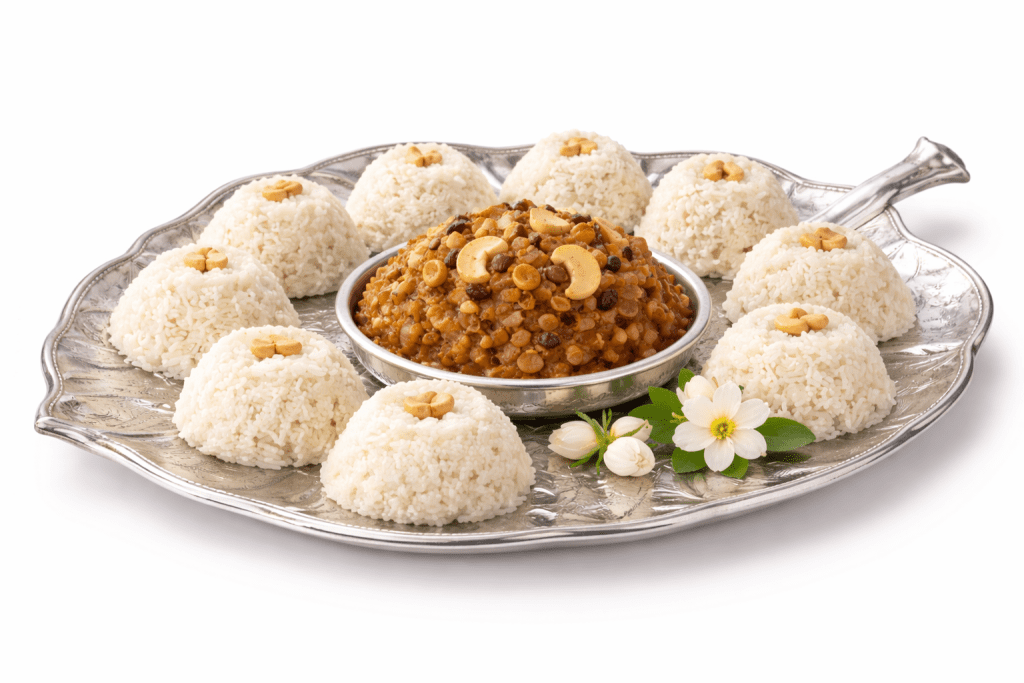
The Hastodaka Seva at the temple is conducted on your behalf by trained archaka priests (temple priests) who are well-versed in the Madhwa Agama procedures. The ritual begins with the preparation of Neivedyam — freshly prepared vegetarian food according to Vedic and temple traditions. The Neivedyam is first placed before Lord Hayagreeva with appropriate Vedic mantras, followed by Pranadevaru. It is then respectfully offered to each Yati Vrundavana enshrined at the temple using the prescribed ritual offering procedures. A sacred water offering (the literal Hastodaka element) accompanies the Neivedyam as a mark of respect, akin to welcoming a highly honoured guest.
After the Neivedyam is offered, the consecrated food becomes Prasada — sanctified by contact with the divine and the Yati consciousness. This Prasada is dispatched to the sponsoring devotee as a tangible blessing from the temple.
Spiritual Benefits of Hastodaka Seva
Sponsoring Hastodaka Seva is believed to confer a wide range of spiritual and material benefits. The grace of the Yatis of the Madhwa parampara is said to remove obstacles on the path of spiritual progress, resolve long-standing family problems, and bring peace in the household. Devotees experiencing career difficulties, educational challenges, or health concerns have traditionally sought the blessings of Yati Vrundavanas, and Hastodaka Seva at Shri Vadiraja Mandira makes this accessible to devotees anywhere in the world. The combined blessings of Lord Hayagreeva (presiding over wisdom and learning), Pranadevaru (presiding over strength and vitality), and the parampara Yatis create a uniquely comprehensive spiritual shield.
For students, this seva is particularly recommended before board examinations and competitive entrance tests. For families facing health challenges or disputes, it helps invoke the benevolent presence of realised masters who see beyond ordinary human difficulties.
Prasada from Hastodaka Seva
After the Neivedyam is offered at the temple, the consecrated Prasada is carefully packed and dispatched to the devotee who has sponsored the seva. Receiving and consuming this Prasada with faith is itself considered an act of Guru Bhakti, a direct channel of blessings flowing from the parampara. For devotees who cannot be physically present at Chintamani, the Prasada bridges the distance between the temple and the home.
To book this sacred offering, visit our Hastodaka Seva booking page and schedule the seva for your preferred date.
What is the difference between Hastodaka Seva and regular Neivedyam offering?
Regular Neivedyam is offered to the main presiding deity in the sanctum. Hastodaka Seva is a specialised offering that specifically serves Neivedyam to the Mruttika Vrundavanas of the parampara Yatis — Shri Madhwa lineage saints — following the traditional sequence of Hayagreeva, Pranadevaru, and Yati Vrundavanas. It invokes the blessings of the entire Guru lineage rather than just the presiding deity.
On which days should Hastodaka Seva be booked?
Hastodaka Seva can be performed on any day. However, Ekadashi, Pournami (Full Moon), and the birth/mahasamadhi anniversaries of the revered Yatis are considered especially auspicious. Thursdays, associated with Guru (Jupiter) energy, are also traditional days for Guru-related offerings.
Can I book Hastodaka Seva from outside India?
Yes. Shri Vadiraja Mandira, Chintamani accepts online bookings from devotees worldwide. The seva will be performed on the specified date and Prasada dispatched to your registered address within India. Devotees outside India can request a close family member in India to receive the Prasada on their behalf.
Is Hastodaka Seva related to ancestral healing (Pitru Dosha)?
While Hastodaka Seva is primarily a Guru Bhakti ritual, the blessings of the parampara Yatis extend to healing family lineages as well. Many devotees book this seva alongside Gau Grasa Seva and Panchami Archana Seva for comprehensive ancestral and family wellbeing. The cumulative grace of these offerings is considered exceptionally powerful in the Madhwa tradition.
Experience the living grace of the Madhwa parampara by sponsoring Hastodaka Seva at Shri Vadiraja Mandira, Chintamani today.