
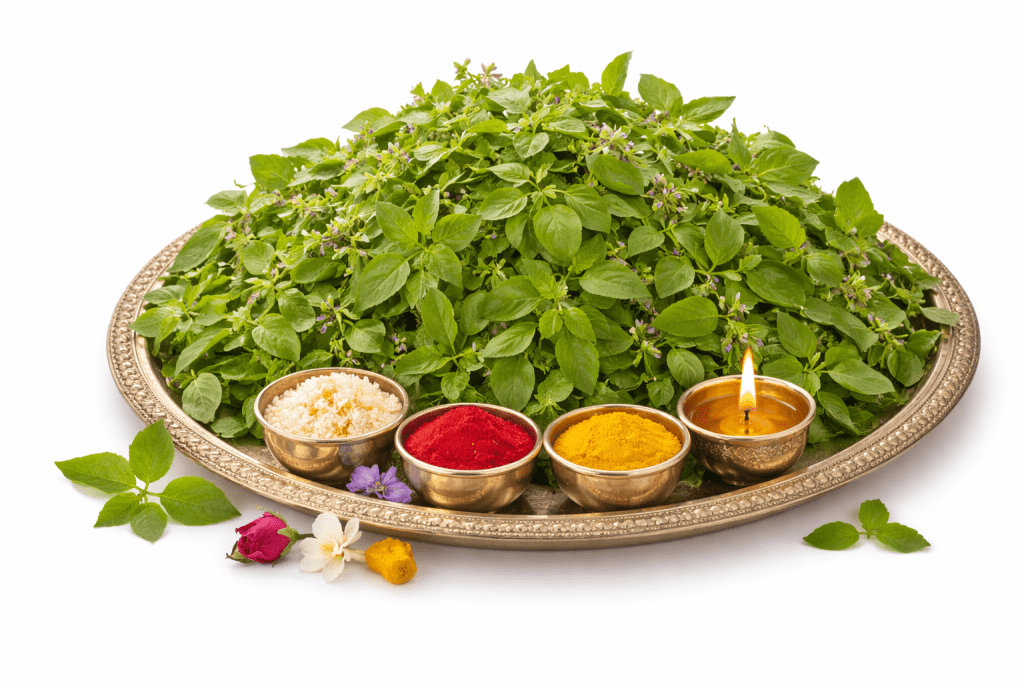
Tulasi Archane Seva is the sacred offering of Tulasi (Holy Basil) leaves to Lord Vishnu and his forms, with each leaf offered at each divine name recited during the Archana. At Shri Vadiraja Mandira, Chintamani, this seva creates a moment of intensely focused Vaishnava devotion where the most sacred plant in the tradition — Tulasi, regarded as the consort of Vishnu himself — becomes the medium through which the devotee’s love and prayers reach the divine. No other offering in Hindu temple worship combines natural sacredness, devotional focus, and theological depth quite as powerfully as Tulasi Archane.
The Gautamiya Tantra contains one of the most complete theological statements about Tulasi’s divine status: “Tulasi shri sakhi shubhe, papa harine punya de, namasthe naradanuthe, namo Narayana priye” — “O Tulasi, friend of Shri (Lakshmi), auspicious one, destroyer of sins, giver of merit, I bow to you who are glorified by Narada and beloved of Lord Narayana.” This verse encapsulates the tradition’s understanding: Tulasi is not merely a sacred plant but a divine being, eternally associated with Lord Vishnu, and through her, the devotee reaches the Lord.
The Skanda Purana describes a remarkable exchange where Lord Vishnu tells his devotees: “Whoever worships me with Tulasi has worshipped me with all the sacred rivers, all the holy tirthas, and all the gems of the three worlds.” This statement positions Tulasi as a complete sacred universe in herself — containing within her fragrant leaves the merit of all pilgrimages, all offerings, and all sacred acts. It is this understanding that makes Tulasi Archane one of the most potent sevas available at any Vaishnava temple.
Tulasi and the Madhwa Tradition
In the Madhwa Vaishnava tradition, Tulasi is indispensable. Not a single ritual is performed without Tulasi — not Abhisheka, not Archana, not Neivedyam (food offering), not Puja. Shri Madhwacharya’s commentary on the Bhagavata Purana highlights Tulasi’s role in purifying the offering space and making the Bhakta’s offering acceptable to the Lord. The tradition holds that Vishnu will not accept any offering presented without Tulasi, making her not just sacred but essentially a co-mediator in all worship.
At Shri Vadiraja Mandira, Tulasi is grown in consecrated Tulasi Vrindavanas (sacred pots) within the temple compound. The priests harvest fresh Tulasi leaves each morning for use in the day’s worship. When devotees sponsor Tulasi Archane, they are providing the primary sacred medium for an archana that the Lord himself prefers above all other leaf offerings.
Tulasi Vivaha: The Sacred Marriage
One of the most charming expressions of Tulasi’s divine status is the Tulasi Vivaha — the ritual marriage of the Tulasi plant to Lord Vishnu (usually in the form of Shaligrama or Vishnu idol) performed on Utthana Ekadashi (the day Vishnu “wakes” from his four-month cosmic sleep in Chaturmasa). This ritual marks the beginning of the auspicious wedding season in the Hindu calendar. By worshipping Tulasi before and during her marriage ceremony, devotees participate in the divine love story that Tulasi Vivaha enacts — the reunion of the devoted soul (Tulasi) with the Supreme Lord (Vishnu).
At Shri Vadiraja Mandira, Tulasi Archane is particularly recommended during the Utthana Ekadashi period, when Tulasi’s connection to the Lord is celebrated with special fervour. Booking Tulasi Archane on this day is considered equivalent to sponsoring a portion of the Tulasi Vivaha ceremony itself.
How Tulasi Archane Seva is Performed
The Archana begins with the Sankalpa — the priest recites the devotee’s name, gothra, and purpose of the offering. Fresh Tulasi leaves, washed and prepared, are placed in a consecrated plate before the deity. The priest then recites the divine names — from the Vishnu Sahasranama or the deity’s specific Astottara — one by one, offering a fresh Tulasi leaf at each name. This process of 108 names takes approximately 30–40 minutes; the 1008-name recitation takes 90–120 minutes. Throughout this time, the sanctum is filled with the remarkable fragrance of fresh Tulasi — a fragrance the tradition describes as purifying the entire surrounding atmosphere.
After the archana, the Tulasi leaves that have touched the deity become deeply sacred Prasada. Devotees present receive these leaves directly. Remote sponsors receive pressed dried Tulasi Prasada by post. Consuming or wearing a Tulasi Prasada leaf from this archana is said to be especially auspicious.
Spiritual Benefits of Tulasi Archane
The Skanda Purana enumerates specific benefits: freedom from past sins accumulated over multiple lifetimes; protection of the household from negative energies; healing of chronic illnesses particularly those related to respiratory health (Tulasi’s own medicinal properties align symbolically with her purifying role); success in devotional practices; and the grace of Lord Vishnu in the form of a peaceful, purposeful life. For devotees working through a period of grief, confusion, or spiritual dryness, Tulasi Archane is prescribed as a restorative practice that reconnects the soul to its natural orientation toward the divine.
Book your Tulasi Archane Seva at Shri Vadiraja Mandira today. For a broader flower-based worship experience, explore Pushpalankara Seva. And for the special connection of Tulasi to the Panchami tithi worship at this temple, see Panchami Archana Seva.
Why is Tulasi considered Vishnu’s favourite plant?
The Puranas narrate that Tulasi is the earthly form of Vrinda Devi, who was transformed into the sacred plant through a divine process and merged with the Lord’s devotion permanently. She is thus considered his eternal devotee and most beloved offering medium. The Bhagavata Purana records Vishnu declaring that even a leaf of Tulasi offered with love pleases him more than elaborate offerings presented without true devotion.
Can Tulasi Archane be performed for specific purposes like health or marriage?
Yes. Tulasi Archane is flexible in its application. For health — particularly respiratory and immunity issues — Tulasi Archane with a specific prayer is highly recommended. For marriage — seeking an auspicious life partner — performing Tulasi Archane on Fridays with Lakshmi’s names is a traditional practice. For general spiritual progress, any day’s archana with Vishnu Sahasranama is efficacious.
Is Tulasi Archane suitable during mourning periods?
In many traditions, families observe a period of ritual impurity after a death, during which temple visits and some rituals are restricted. However, Tulasi Archane can be sponsored remotely through the temple during such periods, as the ritual is performed by the priests on behalf of the family. The purifying quality of Tulasi is considered especially beneficial during such difficult times, helping to restore spiritual harmony after loss.
How does Tulasi Archane differ from Pushpalankara?
Pushpalankara focuses on the visual decoration of the deity with various flowers, making the divine form beautiful. Tulasi Archane is a focused devotional practice of name-recitation where Tulasi leaves are the offering medium — it is more meditative and focused on the devotee’s internal devotion than on external decoration. Both are powerful but serve different spiritual functions.
Connect with the Lord through his most beloved plant — book Tulasi Archane Seva at Shri Vadiraja Mandira, Chintamani.