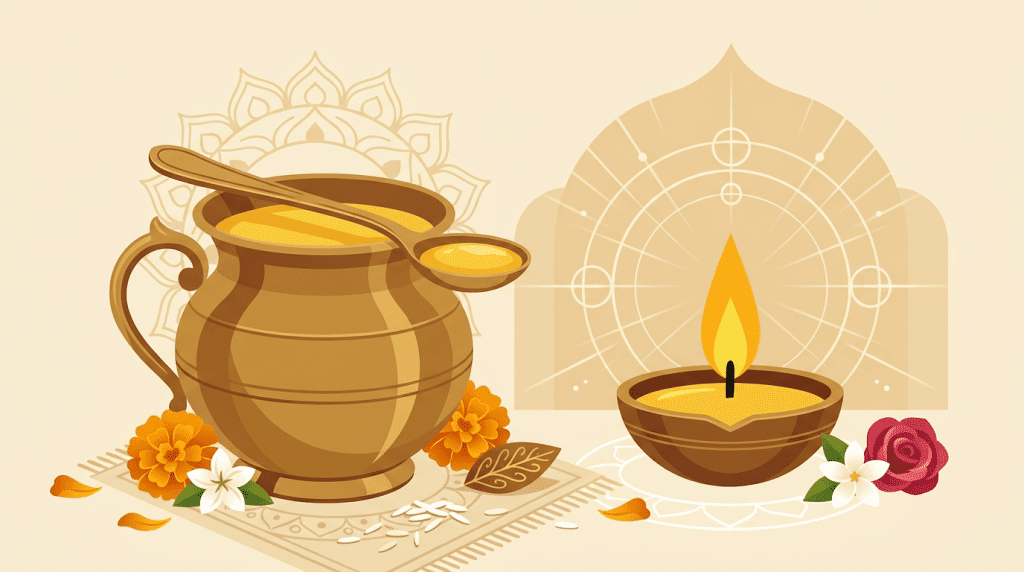
Ghee—ghruta in Sanskrit—is the golden, clarified essence of cow’s milk butter. In Hindu worship, ghee occupies a position of unrivalled sanctity. From the Vedic yajna (fire ritual) to the humble household lamp, from the grand temple abhisheka to the daily Naivedya, ghee is the thread that runs through every layer of sacred practice. In the Madhwa sampradaya, ghee is revered as the most sattvic (pure and elevating) of all substances, and its use in worship is prescribed extensively in Madhwacharya’s works.
The significance of ghee is not merely traditional—it is rooted in the deepest teachings of Vedic philosophy. The Vedas declare, “Ghruta is the first offering, the most beloved of Agni, the sustainer of yajna.” In Dvaita philosophy, offering ghee to the Lord is a genuine act of service to the Supreme Being, who accepts and is pleased by the purity and devotion embodied in this golden substance.
Ghee in the Vedic Yajna Tradition
The connection between ghee and worship is as old as the Vedas themselves. In the Vedic period, yajna (sacrificial fire ritual) was the primary mode of worship, and ghee was its essential fuel:
- Agni’s Favourite: The Rig Veda repeatedly describes ghee as the offering most pleasing to Agni (the fire deity who carries offerings to the gods). The pouring of ghee into the sacred fire—ghruta ahuti—is the central act of every Vedic yajna.
- Medium of Offering: Ghee serves as the medium through which all other offerings are transmitted to the deities. Grains, herbs, and other sacred substances are mixed with ghee before being offered to the fire, symbolising the purification of the offering.
- Sustainer of the Sacred Fire: Unlike other fuels, ghee burns with a clean, bright, fragrant flame. This pure flame represents jnana (knowledge) and tejas (spiritual radiance). The yajna fire fed by ghee is considered the most sacred form of Agni.
- Cosmic Significance: The Yajur Veda describes ghee as born from the cosmic waters, refined by creation itself. Offering ghee back to the fire completes a sacred cycle—creation’s purest product returned to the divine source through the medium of Agni.
Sri Madhwacharya, who performed numerous yajnas during his lifetime and established the tradition of unbroken fire worship in the Ashta Mathas of Udupi, placed ghee at the centre of all ritual practice. His Tantrasara Sangraha specifies the quality, quantity, and method of ghee offerings for various rituals.
Why Ghee Is Considered Sattvic
In the framework of the three gunas (qualities) that characterise all matter—sattva (purity), rajas (passion), and tamas (inertia)—ghee is classified as supremely sattvic. This classification has both scriptural and experiential basis:
- Source: Ghee comes from cow’s milk. The cow (go-mata) is revered in Hinduism as a sacred animal whose products are inherently pure. Cow’s milk, butter, and ghee are all considered sattvic foods that nourish the body without agitating the mind.
- Process: The making of ghee involves a progressive refinement—milk becomes curd, curd becomes butter, and butter is clarified into ghee. Each stage removes impurities, making ghee the purest essence of the original milk. This mirrors the spiritual process of refining the soul through devotion and knowledge.
- Effect: Consuming ghee in moderate quantities is said to enhance medha (intellect), smriti (memory), and ojas (vital energy). Ayurveda classifies ghee as agni deepaka (that which kindles the digestive fire) and sattvavarddhaka (that which increases purity of mind).
In Madhwacharya’s philosophy, the sattvic nature of ghee is directly relevant to worship. Offering sattvic substances to the Lord is not merely a preference but a requirement—the Supreme Being, who is the embodiment of all auspicious qualities, is to be worshipped with the purest materials available. Ghee fulfils this standard perfectly.
Ghee Lamp vs Oil Lamp: Understanding the Distinction
Both ghee lamps and oil lamps are used in Hindu worship, but the Madhwa tradition draws a clear distinction between them:
- Ghee Lamp (Ghruta Deepa): A lamp fuelled by ghee is considered the highest form of lamp offering. Its flame is brighter, steadier, and more fragrant. The ghee lamp is prescribed for deity worship, sandhyavandana, and special rituals. Lighting a ghee lamp before the Lord is said to dispel spiritual darkness and ignorance.
- Oil Lamp (Taila Deepa): Sesame oil lamps are commonly used for daily household lighting and for certain specific rituals (such as Shani pooja). While respected, oil lamps are considered secondary to ghee lamps in the context of Vishnu worship.
- Scriptural Preference: The Skanda Purana states: “A ghee lamp lit before Lord Vishnu equals in merit the performance of a thousand yajnas.” The Hari Bhakti Vilasa and other texts consistently rate ghee lamps above oil lamps for Vaishnava worship.
In practical terms, the ghee lamp burns more cleanly, produces less soot, and creates a warm, golden glow that enhances the atmosphere of the pooja room. Many Madhwa families maintain at least one ghee lamp burning throughout the day as a mark of the Lord’s presence in their home.
Ghee in Abhisheka and Naivedya
Beyond lamps, ghee features prominently in two other pillars of Madhwa worship:
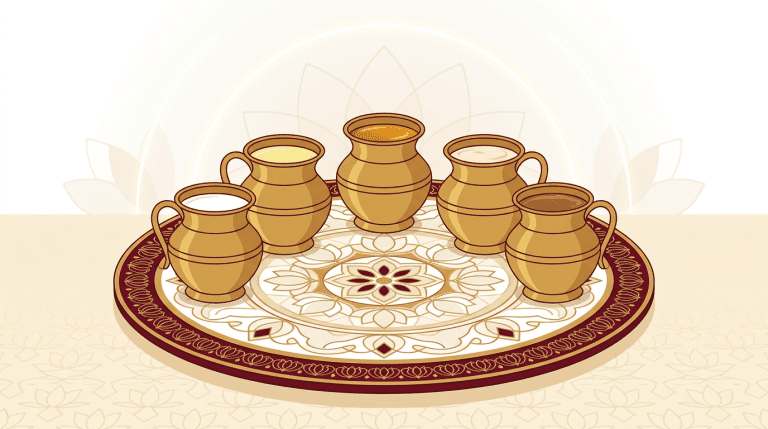
Abhisheka (Sacred Bathing): Ghee is one of the five ingredients of Panchamruta Abhisheka—the bathing of the deity with milk, curd, ghee, honey, and sugar. Ghee can also be used independently for Ghruta Abhisheka, where clarified butter alone is poured over the deity’s vigraha while Vedic mantras are chanted. This is a particularly powerful ritual for invoking the Lord’s radiance and blessings.
Naivedya (Food Offering): In Madhwa tradition, all food offered to the Lord (Naivedya) is prepared with ghee. Rice, sweets, savories—every item of the Lord’s meal is cooked in or flavoured with ghee. This is not merely a culinary preference; it ensures that the food offered to the Supreme Being meets the standard of sattvic purity. Madhwacharya’s writings specify that Naivedya prepared without ghee is incomplete.
The preparation of temple prasada at Madhwa institutions is therefore always ghee-based. The famous Kosambari, Payasa, and Chitranna served at Madhwa temple festivals are all prepared generously with ghee, reflecting the tradition’s commitment to offering the best to Lord Vishnu.
Ghruta Nanda Deepa: The Perpetual Ghee Lamp
Among the most revered sevas in Madhwa temples is the Ghruta Nanda Deepa—a perpetual ghee lamp that burns continuously before the deity. The word Nanda means “joy” or “eternal,” signifying that this lamp is a source of unending spiritual light.
The tradition of maintaining a perpetual lamp is ancient. The Agni Purana describes the Akhanda Deepa (unbroken lamp) as one of the greatest forms of seva, stating that the merit of maintaining such a lamp is equivalent to performing daily yajna. The flame, kept alive without interruption, represents the devotee’s unwavering commitment to the Lord.
At Shri Bhaavi Sameera Vadiraja Mandira in Chintamani, the Ghruta Nanda Deepa Seva allows devotees to sponsor the perpetual ghee lamp for one month. The ghee required to keep this lamp burning is provided through the generosity of devotees, and the merit of the offering is shared by all who contribute.
Sponsoring Ghruta Nanda Deepa is particularly recommended for:
- Those seeking to dispel obstacles and bring light into difficult situations
- Families wishing for health, prosperity, and spiritual growth
- Devotees observing special vratas (vows) who wish to amplify their merit
- Those commemorating the memory of departed family members, as the perpetual lamp is said to guide souls towards liberation
Frequently Asked Questions
Why is ghee preferred over oil for lamps in Vishnu worship?
Ghee is considered the most sattvic (pure) substance, derived from the sacred cow and refined through a process that removes all impurities. Scriptures like the Skanda Purana declare the merit of a ghee lamp to be far greater than that of an oil lamp. The ghee flame burns brighter, cleaner, and more steadily, symbolising the unwavering light of divine knowledge. In Madhwa tradition, ghee lamps are the prescribed standard for all Vishnu worship.
What is the significance of Ghruta Nanda Deepa in Madhwa temples?
Ghruta Nanda Deepa is a perpetual ghee lamp that burns continuously before the deity, representing the devotee’s unbroken devotion and the Lord’s eternal presence. Maintaining this lamp is considered equivalent to performing daily yajna. At Shri Bhaavi Sameera Vadiraja Mandira, devotees can sponsor this seva for one month, contributing to the unbroken flame and sharing in its spiritual merit.
How is ghee used in Naivedya preparation according to Madhwa tradition?
In the Madhwa sampradaya, all food offered to the Lord (Naivedya) must be prepared with ghee to meet the standard of sattvic purity. Rice dishes, sweets, savouries, and even simple offerings are cooked in or flavoured with ghee. Madhwacharya’s Tantrasara Sangraha specifies this requirement. The ghee-based preparation ensures that the food offered to the Supreme Being is of the highest quality and purity.
Can lighting a ghee lamp at home bring spiritual benefits?
Yes. Lighting a ghee lamp before the household deity each morning and evening is a foundational practice in Madhwa households. Scriptures describe numerous benefits: the dispelling of ignorance, the attraction of auspiciousness, the purification of the home environment, and the accumulation of spiritual merit. Sri Raghavendra Swami emphasised that even a single ghee lamp lit with devotion transforms the home into a sacred space where the Lord’s grace flows freely.
Is ghee abhisheka different from Panchamruta Abhisheka?
Yes. In Ghruta Abhisheka, only clarified ghee is poured over the deity, while in Panchamruta Abhisheka, all five ingredients (milk, curd, ghee, honey, and sugar) are used. Both are valid and powerful forms of worship. Ghruta Abhisheka specifically invokes the Lord’s radiance and is associated with the Vedic fire offering tradition. Panchamruta Abhisheka is a more comprehensive ritual that invokes the full spectrum of the Lord’s blessings through five-fold offering.
Ghee is the golden thread that connects every act of Vaishnava worship—from the Vedic yajna to the temple lamp, from the daily Naivedya to the sacred abhisheka. Its purity, its radiance, and its scriptural sanctity make it the ideal offering to Lord Vishnu. Sponsor the Ghruta Nanda Deepa Seva at Shri Bhaavi Sameera Vadiraja Mandira and keep the eternal flame of devotion burning bright. Explore all sacred sevas to discover every way you can participate in the worship of Sri Hari at the mandira.