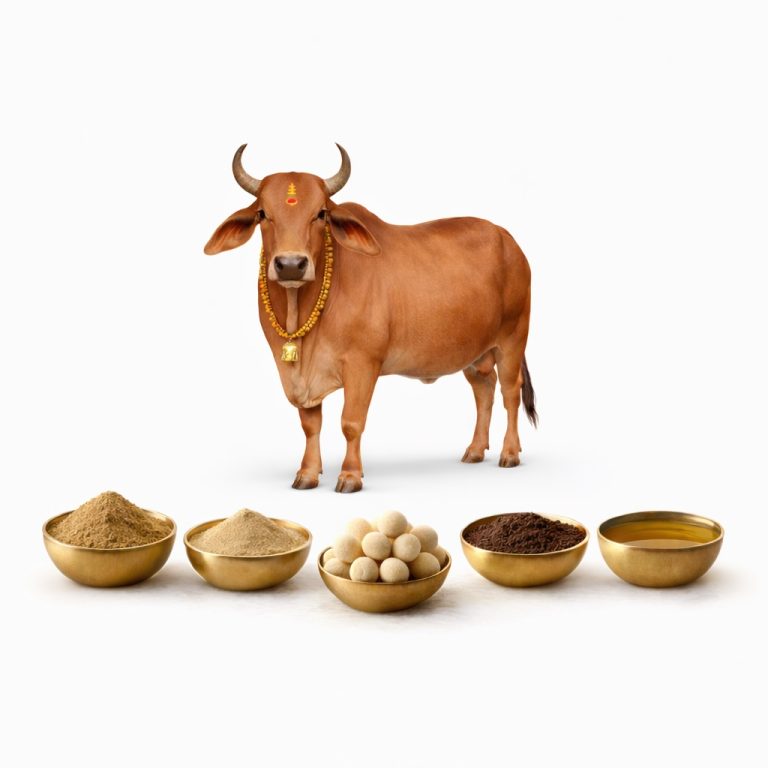
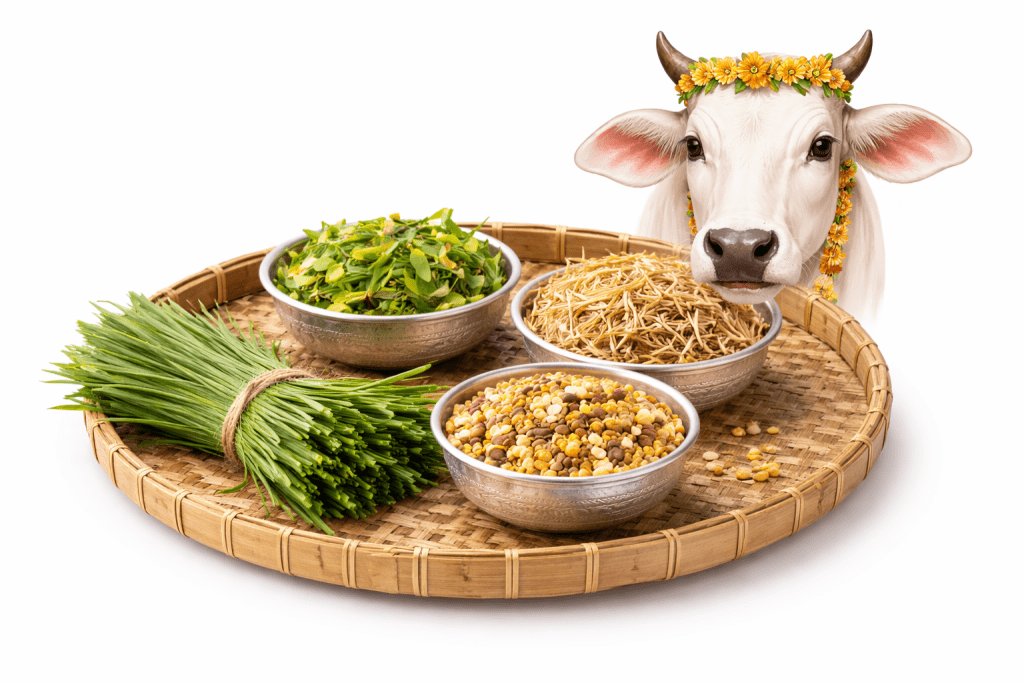
Gau Grasa Seva — the sacred offering of food to cows — is one of the most deeply grounded and universally revered acts of devotion in the Vedic tradition. At Shri Vadiraja Mandira, Chintamani, this seva allows devotees anywhere in the world to sponsor the daily feeding of cows maintained at the temple’s Gaushala, creating a direct connection between the devotee’s intention, the welfare of these sacred animals, and the vast field of merit that cow-feeding generates. In a tradition where the cow is called “Kamadhenu” — the wish-fulfilling divine animal — this act carries profoundly practical spiritual significance.
The Garuda Purana, one of the eighteen Mahapuranas and an authoritative text on dharma and its rewards, contains an extended teaching on the merit of cow-feeding: “Gavah srushtyaadau brahmaNA nirmitaah, tasmaad gaavo brahmanaaH samaah” — “Cows were created at the beginning of creation by Brahma; therefore cows are equal to the Brahmanas.” The Purana goes on: feeding a cow is equivalent to feeding one million Brahmanas; one who feeds a cow daily in this lifetime will never face hunger across seven successive lifetimes; the merit of Gau Grasa removes all accumulated sins of three generations.
The Mahabharata’s Anushasana Parva devotes several chapters to the glories of the cow and cow-feeding, with Bhishma telling Yudhishthira: “There is no act of merit equal to feeding a cow. The cow is the mother of all creatures, the refuge of all life. One who feeds her feeds the entire universe.” This hyperbolic but sincere statement reflects the ecological reality embedded in Vedic theology: cows are the foundation of the agricultural and food economy, the source of milk, curd, ghee, and Panchagavya — and their welfare is directly linked to the welfare of all.
Saturday and the Cow: Astrological Significance
In Vedic astrology (Jyotish), the cow is specifically associated with Saturn (Shani) — the planet that governs karma, discipline, service, and the working out of past-life obligations. Saturday is Shani’s day, and feeding a cow on Saturday is one of the most commonly prescribed astrological remedies for Saturn-related challenges including Sade Sati (the seven-and-a-half year Saturn transit), Shani Mahadasha, delayed marriage, career obstacles, chronic health issues, and Pitru Dosha (ancestral karmic debt).
This is not merely superstition — the logic is elegant: Saturn represents the masses, the poor, and the marginalized; the cow represents nourishment, abundance, and maternal care. By feeding the cow on Saturn’s day, the devotee activates Saturn’s most benevolent quality (the capacity to provide abundantly for all) and aligns their own karma with the principle of compassionate, selfless service that Saturn ultimately rewards.
Gau Grasa Seva at Shri Vadiraja Mandira on Saturdays is therefore one of the most popular ongoing remedial sevas in the temple’s schedule. For families experiencing extended periods of difficulty, booking Gau Grasa for every Saturday over several months creates a sustained astrological and spiritual remedy that many families have found deeply effective.
The Gaushala at Shri Vadiraja Mandira
The temple maintains a Gaushala (cow shelter) where indigenous Indian breeds — known for their spiritual significance and natural adaptability to the Indian climate — are housed, fed, and cared for. These cows provide milk for the temple’s daily offerings (Abhisheka, Neivedyam), their dung is used for the sacred Gomaya (cow dung purification) applied to the temple floors, and their sacred presence within the temple compound is itself a source of ongoing spiritual energy.
When you sponsor Gau Grasa Seva, your contribution provides feed for these cows on the specified day. The feeding is done in the morning, with a brief prayer recited over the feed before it is given to the animals. The cows’ contentment is itself understood as an auspicious sign — the tradition holds that a happy cow draws Lakshmi into any environment where she resides.
Pitru Shanti and Ancestral Healing through Gau Grasa
The Garuda Purana’s section on Pitru Tarpana (ancestral offerings) specifically mentions cow-feeding as one of the most effective means of Pitru Shanti (peace for the departed ancestors). Cows, as beings who give without receiving, represent the ideal of pure gift — the quality that ancestors most need to complete their journey to higher realms. When cows are fed in the name of departed family members, the merit generated is said to reach those souls directly, easing any burden they carry and facilitating their spiritual progress.
For families experiencing Pitru Dosha symptoms — unexplained health issues, repeated miscarriages, marriage obstacles, financial instability across generations — Gau Grasa Seva on Saturdays and Amavasya (new moon) days, ideally paired with Taila Nanda Deepa, is one of the most comprehensive and accessible remedial programs available.
Book your Gau Grasa Seva at Shri Vadiraja Mandira and join the sacred tradition of cow-feeding. For the related blessing of Gau Mrittika (cow’s sacred earth), explore Gau Pooja Seva.
How often should I book Gau Grasa Seva for Shani Dosha relief?
For Shani Dosha, Sade Sati, or Shani Mahadasha, Jyotish tradition recommends feeding cows every Saturday for a minimum of 11 Saturdays, ideally 43 or 108 consecutive Saturdays. The temple’s online system allows you to book Gau Grasa for specific recurring days, making sustained remedial programs easy to maintain even for devotees living far from Chintamani.
Can Gau Grasa Seva be combined with Annadana on the same day?
Yes. Many devotees book Gau Grasa (feeding cows) and Annadana (feeding people) together on the same day, creating a comprehensive act of nourishment that spans both the animal and human realms. This combination is said to maximise the merit of the Dana (charitable giving) dimension of the day’s worship.
Is Gau Grasa Seva suitable for Pitru Paksha (ancestral fortnight)?
Absolutely. Gau Grasa during Pitru Paksha is specifically recommended in the Garuda Purana. Booking Gau Grasa for every day of the 15-day Pitru Paksha period is one of the most comprehensive Pitru Tarpana programs available. Many families maintain this as an annual practice during the ancestral fortnight each year.
What Prasada is received from Gau Grasa Seva?
The Prasada from Gau Grasa Seva includes a portion of sacred food from the temple’s daily Neivedyam offering, as well as a portion of Gau Mrittika (the sacred earth from the cow’s living space) in some packages. The Gau Mrittika is used in home purification and pooja. Specific Prasada contents depend on the package booked; please see the Gau Grasa booking page for details.
Feed the sacred, heal the lineage — book Gau Grasa Seva at Shri Vadiraja Mandira, Chintamani.