
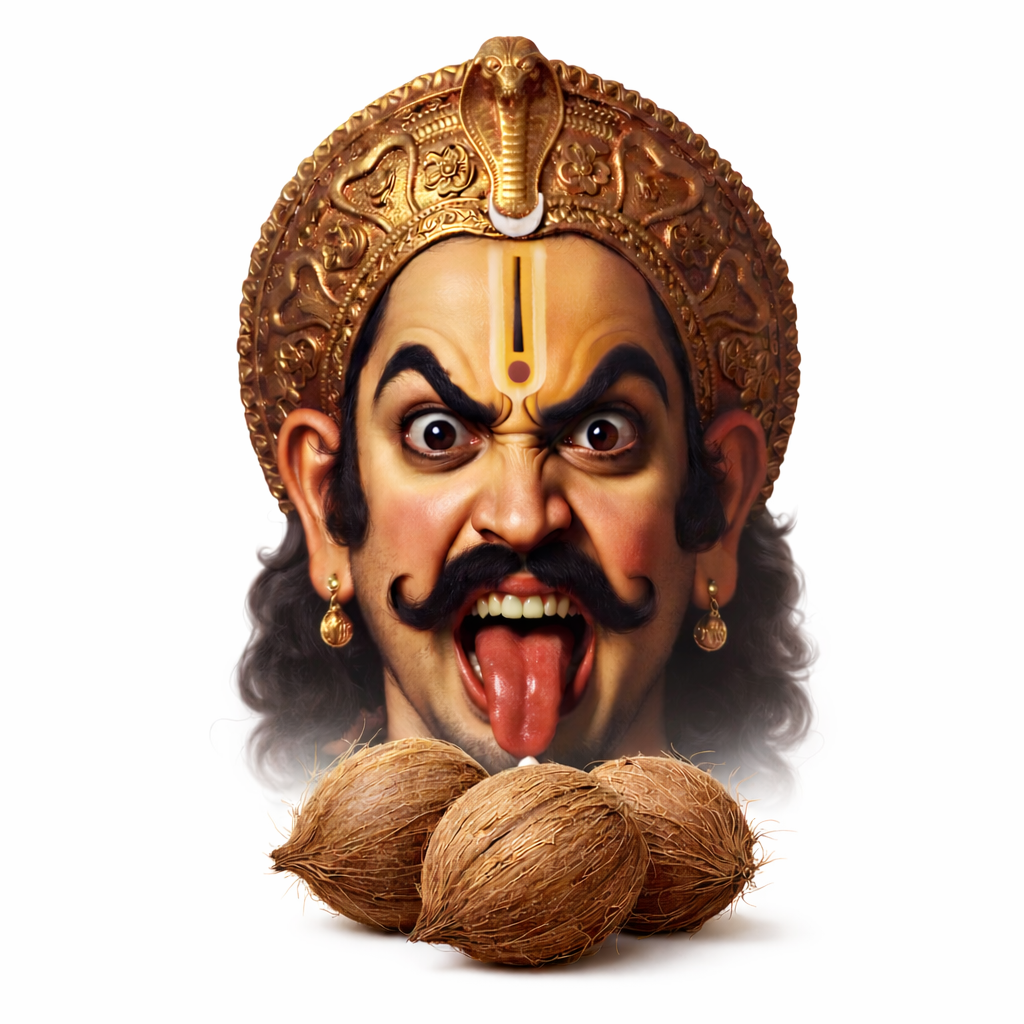
Bhootarajara Narikela Seva — the offering of a sacred coconut rolled to the shrine of Bhootarajaru — is a distinctive and profoundly meaningful seva at Shri Vadiraja Mandira, Chintamani. To understand this seva, one must first know who Bhootaraja truly is: not merely a guardian deity, but the most devoted and extraordinary servant of Shri Vadirajaru himself, whose journey to this exalted role spans three successive lifetimes across the ages of Treta Yuga, the Mahabharata era, and the time of Vadirajaru at Sodhe. The tradition holds that one who offers a coconut to Bhootarajaru will have all their needs fulfilled — a testament to the grace this divine servant-guardian extends to sincere devotees of Vadirajaru.
In the Madhwa taratamya (the precise hierarchy of divine and semi-divine beings established by Shri Madhwacharya), Bhootaraja occupies the third tier — alongside Garuda, Shesha, and Rudraru — as an incarnation of Patrataapa Rudra, the tenth Rudra. He is thus above the revered Yatis and Dasas in the hierarchy, serving as the eternal kshetra paalaka (sacred precinct guardian) of Sodhe — and, by extension, of all temples and sacred sites where Vadirajaru is worshipped.
Who is Bhootaraja? Three Lifetimes of a Devoted Soul
The traditional accounts of Sodhe Matha describe Bhootaraja’s journey through three births, each marked by his connection to the divine will that would eventually bring him to his final role as Vadirajaru’s eternal guardian:
First Life — Tapodhana (Treta Yuga): In the court of Lord Rama at Ayodhya, after Ravana vadha, a brahmin called Tapodhana — who was Patrataapa Rudra — arrogantly mocked other brahmins, claiming only he had the tapas-shakti to absolve the sin of brahmahatya. Lord Rama gently but firmly stated that mocking brahmins would result in becoming a brahma rakshasa in the next birth. Though Tapodhana immediately sought forgiveness and Rama, smiling, promised he would eventually be freed through service to one who would be Vayu in the next Kalpa — none other than the future Vadirajaru — the seed of karma was sown.
Second Life — Somadatta (Mahabharata era): Patrataapa Rudra next took birth as Somadatta, the son of Bahlika (himself an incarnation of Prahlada) and a celebrated warrior in the Mahabharata war. Though a man of great qualities who advised against war with the Pandavas, he fought alongside the Kauravas due to his loyalty to Bhishma and was eventually slain in battle.
Third Life — Narayana Sharma (Time of Vadirajaru): In his final preparatory birth, Patrataapa Rudra incarnated as Narayana Sharma, a brilliant scholar and devoted disciple of Shri Vadirajaru at Sodhe. It is in this life that the remarkable story of his transformation into Bhootaraja unfolds.
The Curse, the Forest, and the Liberation
One day, the great saint Vyasarajaru paid an unexpected visit to Vadirajaru’s matha on a dwadashi day. Not wanting to keep the honoured guest waiting for his dwadashi bhojana, Vadirajaru joined him for the meal. After eating, Vadirajaru instructed all his disciples to remain at the matha and not follow him. He went to the Shalmali river, brought a large leaf, sat on a rock, and through extraordinary yogic power, brought out all the food from his stomach exactly as it was served — raw, hot, and completely undigested. He performed his snana and pooja, and then ate the same food again as his actual dwadashi bhojana — the meal he had shared with Vyasarajaru being the apparent meal that satisfied the guest while leaving Vadirajaru’s actual ritual requirements intact.
Narayana Sharma had secretly followed Vadirajaru and witnessed this extraordinary miracle from the top of a tall tree. When Vadirajaru discovered what had happened upon his return, he cursed Narayana Sharma: the consequence of spying on a guru’s private miraculous acts was to become a brahma rakshasa. When the shattered disciple begged for forgiveness, Vadirajaru said: “Roam in forests and ask — Aa Ka Ma Vai… Ko Na Snathaha? (Who has not bathed in the months of Ashwayuja, Karteeka, Maagha, and Vaishakha?) — and whoever correctly answers this question will release you.”
For years, Narayana Sharma wandered as a fearsome brahma rakshasa in forests near Badarikaashrama, and people fled from his path. When word of this suffering reached Vadirajaru, his compassion would not rest. He personally visited the dangerous forest. When the brahma rakshasa stopped him with the ritual question, Vadirajaru answered: “Randa Putra, tvam na snataha” — those like a brahma rakshasa who do not observe the sacred baths in those four holy months are “not bathed.” At that very instant, the curse dissolved. Narayana Sharma’s body blazed like the emerging sun; in his true form as Patrataapa Rudra, he fell at Vadirajaru’s feet in saashtaanga namaskara (full prostration) and surrendered himself entirely. Vadirajaru blessed him: he would be the Bhaavi Rudra (the Rudra of the next Kalpa), the eternal kshetra paalaka at Sodhe, and forever known as Bhootaraja. From that moment, Bhootaraja serves Vadirajaru invisibly, as his most powerful earthly guardian.
The Narikela (Coconut) Seva: Rolling, Not Breaking
The unique feature of Bhootarajara Narikela Seva is that the coconut is rolled to the shrine — not struck and broken as in some other traditions. This rolling is an act of complete, humble surrender: the devotee rolls the coconut gently toward Bhootarajaru as one would offer something reverently to a great and dignified being who is seated. Just as Narayana Sharma himself bowed fully to Vadirajaru in gratitude and surrender, the rolling of the coconut enacts this spirit of complete prostration — the offering that says, “I come to you humbly, with my whole self, asking for your protection.”
The coconut’s own symbolism deepens the offering: the rough outer husk represents worldly difficulties and the hard shell of ego; the sweet white flesh within represents inner purity and devotion; and the sacred water at the centre represents the divine nectar of surrender. Rolling this complete, three-layered offering to Bhootarajaru is a prayer for protection that travels from the outer circumstances of life all the way to the innermost aspiration of the heart.
Important: Everything said here about rolling (not breaking) the coconut applies only to Bhootarajara Narikela Seva before Sri Bhootarajaru. It is not a description of how coconuts are offered to Sri Narasimha Devaru, Prana Devaru, Vadirajaru, or at any other sannidhana or place — those follow their own established practices.
The Bhootaraja Shrine at Sodhe and at Shri Vadiraja Mandira
At the original Sodhe matha, there is a dedicated shrine for Bhootarajaru with a special entrance in the sarovara (temple tank area) reserved exclusively for him — not open to other devotees. Every evening, Bhootaraja Bali Pooja (evening protective offering) is conducted, maintaining the ancient rhythm of his guardianship. At Shri Vadiraja Mandira, Chintamani, the Bhootarajara Narikela Seva similarly connects devotees to this same protective presence. When you sponsor this seva, the archaka priest performs the Sankalpa in your name and rolls the consecrated coconut to the Bhootaraja shrine with appropriate protective mantras.
Spiritual Benefits of Bhootarajara Narikela Seva
The tradition is clear: one who offers a coconut to Bhootarajaru will have all their needs fulfilled. More specifically, Bhootarajara Narikela Seva is sought for: protection of the home and family from harm; removal of obstacles and adversity that resist ordinary approaches; safe travel and protection during journeys; freedom from fear and unexplained anxiety; and the grace of Vadirajaru flowing through his most powerful servant-guardian. As the kshetra paalaka, Bhootaraja is particularly responsive to prayers for the safety and sanctity of one’s home and immediate environment.
Book your Bhootarajara Narikela Seva at Shri Vadiraja Mandira, Chintamani and receive the protection of Vadirajaru’s eternal guardian. For deeper immersion in Vadirajaru’s grace, explore Panchami Archana Seva.
Who is Bhootaraja and why is he considered the greatest of Vadirajaru’s servants?
Bhootaraja is an incarnation of Patrataapa Rudra — the tenth Rudra — who, through three lifetimes of karma and divine will, was finally prepared to serve as Vadirajaru’s eternal kshetra paalaka (guardian of the sacred precinct) at Sodhe. He is described in the Madhwa tradition as “the best among the servants of Vadirajaru,” a title that reflects both his extraordinary devotion and his immense spiritual power as a Rudra. In the Madhwa taratamya, he is in the third tier alongside Garuda, Shesha, and Rudraru — above all Yatis and Dasas — a position that reflects his unique and exalted role in the divine order.
Why is the coconut rolled to Bhootaraja rather than broken?
The rolling of the coconut is the specific traditional mode of offering prescribed for Bhootarajaru only at Sodhe and in temples in this lineage, for this seva. Rolling, unlike breaking, is an act of gentle, humble, and complete surrender — offering the whole coconut intact to the great guardian, allowing him to receive it on his own terms. It is consistent with the spirit of the story of Narayana Sharma’s transformation: the devotee approaches Bhootaraja not with force or conquest (breaking) but with complete prostration and reverence (rolling toward his feet). Again, this narrative and practice are not meant to apply to Narasimha Devaru or other murthis.
What is the Panchavrundavana and is it related to Bhootarajara Seva?
The Panchavrundavana refers to the five Vrundavanas of Vadirajaru himself — five sacred forms (roopas) of the saint, not five different Yatis. Bhootaraja, as the eternal servant and guardian of Vadirajaru, is inseparably connected to the entire sacred precinct that houses the Panchavrundavana. By seeking Bhootaraja’s protection through Narikela Seva, devotees are also invoking the protective grace that stands guard over Vadirajaru’s own sacred presence.
Can Bhootarajara Narikela Seva be done for protection of a new home or business?
Yes. As kshetra paalaka — guardian of sacred space — Bhootaraja’s blessing is especially appropriate at the beginning of any new space: a new home, new business premises, new land. Many families in the Madhwa tradition sponsor Bhootarajara Narikela Seva as part of their Gruha Pravesh (housewarming) rituals, seeking his specific blessing for the safety and sanctity of their new space. Pair this with Sarva Seva for a comprehensive blessing of the new beginning.
Seek the protection of Vadirajaru’s most devoted guardian — book Bhootarajara Narikela Seva at Shri Vadiraja Mandira, Chintamani today.