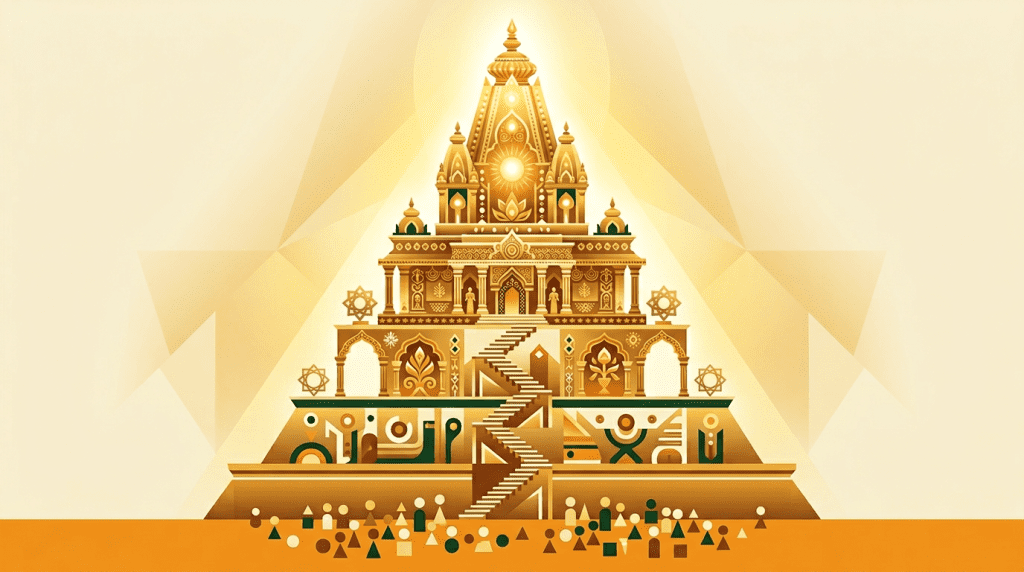
In the Madhwa tradition, Taratamya (Sanskrit: tara-tamya, meaning “gradation” or “hierarchy”) is the doctrine that all beings — from the highest devata to the smallest creature — exist in a divinely ordained hierarchy of spiritual capacity, authority, and proximity to the Supreme Lord. This is not an arbitrary ranking but an expression of each being’s intrinsic yogyata (fitness, or inherent spiritual nature) as established eternally by Lord Vishnu.
Taratamya is a direct consequence of Panchabheda — specifically the Jiva-Jiva bheda (the eternal difference between one soul and another). Because each jiva possesses a unique intrinsic nature, each naturally occupies a distinct position in the cosmic order. Understanding this hierarchy is foundational for correct worship, for comprehending the structure of the universe, and for deepening one’s devotion to Lord Vishnu.
The Hierarchy: From Vishnu to the Devatas and Beyond
Madhwacharya’s texts — particularly the Vishnu Tattva Vinirnaya and the Mahabharata Tatparya Nirnaya — outline the Taratamya in detail. The hierarchy proceeds as follows:
- Lord Vishnu (Narayana / Hari) — The Supreme Independent Being (Sarvottama). He stands alone at the pinnacle, unequalled and unsurpassed. All other beings depend upon Him for their existence and powers. His supremacy is absolute — “Hari Sarvottama”.
- Shri Lakshmi Devi — The eternal consort of Lord Vishnu. She occupies the highest position among all dependent beings. She is the mediator of divine grace — no jiva can approach the Lord without Her intercession. She is eternally liberated and free from samsara.
- Chaturmukha Brahma (the four-faced Creator) and Mukhya Prana (Vayu) — These two great beings occupy the next tier. Brahma is the creator of the universe under Vishnu’s direction; Vayu is the chief life-breath who sustains all living beings. Both are the greatest among the devatas. The Madhwa tradition holds Vayu in special reverence because Madhwacharya himself is considered an incarnation of Mukhya Prana — “Vayu Jeevottama” (Vayu is supreme among jivas).
- Saraswati and Bharati Devi — The consorts of Brahma and Vayu respectively. They occupy the tier immediately below their spouses.
- Garuda, Shesha, and Rudra — Garuda (the divine eagle, vehicle of Vishnu), Shesha (the cosmic serpent on whom Vishnu reclines), and Rudra (Shiva, who carries out the function of destruction under Vishnu’s command) occupy the next level. It is important to note that in Madhwa theology, Rudra is a great devata and a devoted bhakta of Vishnu, but he is positioned below Brahma and Vayu in the hierarchy.
- Indra and Kama — The king of the devatas and the god of desire follow.
- Other Devatas, Rishis, Pitrus, and Souls — The hierarchy continues downward through Surya (the Sun God), Chandra (the Moon God), and the various classes of celestial beings (adityas, vasus, rudras), then through the great Rishis (Narada, Prahlada, and others), the Pitrus (ancestral beings), human souls, animals, plants, and finally insentient matter. Within the human realm, souls differ in their spiritual capacities — some are mukti-yogya (eligible for liberation), some are nitya-samsarins (eternally bound to samsara), and some are tamo-yogya (destined for andha-tamas). Each soul’s position reflects its unique, eternal yogyata.
Taratamya in Temple Worship: The Hastodaka Sequence
Taratamya is not merely a theological abstraction — it directly governs how worship is conducted in Madhwa temples. At Shri Bhaavi Sameera Vadiraja Mandira, Chintamani, the Hastodaka Seva follows a precise sequence that mirrors the divine hierarchy:
- First, Neivedyam (sacred food offering) is presented to Lord Hayagreeva — the form of Vishnu worshipped by Shri Vadirajaru. This acknowledges the Lord’s position as Sarvottama.
- Next, the offering goes to Pranadevaru (Mukhya Prana / Vayu) — the Jeevottama, supreme among jivas.
- Then to Shri Vadirajaru’s Panchavrundavana — the five sacred forms of the great saint, who occupies a revered position as a Yati (monk) in the lineage of Madhwacharya.
- Finally, to the Mruttika Vrundavanas of the parampara Yatis — the monks of the Madhwa lineage.
This sequence is not arbitrary or customary — it is a disciplined reflection of Taratamya. Every temple ritual in the Madhwa tradition adheres to this principle: the highest entity is honoured first, and offerings proceed downward through the hierarchy. To reverse or randomise the order would be to violate the cosmic structure that Madhwacharya revealed.
Yogyata: The Intrinsic Fitness of Each Soul
Yogyata is the concept that gives Taratamya its internal logic. Each jiva has an intrinsic spiritual fitness — an eternal, unalterable core nature — that determines its ultimate capacity for bliss, knowledge, and proximity to God. Yogyata is not acquired through action or effort; it is the soul’s essential constitution. What spiritual practice (sadhana) does is manifest that potential — much like polishing a diamond reveals its inherent brilliance.
This means that in liberation (moksha), each soul experiences bliss proportionate to its yogyata. Brahma experiences a degree of bliss surpassed only by Lakshmi; Vayu’s experience is immense but slightly less than Brahma’s; and so on down the hierarchy. Even among liberated human souls, the experience of Vaikuntha differs. Yet every liberated soul is completely satisfied — there is no envy or longing in moksha because each soul is experiencing the fullness of its own nature.
Madhwacharya uses the analogy of vessels of different sizes placed in the ocean. Each vessel fills to its own capacity — a small cup and a great barrel are both completely full, yet they contain different volumes of water. The ocean (God’s grace) is inexhaustible; the vessel (the jiva’s yogyata) determines how much each can hold.
Scriptural Basis for Taratamya
The doctrine of Taratamya is firmly rooted in scripture. Madhwacharya cites numerous Vedic texts in support:
- The Purusha Sukta (Rig Veda 10.90) describes the cosmic hierarchy emanating from the Supreme Purusha (Vishnu).
- The Katha Upanishad (1.3.10-11) presents a hierarchy of reality from the senses upward to the Atman and beyond to the Supreme Lord — a graded structure that mirrors Taratamya.
- The Bhagavad Gita (15.16-18) distinguishes between kshara (perishable beings), akshara (imperishable Lakshmi), and Purushottama (the Supreme Person, Vishnu) — a three-tier classification that supports the hierarchical worldview.
- Shri Jayatirtha’s Nyaya Sudha and Shri Vyasatirtha’s Nyayamruta provide extensive citations from across the Vedic corpus to support each tier of the hierarchy.
Why Taratamya Deepens Devotion
Understanding Taratamya produces a profound spiritual effect. When a devotee realises that God is infinitely above all other beings, worship becomes genuinely reverential — not a transaction between equals but an offering of the small to the infinite. When a devotee understands that the devatas, rishis, and yatis each hold specific positions in the cosmic order, worship becomes precise and informed — one does not conflate a devata with the Supreme or elevate a subordinate entity to a position that belongs to the Lord.
Taratamya also cultivates humility. A devotee who grasps this teaching recognises that countless beings — devatas, rishis, and great saints — stand above him in spiritual attainment. This recognition dissolves spiritual arrogance and fosters a genuine eagerness to learn from the tradition, serve the parampara, and remain in the shelter of the Guru lineage. The great Haridasas expressed this humility in their compositions — Purandaradasa, Kanakadasa, and Vijayadasa all sang of their own lowliness before the Lord and the greatness of the parampara, not as a literary device but as a genuine reflection of their understanding of Taratamya.
At Shri Vadiraja Mandira, every seva is an opportunity to enact Taratamya in practice — honouring the Lord first, then the great devotees, and receiving Prasada as the Lord’s grace flowing downward through the hierarchy to the individual soul.
Frequently Asked Questions
Does Taratamya mean some souls are less valuable to God?
No. God’s love for each jiva is not determined by that jiva’s rank in the hierarchy. Lord Vishnu is equally the Antaratma (inner controller) of every soul, guiding each toward its highest fulfilment. Taratamya describes differences in intrinsic spiritual capacity, not differences in divine love. Just as a parent loves all children equally while recognising that each child has unique talents and temperaments, God cherishes every jiva while acknowledging their inherent diversity.
Is Taratamya fatalistic? If my yogyata is fixed, why should I strive?
Yogyata defines your potential; sadhana realises it. Without effort — study, devotion, moral discipline, and seva — even a high yogyata lies dormant. Madhwacharya is emphatic that spiritual practice is indispensable. Moreover, the jiva does not know its own yogyata; only God does. Therefore, every devotee should strive with full effort and leave the result to the Lord. This produces the ideal combination of maximum effort and complete surrender.
How does Taratamya apply to the Hastodaka Seva at Shri Vadiraja Mandira?
During Hastodaka Seva, the sacred Neivedyam is offered first to Lord Hayagreeva (Supreme God), then to Pranadevaru (Vayu, the Jeevottama), then to Shri Vadirajaru’s Panchavrundavana, and finally to the Mruttika Vrundavanas of the lineage Yatis. This exact sequence is a ritual enactment of Taratamya, honouring each entity in its proper hierarchical position.
Where can I learn more about Taratamya in Madhwa texts?
The primary sources are Madhwacharya’s Vishnu Tattva Vinirnaya and Mahabharata Tatparya Nirnaya. Shri Jayatirtha’s commentary on these works and Shri Vadiraja Tirtha’s Yukti Mallika provide further elaboration. Many of these texts are available in Sanskrit with Kannada and English translations through Madhwa scholarly institutions.
Explore all sacred sevas: Visit our Guide to Madhwa Sevas to discover the complete range of poojas, abhishekas, and archane offerings at Shri Bhaavi Sameera Vadiraja Mandira, Chintamani.