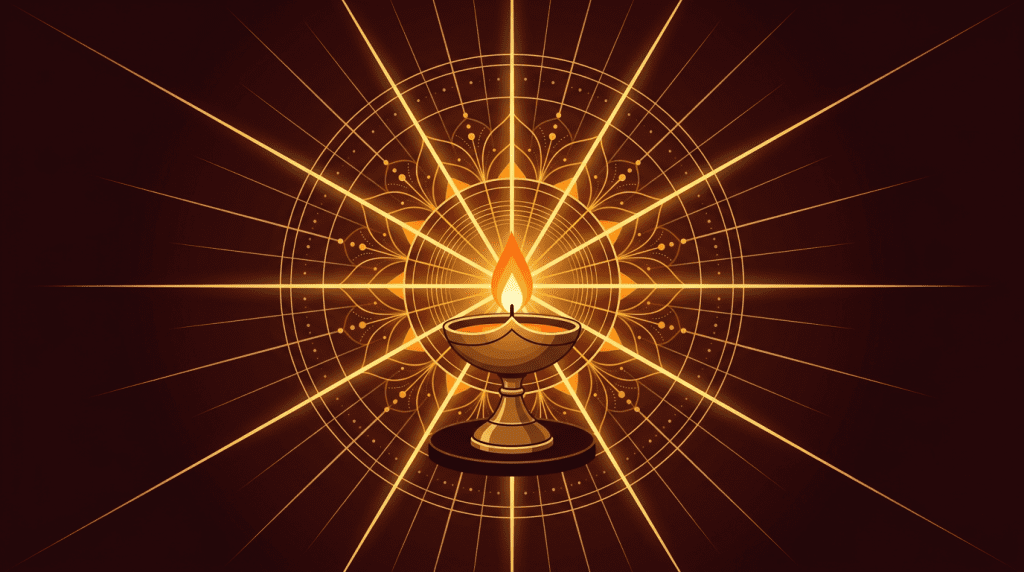
The lamp — Deepa in Sanskrit — is among the most ancient and universal symbols of Hindu worship. Every temple pooja begins and ends with the lighting of a lamp; no ritual is considered complete without its presence. In the Madhwa tradition of Dvaita Vedanta, the Deepa carries a specific theological weight: it represents jnana (knowledge) dispelling ajnana (ignorance), and more profoundly, it symbolises the jiva’s aspiration to be illuminated by the grace of Shri Hari, the Supreme Light from whom all other light derives. Shri Madhwacharya, in his Anu Vyakhyana, describes Bhagavan as Jyotisham Jyotih — the Light of all lights — a being whose radiance makes the sun, moon, fire, and every lamp shine.
Symbolism of Light in Vedic Thought
The Vedas are saturated with the imagery of light. The famous Gayatri Mantra is an invocation of the divine light (Bhargo Devasya) to illuminate the intellect. The Mundaka Upanishad declares: “Tameva bhantam anubhati sarvam, tasya bhasa sarvam idam vibhati” — “Everything shines only after Him; by His light, all this shines.” In the Madhwa interpretation, this verse establishes the absolute dependence of all created entities on the Lord. The lamp we light before the deity is a miniature enactment of this cosmic truth: just as the wick cannot burn without oil and the oil cannot illumine without fire, the jiva cannot achieve knowledge or liberation without the grace of Hari.
Darkness, in Vedic symbolism, is not merely the absence of physical light. It represents tamas — the quality of ignorance, inertia, and spiritual blindness that keeps the jiva trapped in the cycle of samsara. Lighting a Deepa before the Lord is a prayer to dispel this inner darkness. Shri Vadiraja Tirtha, in one of his many devotional compositions, writes that the devotee’s heart is a sanctum that must be illuminated by the Deepa of bhakti before the Lord will take residence within it.
Types of Lamps in Hindu Worship
Two primary types of lamp fuel are used in temple worship, each carrying distinct spiritual significance.
Taila Deepa (Oil Lamp)
Taila refers to sesame oil, the most traditional fuel for temple lamps. Sesame has deep Vedic associations: it is used in Shraddha (ancestral rites), Homa (fire rituals), and as an offering to the Pitrus (ancestors). A sesame oil lamp is believed to pacify departed ancestors, reduce the effects of Pitru Dosha, and counteract malefic Shani (Saturn) influences. For devotees experiencing repeated setbacks, health challenges, or ancestral disturbances, Taila Nanda Deepa Seva at Shri Vadiraja Mandira is a powerful remedy sustained over thirty days.
Ghruta Deepa (Ghee Lamp)
Ghruta is clarified butter (ghee), considered the purest and most sattvic of all lamp fuels. The Skanda Purana states that a ghee lamp pleased the Lord more than a thousand oil lamps. Ghee is a product of the sacred cow and is associated with Lakshmi (prosperity), Saraswati (knowledge), and Agni (the sacred fire). A Ghruta Nanda Deepa Seva is recommended for spiritual advancement, family prosperity, and the invocation of sattvic energies in the household.
Nanda Deepa: The Perpetual Lamp
Nanda Deepa literally means “the lamp that rejoices.” It refers to a lamp that burns continuously — day and night, without being extinguished — for a specified period, typically thirty days. The Agama Shastras prescribe the Nanda Deepa as one of the most meritorious offerings a devotee can make, because the unbroken flame represents akhand bhakti (unbroken devotion). While the devotee goes about daily life — working, sleeping, travelling — the Nanda Deepa burns on their behalf before the deity, maintaining a continuous thread of worship.
At Shri Bhaavi Sameera Vadiraja Mandira, both Taila and Ghruta Nanda Deepa sevas are available. The temple priests maintain the lamp through all six daily poojas, replenishing the fuel as needed. At the conclusion of the thirty-day period, Prasada is dispatched to the sponsoring devotee. Many families book consecutive Nanda Deepas to maintain an unbroken lamp throughout the year, especially during challenging periods.
Deeparadhane: The Ritual of Lamp Worship
Deeparadhane (also called Arati or Nirajana) is the waving of a lit lamp before the deity, typically performed at the conclusion of a pooja. The priest holds a multi-wicked lamp — often a five-wicked Pancharati — and moves it in a clockwise circle before the deity while bells ring and devotees chant. This is the climactic moment of any pooja, the point at which the deity’s presence is most vividly experienced.
In the Madhwa understanding, Deeparadhane is not merely a visual spectacle; it is an act of offering light — the most precious element — to the Lord who is Himself the source of all light. After the waving, the priest brings the flame to the devotees, who cup their hands over the flame and touch their eyes, receiving the sanctified light as a blessing. Deeparadhane Seva at Shri Vadiraja Mandira allows devotees to sponsor this sacred offering and receive Prasada.
Kartika Month: The Season of Lamps
Kartika Masa (the month of Kartika, typically October-November) is considered the most auspicious month for lighting lamps. The Skanda Purana devotes an entire section — the Kartika Mahatmya — to extolling the merit of lighting lamps during this month. Key observances include:
- Akasha Deepa: A lamp suspended high on a pole or placed on a terrace, symbolising a beacon that guides departed souls toward higher realms.
- Tulasi Deepa: A lamp lit at the base of the Tulasi Brindavana (sacred basil plant) every evening during Kartika.
- Temple Deepotsava: A grand festival of lamps held in many Madhwa temples, where the entire sanctum is illuminated with hundreds of oil and ghee lamps.
The Padma Purana states that lighting even a single lamp during Kartika in the presence of Lord Vishnu confers the merit of performing an Ashwamedha Yagna. At Shri Vadiraja Mandira, Kartika is celebrated with special Deeparadhane and Nanda Deepa sevas that devotees can participate in from anywhere.
Scriptural References and Benefits of Lighting Lamps
The Skanda Purana declares: “Deepa-danena Vishnostu priyam bhavati nityashah” — the offering of a lamp is perpetually dear to Vishnu. The Garuda Purana lists lamp offering among the acts that liberate the jiva from the torments of Yama (the lord of death). Shri Raghavendra Swami, the great Madhwa saint, is recorded to have emphasised that a household where a lamp burns before the Lord’s image every evening will never experience poverty or discord.
Specific benefits described in the Puranas include: removal of eye diseases, clarity of intellect, prosperity in business, peace in the household, and the pacification of ancestral debts. In the broader Dvaita perspective, these benefits are not automatic mechanical outcomes — they arise from the santosha (pleasure) of the Lord, who is moved by the devotee’s sincere offering of light.
Deepa Sevas at Shri Bhaavi Sameera Vadiraja Mandira
Devotees can participate in several lamp-related sevas at the temple:
- Taila Nanda Deepa (One Month) — continuous sesame oil lamp for ancestral healing and Saturn remedies
- Ghruta Nanda Deepa (One Month) — continuous ghee lamp for prosperity and spiritual progress
- Deeparadhane — sponsoring the ritual lamp worship during evening pooja
Learn more about the full range of Madhwa sevas in our Guide to Madhwa Sevas.
Frequently Asked Questions
What is the difference between an oil lamp and a ghee lamp in spiritual terms?
Sesame oil (Taila) lamps are especially effective for ancestral healing, Pitru Dosha relief, and Saturn-related remedies. Ghee (Ghruta) lamps are considered more sattvic and are associated with prosperity, spiritual clarity, and the blessings of Lakshmi. Both are scriptural and deeply meritorious; the choice depends on the devotee’s intention.
How long does a Nanda Deepa burn?
A Nanda Deepa at Shri Vadiraja Mandira burns continuously for thirty days. The temple priests replenish the fuel daily and maintain the lamp through all six poojas. Devotees may book consecutive thirty-day periods for an unbroken lamp throughout the year.
Why is Kartika month considered special for lighting lamps?
The Skanda Purana and Padma Purana describe Kartika as the month most dear to Lord Vishnu for lamp offerings. The shortened daylight and the approaching winter solstice give the lamp a heightened symbolic resonance — the light of devotion burning brightest when external darkness is greatest. Lighting lamps during Kartika is said to confer exponentially greater merit than at other times.
Can I light a lamp at home as part of daily worship?
Lighting a lamp before the deity’s image in the home pooja room is a fundamental daily practice in the Madhwa tradition. The lamp should ideally be lit twice daily — at dawn and at dusk — using either sesame oil or ghee. A Tulasi leaf placed near the lamp amplifies the sanctity of the offering. Even when a devotee sponsors a Nanda Deepa at the temple, maintaining a home lamp ensures that the thread of personal devotion remains unbroken.
Is Deeparadhane the same as Aarati?
Deeparadhane and Aarati refer to the same ritual — the waving of a lit lamp before the deity. In Karnataka and the Madhwa tradition, the term Deeparadhane is more commonly used. The ritual is typically performed with a multi-wicked lamp (Pancharati) and is the concluding act of every major pooja.
The Deepa is the devotee’s most eloquent prayer — a flame that speaks without words, reaching upward toward the Source of all light. Book a Deepa seva at Shri Bhaavi Sameera Vadiraja Mandira and let the Lord’s lamp burn on your behalf.
Explore all sacred sevas: Visit our Seva Booking page to discover the complete range of Deepa, Abhisheka, and Archana offerings at Shri Vadiraja Mandira, Chintamani.