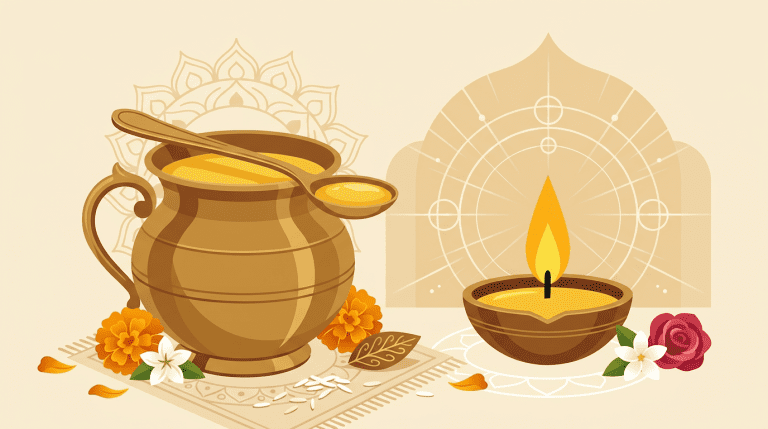
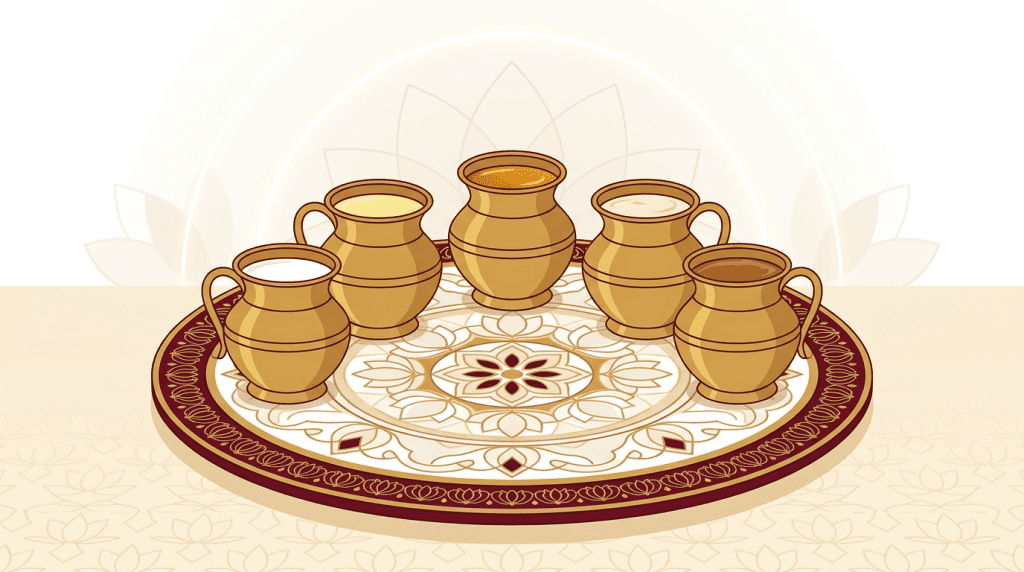
Panchamruta—literally “five nectars” (pancha = five, amruta = nectar)—is one of the most sacred substances in Hindu worship. Composed of five pure ingredients—milk, curd, ghee, honey, and sugar—Panchamruta is used to bathe the deity in a ritual known as Panchamruta Abhisheka. This ancient practice, rooted in Vedic and Puranic tradition, holds a place of special importance in the Madhwa sampradaya.
Sri Madhwacharya’s Tattvavada teaches that worship is not a symbolic exercise. When Panchamruta is poured over the deity’s vigraha (sacred image), Lord Vishnu—who is Svatantra (absolutely independent) and Sarvottama (the Supreme Being)—genuinely receives and accepts the offering. The five nectars represent the finest products of creation offered back to the Creator, and the Lord’s acceptance of them demonstrates His vatsalya (tender affection) for His devotees.
The Five Sacred Ingredients of Panchamruta
Each ingredient of Panchamruta is chosen for its purity, its association with abundance, and its significance in Vedic culture. Together, they create a substance that is greater than the sum of its parts—a divine nectar worthy of bathing the Supreme Lord.
- Ksheera (Milk): Milk represents dharma (righteousness) and purity. It is the first and most fundamental offering, symbolising the nourishing grace of the Lord. The Gopas and Gopis of Vrindavana offered milk to Lord Krishna, establishing an eternal model of loving devotion. In Madhwa philosophy, milk also represents sattvic sustenance—food that elevates the mind and body.
- Dadhi (Curd/Yoghurt): Curd symbolises prosperity and transformation. Just as milk transforms into curd through a natural process, the devotee’s heart is transformed by the Lord’s grace from ignorance to knowledge. Curd is also associated with sowbhagya (good fortune) and is considered indispensable in auspicious ceremonies.
- Ghruta (Ghee/Clarified Butter): Ghee represents tejas (spiritual radiance) and victory. It is the essence of milk, refined through fire—a metaphor for the soul purified through devotion. The Vedas declare ghee as the most sacred of all offerings to the sacred fire, and its inclusion in Panchamruta extends this Vedic sanctity to abhisheka.
- Madhu (Honey): Honey represents the sweetness of divine knowledge and the nectar of the Lord’s words. The Upanishads use the term Madhu Vidya (the knowledge of the honey doctrine) to describe the interconnected sweetness of all creation under the Lord’s sovereignty. Honey in Panchamruta also signifies the sweet fruits of sincere devotion.
- Sharkara (Sugar or Jaggery): Sugar represents ananda (bliss). In the Dvaita understanding, the ultimate goal of the Jiva (individual soul) is to experience the bliss of the Lord’s presence in Vaikuntha. Sugar in Panchamruta symbolises this supreme joy that awaits the devoted soul. Some traditions use jaggery (bella in Kannada) as a more natural alternative.
Scriptural Basis for Panchamruta
The use of Panchamruta in worship finds support across multiple scriptures:
- The Vishnu Purana describes abhisheka with milk, curd, ghee, honey, and sugar as one of the highest forms of worship offered to Lord Vishnu.
- The Bhagavata Purana narrates instances where the Lord is bathed with these sacred substances by devoted worshippers, including the celestial devas.
- Madhwacharya’s Tantrasara Sangraha prescribes the specific method, mantras, and sequence for Panchamruta Abhisheka in both temple and household worship.
- The Skanda Purana states that offering Panchamruta to Lord Vishnu destroys the accumulated sins of many lifetimes and grants the devotee a place in Vaikuntha.
Sri Vyasatirtha, the great Madhwa philosopher who authored the Nyayamruta, emphasised the real efficacy of ritual worship. In Dvaita philosophy, the Lord is not indifferent to worship—He is Bhakta Vatsala (one who cherishes His devotees) and actively receives their offerings. Panchamruta Abhisheka is therefore not a mere ceremony but a genuine interaction between the devotee and the Divine.
How Panchamruta Is Prepared and the Abhisheka Performed
The preparation and performance of Panchamruta Abhisheka follow a specific order prescribed in Madhwa ritual texts:
- Preparation: Each ingredient is sourced fresh and of the highest quality. The milk should be pure cow’s milk, the curd should be homemade, the ghee should be from cow’s milk, the honey should be unprocessed, and the sugar should be natural and unrefined. The five ingredients are either mixed together in a single vessel or kept separate to be poured in sequence.
- Sanctification: Before the abhisheka, the priest performs sankalpa (a formal vow stating the purpose of the worship, the name of the devotee, and the desired blessing). The ingredients are purified with mantras.
- Sequential Bathing: In many Madhwa temples, the ingredients are poured over the deity’s vigraha in a specific sequence—first milk, then curd, ghee, honey, and finally sugar dissolved in water. Each pouring is accompanied by Vedic mantras, Vishnu Sahasranama, or Purusha Sukta chanting.
- Mixed Offering: In some traditions, all five ingredients are mixed together beforehand, and the combined Panchamruta is poured in a continuous stream while mantras are chanted. This method is common in household worship.
- Collection: The Panchamruta that flows over the deity is collected in a vessel placed below. This liquid, now sanctified by contact with the Lord’s vigraha and the power of the mantras, becomes Panchamruta Prasada.
Panchamruta as Prasada: Receiving the Lord’s Grace
The Panchamruta collected after abhisheka is among the most revered forms of prasada in the Madhwa tradition. Devotees receive it with cupped right hands, consume it with reverence, and often touch the remainder to their foreheads and eyes.
In Dvaita philosophy, prasada is not merely food that was “offered and returned.” The Lord, being Svatantra, has genuinely accepted the offering and infused it with His grace. What the devotee receives back is therefore qualitatively transformed—it carries the Lord’s blessing and has the power to purify the body, mind, and soul of the recipient.
Sri Raghavendra Swami of Mantralayam taught that receiving prasada with devotion and gratitude is itself an act of worship. The five nectars, having bathed the Lord, return to the devotee as five-fold blessings: purity (from milk), prosperity (from curd), radiance (from ghee), knowledge (from honey), and bliss (from sugar).
At Shri Bhaavi Sameera Vadiraja Mandira, Panchamruta Abhisheka is performed as a special seva. Devotees can sponsor this sacred bathing ritual for the Lord and receive the sanctified Panchamruta as prasada—a tangible connection to the divine grace of Sri Hari.
Frequently Asked Questions
What are the five ingredients of Panchamruta and what do they symbolise?
Panchamruta consists of milk (purity and dharma), curd (prosperity and transformation), ghee (spiritual radiance and Vedic sanctity), honey (sweetness of divine knowledge), and sugar or jaggery (bliss and divine joy). Together, they represent the finest products of creation offered back to the Supreme Lord. In the Madhwa tradition, each ingredient carries both material purity and spiritual significance.
How does Lord Vishnu actually receive the Panchamruta offering in Dvaita philosophy?
In the Dvaita philosophy of Madhwacharya, Lord Vishnu is Svatantra (absolutely independent) and Sarvajna (all-knowing). He is genuinely present in the vigraha (sacred image) consecrated with proper Vedic mantras. When Panchamruta is poured over the deity, the Lord truly accepts the offering through His divine will. This is not a metaphor or a psychological exercise—the Lord’s acceptance is real, and the prasada that returns to the devotee is genuinely sanctified by His grace.
When is Panchamruta Abhisheka typically performed?
Panchamruta Abhisheka can be performed on any day, but it is especially significant on Ekadashi (the eleventh lunar day sacred to Lord Vishnu), during Vaikuntha Ekadashi, on the Lord’s appearance days (Janmashtami, Rama Navami), and during temple festival celebrations. At Shri Bhaavi Sameera Vadiraja Mandira, devotees can sponsor Panchamruta Abhisheka on any day of their choosing.
Can Panchamruta Abhisheka be performed at home?
Yes, Panchamruta Abhisheka can be performed at home as part of household worship. The five ingredients should be fresh and pure, and the abhisheka should be performed on a properly consecrated Shaligrama or deity image. Madhwa households typically perform this on special occasions, following the guidelines in Madhwacharya’s Tantrasara Sangraha. For elaborate abhisheka with full Vedic chanting, temple sevas are recommended.
Is it safe to consume Panchamruta prasada?
Yes. Panchamruta is made entirely from natural, edible ingredients—milk, curd, ghee, honey, and sugar. After the abhisheka, it is collected in clean vessels and distributed fresh. It is both a sacred prasada and a wholesome, nutritious substance. Devotees consume it in small quantities as a blessing. In the Madhwa tradition, Panchamruta prasada is considered to have healing and purifying properties for body and soul.
Panchamruta Abhisheka is one of the most beautiful and meaningful rituals in Vaishnava worship—a five-fold offering of creation’s finest to the Creator Himself. By sponsoring this seva, you offer the Lord the nectar of your devotion and receive His grace in return. Book Panchamruta Abhisheka at Shri Bhaavi Sameera Vadiraja Mandira and experience the transformative power of this ancient ritual. Explore all sacred sevas to discover the full range of worship services offered at the mandira.