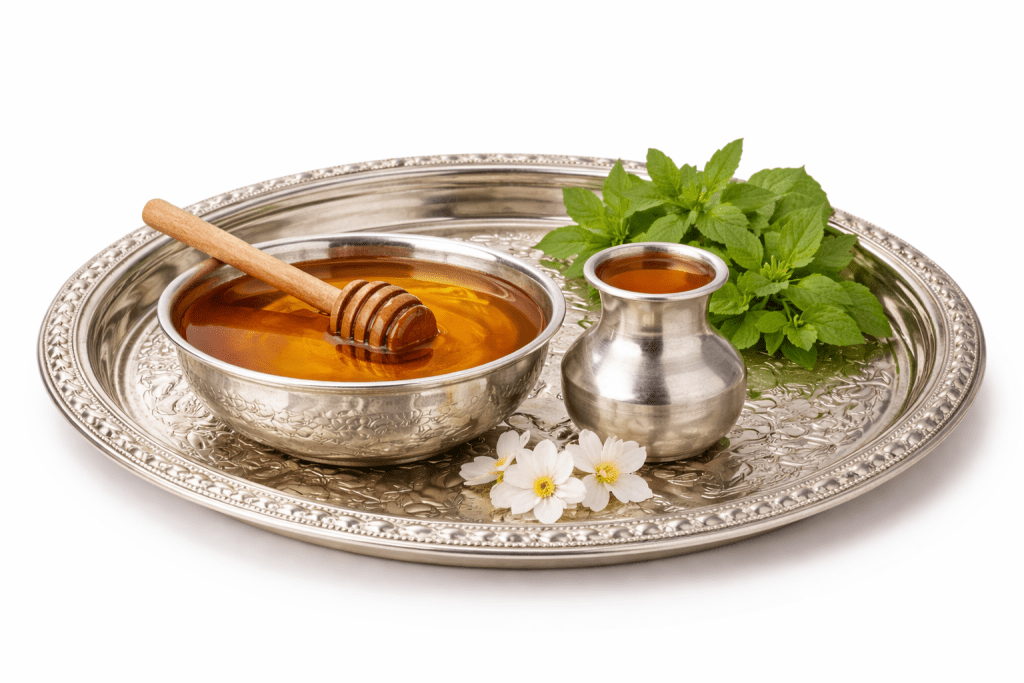
Madhu Abhisheka — the sacred ritual bath with pure honey — is one of the most beloved and spiritually resonant forms of Abhisheka (divine bathing) offered at Shri Vadiraja Mandira, Chintamani. Honey, or Madhu in Sanskrit, is a substance revered across Vedic literature as a symbol of divine sweetness, universal interconnectedness, and the ultimate reality of bliss. When honey is ceremonially poured over the deity with appropriate Vedic mantras, the ritual creates a moment of profound communion between the sweetness of nature and the divine source of all sweetness.
The Rigveda contains the Madhu Sukta — one of its most beautiful hymns — which begins: “Madhu vata ritayate, madhu ksharanti sindhavah” — “The winds blow sweetness, the rivers flow sweetness.” This hymn celebrates honey as the embodiment of the cosmic principle that pervades and sweetens all of creation. Honey bees, the Vedic sages noted, travel great distances to gather nectar from thousands of flowers before distilling it into the single perfection of honey — an act that mirrors the spiritual path itself, where wisdom is gathered from diverse sources before being distilled into the nectar of realisation.
The Brihadaranyaka Upanishad contains the famous Madhu Vidya (Honey Doctrine), which teaches that “this earth is the honey for all beings, and all beings are the honey for this earth.” The doctrine extends this sweetness-interdependence to all elements — fire and the vital force, water and semen, wind and breath — culminating in the teaching that the cosmic Self (Atman) is the ultimate honey, the supreme sweetness that underlies all existence. Offering Madhu in Abhisheka is thus an act that resonates with this deepest Upanishadic teaching.
Honey in Panchamruta and Temple Tradition
Honey is one of the five sacred nectars in Panchamruta Abhisheka — the ritual that combines milk, curd, honey, ghee, and sugar. Within the Panchamruta, honey represents synthesis and the gathering of wisdom from diverse sources. When Madhu Abhisheka is performed as a standalone offering, this quality of synthesis and sweetness is concentrated entirely — rather than being one element among five, honey becomes the sole medium of the entire Abhisheka, intensifying its specific qualities of sweetness, healing, and nourishment.
In the Madhwa temple tradition, Madhu Abhisheka is described as particularly pleasing to Lord Hayagreeva — the deity of knowledge and learning who presides over Shri Vadiraja Mandira alongside Vadirajaru. Hayagreeva is the divine form who revealed the sweetness of the Vedas and Upanishads to the sages, making honey a symbolically perfect offering to him. Many families sponsor Madhu Abhisheka specifically for students appearing for competitive examinations, creative persons seeking inspiration, and devotees praying for eloquence in speech and depth in learning.
How Madhu Abhisheka is Performed at Shri Vadiraja Mandira
The ritual begins with the Sankalpa, where the priest formally declares the devotee’s name, gothra, and intention before the deity. Pure, unadulterated honey is then prepared in a consecrated vessel. The archaka recites the appropriate Vedic mantras — including selections from the Madhu Sukta and the Vishnu Sahasranama — while slowly and respectfully pouring the honey over the deity from head to feet. The honey is allowed to coat the divine form, symbolising the complete immersion of the devotee’s prayer in divine sweetness.
After the honey Abhisheka, the deity is bathed with pure water to cleanse, and then reclothed in fresh garments and adorned with flowers. The Madhu Abhisheka typically takes 30–45 minutes. The honey that has flowed over the deity — now Madhu Prasada — is collected, mixed with fresh honey if needed, and made available to devotees.
Spiritual and Healing Benefits of Madhu Abhisheka
Honey is described in Ayurveda as a Rasayana — a rejuvenating substance that promotes longevity, enhances intelligence (Medhya), heals the respiratory tract, and purifies the blood. When honey sanctified by Vedic mantras is received as Prasada, these physical properties are said to be amplified by the divine blessing embedded in the offering. Devotees who receive Madhu Prasada and consume it are said to receive both physical and spiritual healing simultaneously.
Specifically, Madhu Abhisheka is recommended for: students seeking improvement in learning capacity and academic performance; individuals with speech difficulties or who seek eloquence; artists, writers, and musicians seeking creative flow; those experiencing bitterness in relationships (the sweetness of honey symbolically dissolves bitterness); and families where chronic disagreements create discord (offering honey to the deity and receiving it as Prasada is believed to “sweeten” household relationships).
Book your Madhu Abhisheka Seva at Shri Vadiraja Mandira today and experience the cosmic sweetness of divine communion. If you wish to experience all five sacred nectars together, consider the Panchamruta Abhisheka.
What is the significance of honey specifically in Lord Vishnu worship?
Honey represents Bhakti Rasa — the nectar of devotion — in the Vaishnava tradition. Just as honey is the concentrated essence of countless flowers, Bhakti is the concentrated essence of all spiritual practices. Offering honey to Vishnu and his associated forms symbolises the devotee’s aspiration to develop this sweetness of devotion. The Srimad Bhagavatam describes the nectar of divine love as being sweeter than honey, and the Madhu Abhisheka enacts this metaphor concretely.
Is the Madhu Prasada safe to consume? How should it be used?
Yes. The Madhu Prasada from this Abhisheka is pure honey that has been sanctified by contact with the consecrated deity and Vedic mantras. Consume a small portion (1–2 teaspoons) with reverence on the day of receipt. Honey should not be heated, mixed with hot water, or given to children under one year. For those with diabetes, consume in very small ritual quantities only, in consultation with your doctor.
On what occasions is Madhu Abhisheka most commonly booked?
Madhu Abhisheka is popularly booked for: Vidyarambha (beginning of formal education for a child); Saraswati Pooja; before major examinations; Akshaya Tritiya; Vishnu Jayanthi; and when the Moon is in Rohini Nakshatra (considered especially sweet and auspicious). Some devotees book it on Panchami tithi, resonating with the five-nectar tradition of the Panchamruta.
Can Madhu Abhisheka be combined with other sevas on the same day?
Yes. Madhu Abhisheka pairs beautifully with Pushpalankara (flower decoration after the bath) and Deeparadhane (lamp offering at the culmination). Booking these together creates a complete sensory worship experience — the sweetness of honey, the beauty of flowers, and the warmth of lamps all in one divine encounter. For a comprehensive day of worship, the Sarva Seva package bundles multiple offerings.
Immerse the Lord in sweetness — book Madhu Abhisheka Seva at Shri Vadiraja Mandira, Chintamani today.