If Ekadashi is the foundation of Vaishnava fasting, then Dwadashi — the twelfth day of the lunar fortnight — is its essential counterpart. In the Madhwa tradition, the rules governing Dwadashi Parane (the breaking of the Ekadashi fast) are just as precise and binding as the rules of the fast itself. Shri Madhwacharya’s Krishnamruta Maharnava devotes substantial verses to Dwadashi, warning that an improperly broken fast can nullify the entire merit of Ekadashi observance. Understanding Dwadashi is therefore not optional — it is an integral part of correct Ekadashi practice.
At Shri Bhaavi Sameera Vadiraja Mandira, Chintamani, the archakas (temple priests) guide devotees on Parane timing for every Ekadashi, ensuring that the sacred fast is completed correctly. This guide covers the Dwadashi rules in detail — timing, sequence, permitted foods, and the spiritual significance of this often-overlooked day.
What Is Dwadashi?
Dwadashi literally means “the twelfth” — it is the twelfth tithi (lunar day) of each fortnight. Since Ekadashi is the eleventh tithi, Dwadashi always follows Ekadashi. In the Vaishnava calendar, every Dwadashi is intrinsically linked to the preceding Ekadashi; the two form an inseparable pair. Fasting on Ekadashi without correctly breaking the fast on Dwadashi is considered incomplete, and the Krishnamruta Maharnava states that such negligence can even accrue sin rather than merit.
The word Parane (also spelled Paarane or Paarana) refers specifically to the ritual breaking of a fast. In Sanskrit, it derives from paarana, meaning “completion” or “fulfilment.” The Parane on Dwadashi is the fulfilment of the Ekadashi vrata — without it, the vow remains unfulfilled.
Parane Timing: The Critical Window
The most crucial aspect of Dwadashi observance is timing. The Madhwa tradition, drawing from the Krishnamruta Maharnava and the Dharma Sindhu, prescribes a specific window during which the fast must be broken. Missing this window is considered a serious transgression.
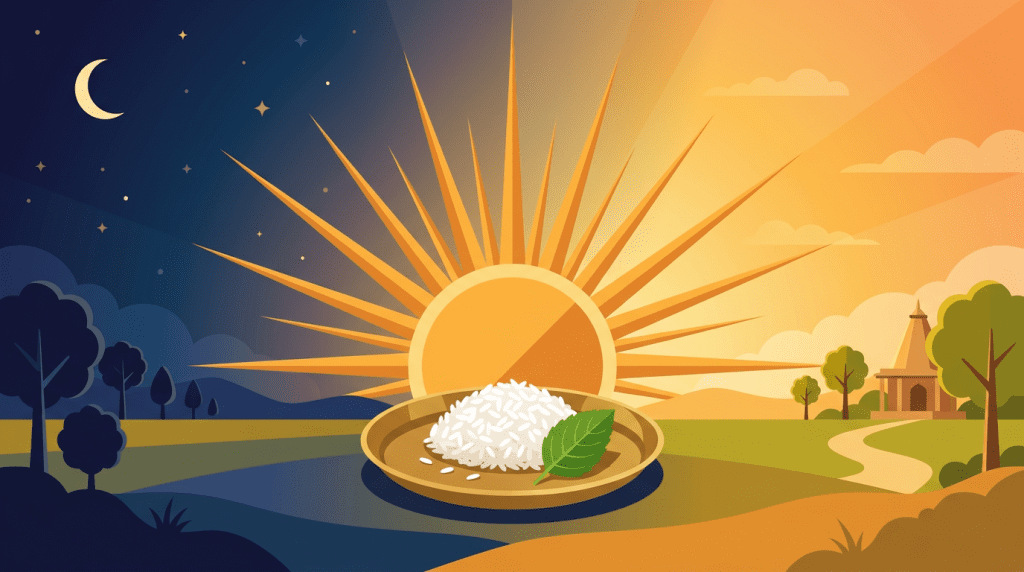
The general rule: Parane must be done after sunrise on Dwadashi morning and before the Dwadashi tithi ends. However, the precise window is narrower than this. The fast should ideally be broken during the Hari Vasara period — the auspicious span after sunrise when Dwadashi tithi is active. If Dwadashi ends before a certain time in the morning, the Parane window may be extremely short — sometimes only thirty to sixty minutes.
Key timing principles per Madhwa tradition:
- Parane must occur after completing the morning Sandhyavandana and Devara Pooja on Dwadashi morning.
- The Krishnamruta Maharnava instructs that one should not delay Parane beyond the prescribed time for the sake of convenience, social engagements, or work. Spiritual obligation takes precedence.
- If Dwadashi tithi ends very early in the morning (before sunrise), the Parane should still be done as early as possible after sunrise, following the panchanga (almanac) guidelines for that specific day.
- Consulting a reliable Madhwa panchanga or the temple priest is essential for determining the exact Parane time for each Ekadashi–Dwadashi cycle, as the window varies with every occurrence.
At Shri Vadiraja Mandira, the Parane time is announced to devotees before each Ekadashi, and the temple follows the panchanga compiled by respected Madhwa scholars. Devotees who book sevas for Ekadashi can also receive guidance on Parane timing from the temple office.
What to Eat First When Breaking the Fast
The sequence of foods consumed during Parane is prescribed in the Dharma Shastras and reiterated in Madhwa practice:
- Begin with Tirtha (sacred water): The first substance to enter the devotee’s body should be Tirtha — sanctified water, ideally from the temple. If temple Tirtha is unavailable, water sanctified with Tulasi leaves during the morning Devara Pooja serves the purpose.
- Consume Phala (fruit) or a light offering: A small piece of fruit or a simple Naivedya item is consumed next. Banana or dry dates are common choices.
- Follow with a grain-based meal: After the initial Tirtha and fruit, the full meal containing grains (rice, roti, etc.) can be consumed. This meal should be freshly prepared, offered to the deity as Naivedya, and then eaten. Stale food or leftovers from the previous day should never be used for Parane.
The principle underlying this sequence is that the body, purified by the Ekadashi fast, should be re-nourished in a sacred and gradual manner — from the subtlest substance (Tirtha) through fruit to full nourishment. Rushing directly to a heavy meal is considered disrespectful to the vrata.
What to avoid during Parane:
- Do not consume non-vegetarian food, onion, or garlic during Parane. (Madhwa families avoid these permanently, but even those from less strict backgrounds should observe this during Parane.)
- Do not eat at a restaurant or eat food prepared by someone who has not observed Ekadashi, if possible. The ideal is food cooked at home by a family member who maintained the fast.
- Avoid excessive eating. Parane is a sacred act, not a compensation for the previous day’s hunger. Moderation and gratitude should characterise the meal.
Consequences of Missing the Parane Window
The Krishnamruta Maharnava is unambiguous about the seriousness of missing Parane. The text states that failing to break the fast within the prescribed Dwadashi window is equivalent to not having fasted at all. In some verses, the consequence is described as even more severe — the devotee not only loses the merit of Ekadashi but accumulates the sin of violating a sacred vow.
This strict position exists because the Ekadashi-Dwadashi pair is a complete ritual unit. The fast is the tapas (austerity); the Parane is the completion of the vow. An incomplete vow is a broken promise to the Lord, and the Shastras treat broken vows with gravity. Shri Jayatirtha, the great commentator on Madhwacharya’s works, emphasises this point in his Nyaya Sudha — the vow of Ekadashi includes the commitment to perform Parane correctly.
For this reason, practical Madhwa families take Dwadashi timing very seriously. Many set alarms for the Parane window. Families with elderly or ill members prepare the Parane meal the evening before and keep it ready so that the fast can be broken promptly. Some families keep dates, bananas, and Tulasi Tirtha beside the bed so that the first thing consumed upon waking is within the Parane framework.
Dwadashi Vrata and Special Dwadashi Observances
While Dwadashi is most commonly understood as the Parane day following Ekadashi, certain Dwadashis carry their own vrata status:
Utthaana Dwadashi: Falling in Kartika Shukla Paksha, this Dwadashi marks the day Lord Vishnu awakens from His Yoga Nidra (cosmic sleep). It concludes the Chaturmasa period and is celebrated with Tulasi Vivaha at Shri Vadiraja Mandira.
Vaikunta Dwadashi: The Dwadashi following Vaikunta Ekadashi, when the Parane is performed with particular celebration. The Parane meal on this day traditionally includes special dishes prepared with devotion and offered to the Lord.
Saphala Dwadashi, Putrada Dwadashi: Certain Dwadashis in specific months carry names and vrata traditions described in the Padma Purana. While these are less commonly observed as standalone vratas in the Madhwa tradition, awareness of their existence enriches the devotee’s understanding of the lunar calendar.
The Ekadashi-Dwadashi Connection: A Complete Spiritual Cycle
Shri Vyasatirtha, the great Madhwa philosopher-saint, taught that Ekadashi and Dwadashi together represent a microcosm of the soul’s journey. The fast represents vairagya (detachment) — the jiva temporarily renouncing bodily sustenance to focus entirely on the Lord. The Parane represents prasada — the Lord’s grace returning to nourish and sustain the devotee. Just as liberation (moksha) in Dvaita Vedanta is not the annihilation of the self but the jiva’s eternal, blissful service to the Lord in Vaikunta, the Parane is not the “end” of spiritual practice but its fruition — the devotee is nourished by God’s grace to continue serving with renewed strength.
This understanding transforms Dwadashi from a mere practical necessity into a profoundly meaningful spiritual moment. When you break your fast with Tirtha and Naivedya, you are not simply eating after a day of hunger — you are receiving the Lord’s prasada with the humility and gratitude of a soul that has been purified by tapas.
For devotees who wish to enhance their Ekadashi-Dwadashi observance, booking a seva at Shri Vadiraja Mandira ensures that a qualified archaka performs worship on your behalf during this sacred cycle. The Hastodaka Seva is particularly recommended on Ekadashi-Dwadashi, as the Neivedyam offered to the Yati Vrundavanas becomes your Parane prasada — sanctified by the entire parampara.
What if Ekadashi and Dwadashi tithis overlap or are very short?
Hindu tithis are based on the angular distance between the Sun and Moon and can vary in duration from approximately 20 to 27 hours. Occasionally, Ekadashi or Dwadashi may be very short (called “kshaya tithi”) or may overlap with adjacent tithis. In such cases, the Madhwa panchanga provides specific rules — sometimes the fast is observed on a different day than expected (called “Smartha” and “Vaishnava” Ekadashi). Always follow the Madhwa panchanga rather than a generic calendar, as the calculations differ by tradition.
Can Parane be done with just water, or must I eat food?
Parane requires consumption of food — specifically, Tirtha followed by a grain-based meal. Simply drinking water does not constitute Parane. The Krishnamruta Maharnava is clear that the fast must be broken with the specific sequence of Tirtha, fruit, and grains. If health conditions prevent eating solid food, consult a learned Madhwa priest for guidance on alternative Parane methods.
Should I perform Parane before going to work or office?
Yes. Parane takes priority over all secular obligations. The Krishnamruta Maharnava instructs that missing the Parane window for worldly reasons is a violation of the vrata. Practical steps include waking earlier on Dwadashi, keeping the Parane meal simple and quick to prepare, or preparing components the previous evening. Many working devotees complete Sandhyavandana, Devara Pooja, and Parane within sixty to ninety minutes of waking, leaving adequate time for their professional schedules.
Is there a specific mantra to recite during Parane?
Before consuming the first morsel, the devotee recites the sankalpa declaring the completion of the Ekadashi vrata. The specific wording varies by family tradition, but the essence is: “I am breaking this fast on Dwadashi as prescribed by the Shastras, having observed Ekadashi in honour of Lord Vishnu.” Many families also recite the Brahmarpanam mantra from the Bhagavad Gita (Chapter 4, Verse 24) before eating, as is standard Madhwa practice before all meals.
Complete your Ekadashi-Dwadashi cycle with the full blessings of the parampara. Book a seva at Shri Vadiraja Mandira and receive consecrated prasada to make your Parane truly sacred.
Explore all sacred sevas: Visit our Seva Booking page to discover the complete range of poojas, abhishekas, and archane offerings at Shri Bhaavi Sameera Vadiraja Mandira, Chintamani.