
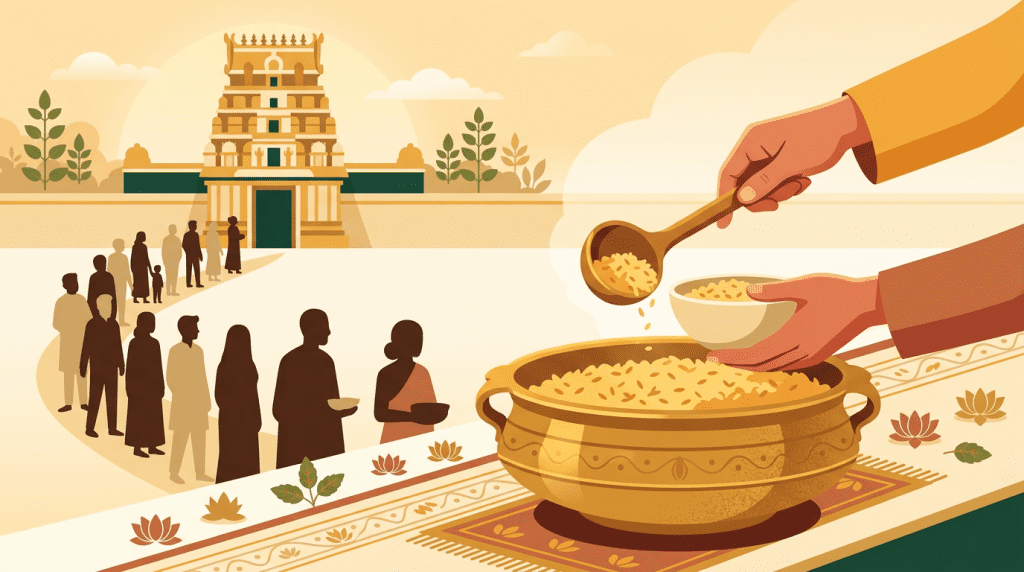
Of all forms of charity prescribed in Hindu scripture, Annadana — the gift of food — stands supreme. The Taittiriya Upanishad proclaims: “Annam Brahmeti Vyajanaat” — “Know that food is Brahman (the Divine).” This is not a metaphor. In the Madhwa Vaishnava understanding, food is a direct manifestation of Lord Vishnu’s sustaining power — it is the medium through which the Lord nourishes and maintains all living beings. Giving food to the hungry is therefore not merely a social service or an act of compassion; it is a form of worship, a participation in God’s own function of sustaining creation.
At Shri Bhaavi Sameera Vadiraja Mandira, Chintamani, Annadana is a daily practice — not a special event. The temple feeds devotees, visitors, and the needy every day as part of its dharmic mission. Through the Ruju Yogi Foundation, devotees worldwide can sponsor Annadana and share in this highest of charities.
Scriptural Basis for Annadana
The authority for Annadana’s supreme status is drawn from multiple Vedic and Puranic sources:
Taittiriya Upanishad: The Bhrigu Valli of this Upanishad contains one of the most celebrated passages on food: “Annam na nindhyaat. Tat Vratam. Annam na parichakshita. Tat Vratam. Annam bahu kurvita. Tat Vratam.” — “Do not condemn food. That is the vow. Do not reject food. That is the vow. Produce food in abundance. That is the vow.” This triple injunction — do not waste food, do not refuse food to the hungry, and produce food generously — establishes the sacred framework within which Annadana operates. In Madhwa interpretation, these injunctions are commands from Lord Vishnu Himself, embedded in the Veda for the guidance of all souls.
Bhagavata Purana: The Bhagavata describes how King Rantideva attained the highest realms through his unwavering practice of Annadana — despite facing extreme personal deprivation, he never turned away a hungry guest. Shri Madhwacharya, in his commentary, emphasises that Rantideva’s greatness lay not merely in his generosity but in his understanding that feeding a hungry person was feeding the Lord who resided within that person. This is the Dvaita principle of Antaryami (the Lord as the inner dweller) applied to charity.
Mahabharata (Anushasana Parva): Bhishma declares to Yudhishthira: “Annadaanaat Param Daanam Na Bhutam Na Bhavishyati” — “There has never been, nor will there ever be, a charity greater than Annadana.” This unequivocal statement, from the deathbed discourse of the greatest warrior-sage, establishes Annadana permanently at the apex of all charitable acts. Shri Madhwacharya’s Mahabharata Tatparya Nirnaya gives special attention to this passage, confirming that the merit of Annadana exceeds even Go-Dana (cow donation) and Bhoo-Dana (land donation) in certain contexts.
Vishnu Purana: The Vishnu Purana states that the merit of Annadana performed with devotion and without expectation of return is inexhaustible. It protects the donor from the effects of past sins, ensures prosperity in this life, and secures a favourable rebirth leading toward moksha.
Annadana as the Highest Daana
Hindu scripture recognises many forms of daana (charitable giving): Vidya-Dana (gift of knowledge), Aushadha-Dana (gift of medicine), Abhaya-Dana (gift of fearlessness), Vastra-Dana (gift of clothing), Go-Dana (gift of cows), Bhoo-Dana (gift of land), and Annadana (gift of food). Among all these, Annadana is repeatedly placed at the summit. The logic is both spiritual and practical:
- Universality: Every living being needs food. While knowledge, medicine, or land may be needed by some, food is needed by all. Annadana therefore serves the widest possible range of recipients.
- Immediacy: The benefit of food is immediate — a hungry person is nourished instantly. This directness of impact gives Annadana a unique potency.
- Connection to Prana: Food sustains Prana (life force). In Madhwa theology, Prana is governed by Mukhya Prana (Lord Vayu), who is the direct servant and instrument of Lord Vishnu. Feeding the hungry is therefore sustaining the very force through which Vishnu maintains life.
- Sarva-Devata Priti: Because all deities reside in the digestive fire (Vaishvanara Agni) of every being, food offered to a hungry person is implicitly offered to all deities simultaneously. This makes Annadana a universal yajna (sacrifice).
Types of Annadana
Annadana can be performed in several ways, each carrying its own merit:
Nitya Annadana (Daily Temple Feeding): This is the most meritorious form — maintaining a daily feeding programme at a temple or dharmic institution where anyone can eat without discrimination. At Shri Vadiraja Mandira, Nitya Annadana ensures that every visitor and devotee who comes for darshana receives a sattvic meal. The food is first offered as Naivedya to Lord Hayagreeva, then distributed as prasada, making every meal a sacred act.
Utsava Annadana (Festival Feeding): Large-scale community feeding during festivals — Krishna Janmashtami, Vadiraja Jayanti, Vaikunta Ekadashi — where hundreds or thousands of devotees are fed. The merit of festival Annadana is multiplied by the auspiciousness of the occasion.
Naivedya-Based Annadana: In the Madhwa tradition, all temple food is first offered to the deity as Naivedya before being distributed. This means that Annadana at a Madhwa temple is qualitatively different from secular feeding — the food has been sanctified by divine contact and carries spiritual potency beyond mere nutrition.
Pitru Annadana: Feeding Brahmins or the needy in the name of departed ancestors is a powerful form of Pitru Tarpana (ancestral propitiation). The Vishnu Purana states that Annadana performed during Pitru Paksha (the ancestral fortnight) reaches the departed directly and grants them peace in the higher realms.
How Annadana Works at Vadiraja Mandira
The Annadana programme at Shri Vadiraja Mandira operates daily, combining tradition with devotion:
- Kitchen preparation: The temple kitchen team prepares fresh, sattvic vegetarian food every day. The menu is simple yet nourishing — rice, sambar, rasam, vegetable preparations, and a sweet dish — prepared without onion, garlic, or tamasic ingredients per Madhwa dietary standards.
- Naivedya offering: Before distribution, the food is offered as Naivedya to Lord Hayagreeva and the Panchavrundavana of Shri Vadirajaru. The archaka priest performs the offering with Vedic mantras, transforming the food into prasada.
- Distribution: Devotees, visitors, and anyone in need sit together and are served with respect and care. In the Madhwa Annadana tradition, the server is considered as important as the cook — both are performing service to the Lord by serving His devotees.
- Sankalpa for sponsors: For devotees who have sponsored Annadana online, the archaka takes a specific sankalpa in their name before the Naivedya offering, ensuring that the merit of the entire day’s feeding accrues to the sponsor and their family.
To sponsor a day’s Annadana at the temple, book Annadana Seva online.
Spiritual Benefits of Annadana per Madhwa Tradition
Shri Vyasatirtha, the great philosopher-saint of the Madhwa tradition, taught that Annadana is the one dharmic act that generates merit in all three worlds simultaneously — Bhu Loka (earth), Pitru Loka (ancestral realm), and Deva Loka (divine realm). The specific benefits enumerated in the Puranas include:
- Destruction of accumulated sins from past births
- Ancestral propitiation — feeding the hungry on earth feeds one’s ancestors in the higher realms
- Protection from poverty and financial difficulties in future births
- Earning the grace of all deities who reside in the Vaishvanara Agni of the fed person
- Progress toward moksha when performed with devotion and without expectation of worldly return
Shri Raghavendra Swami, the revered saint of Mantralaya, made Annadana a cornerstone of his mission. He established feeding programmes at his Matha that continue to this day — feeding thousands daily. His teaching was clear: “He who feeds one hungry person has performed a hundred yajnas.”
Annadana and Pitru Tarpana
The connection between Annadana and ancestral wellbeing is particularly strong in the Madhwa tradition. During Pitru Paksha (Mahalaya Paksha — the sixteen-day period dedicated to ancestors), performing Annadana at a temple is considered one of the most effective Pitru Tarpana acts. The Garuda Purana states that ancestors who are suffering in lower realms can be elevated through the merit generated by Annadana performed in their name. Many Madhwa families sponsor Annadana at Shri Vadiraja Mandira during Pitru Paksha specifically for this purpose.
Beyond Pitru Paksha, any Annadana performed on Amavasya (new moon), Ekadashi, or the death anniversary (Tithi) of a departed family member carries enhanced ancestral merit. Combining Annadana with Gau Grasa Seva creates a powerful dual offering that addresses both the ancestral and divine dimensions simultaneously.
Who can sponsor Annadana at Vadiraja Mandira?
Anyone — regardless of location, background, or tradition — can sponsor Annadana. The Annadana Seva is available for online booking with delivery of prasada to the sponsor. Families, individuals, corporate groups, and NRI devotees regularly sponsor Annadana for occasions ranging from birthdays and anniversaries to memorial days for departed family members.
Is Annadana more meritorious on certain days?
Yes. Annadana performed on Ekadashi, Dwadashi, Amavasya, Pournami, Mahalaya Paksha, solar and lunar eclipse days, Sankranti, and festival days carries multiplied merit per Puranic injunction. However, the Mahabharata also states that Annadana performed on any ordinary day with devotion and without ostentation is immensely meritorious. The consistency of daily Annadana is considered superior to occasional grand feeding events.
Can I sponsor Annadana for a deceased family member?
Yes, and this is one of the most beautiful applications of Annadana. When booking, specify the deceased family member’s name and tithi (death anniversary date) in the sankalpa details. The archaka will take the sankalpa specifically for the departed soul’s upliftment. The merit of the Annadana reaches the deceased directly, per the Garuda Purana’s assurance. Many families make this an annual practice — sponsoring Annadana on the tithi of departed parents or grandparents.
How is Annadana different from running a soup kitchen or charity meal?
Secular charity feeding is a noble act, but temple Annadana in the Madhwa tradition carries an additional spiritual dimension: the food is first offered to God as Naivedya, transforming it into prasada before distribution. This means the person being fed receives not just nutrition but divine grace embedded in the food. The sankalpa recited by the archaka creates a specific spiritual connection between the sponsor, the deity, and the recipients. This three-way sacred transaction is what elevates Annadana from social service to spiritual worship.
Join the timeless tradition of feeding the hungry in God’s name. Book Annadana Seva at Shri Bhaavi Sameera Vadiraja Mandira, Chintamani, and participate in the highest charity known to Hindu scripture.
Explore all sacred sevas: Visit our Seva Booking page to discover the complete range of poojas, abhishekas, and archane offerings at Shri Bhaavi Sameera Vadiraja Mandira, Chintamani.