In the Vaishnava tradition, few sacred elements hold the exalted status that Tulasi (holy basil, Ocimum tenuiflorum) commands. Revered as the physical manifestation of Vrinda Devi, a beloved devotee and consort of Lord Vishnu, Tulasi occupies a singular place in daily worship, temple rituals, and household devotion. No offering to Lord Vishnu—whether a simple prayer at home or an elaborate temple abhisheka—is considered complete without the presence of Tulasi leaves.
Sri Madhwacharya, the propounder of Tattvavada (the philosophy of reality as it truly is), emphasised the indispensable role of Tulasi in Vishnu aradhana. In the Madhwa sampradaya, every act of worship—from the morning Sandhyavandana to the evening Naivedya—draws upon Tulasi as a sacred link between the devotee and the Supreme Lord, Sri Hari.
Vrinda Devi: The Divine Origin of Tulasi
The Padma Purana narrates the sacred history of Tulasi in detail. Vrinda Devi, a devoted woman of extraordinary piety, performed intense tapas (austerity) seeking the grace of Lord Vishnu. Pleased by her unwavering devotion, the Lord granted her the boon of eternal proximity to Him. She manifested as the Tulasi plant, and since that time, Lord Vishnu has declared that He does not accept any offering that lacks Tulasi.
The Skanda Purana reinforces this, stating: “Tulasi is dear to Keshava. Any worship offered with Tulasi leaves grants immeasurable punya (merit).” This is not merely a symbolic association. In Dvaita philosophy, as taught by Madhwacharya, the relationship between the Lord and His devotees is real and eternal. Vrinda Devi’s presence as Tulasi is a genuine divine manifestation—Hari sarvottama (Vishnu is supreme) and His devotees hold their eternal, distinct identities in His service.
Sri Vadiraja Tirtha, the great Madhwa saint who established the sacred tradition at Sode and whose legacy continues at Shri Bhaavi Sameera Vadiraja Mandira in Chintamani, composed verses glorifying Tulasi as the most sacred of all plants, worthy of daily veneration.
Why Tulasi Is Dear to Lord Vishnu
Several Puranic and Vedic references establish why Tulasi holds unparalleled favour with Lord Vishnu:
- Eternal Devotion: Tulasi represents the ideal of nishkama bhakti (selfless devotion). Vrinda Devi sought nothing but the Lord’s presence, and her form as Tulasi embodies that complete surrender.
- Purifying Power: The Padma Purana states that the mere sight of Tulasi destroys accumulated sins, and water sanctified with Tulasi leaves becomes Vishnu Tirtha—as sacred as pilgrimage waters.
- Fragrance Pleasing to Hari: The natural fragrance of Tulasi is said to be especially pleasing to Lord Vishnu. Offering Tulasi leaves upon the lotus feet of the Lord’s vigraha (sacred image) is considered the highest form of pushpa (floral) offering.
- Scriptural Mandate: The Skanda Purana declares, “Where Tulasi grows, that place is a tirtha. Where Tulasi is offered, there Lord Vishnu resides.”
In the Madhwa understanding, these are not poetic metaphors. Lord Vishnu, being Svatantra (absolutely independent), genuinely accepts the offerings made with devotion and Tulasi. The Jiva (individual soul), being eternally dependent on Hari, expresses that dependence through acts like Tulasi offering.
Tulasi in Daily Madhwa Worship
In every Madhwa household and matha (monastery), Tulasi is integral to the daily worship routine:
- Morning Pooja: Fresh Tulasi leaves are plucked with reverence (never with nails or after sunset) and placed on the Naivedya, on the Lord’s feet, and in the Tirtha (sacred water).
- Tulasi Tirtha: Water in which Tulasi leaves have been immersed overnight becomes sacred Tirtha, consumed by devotees as prasada each morning.
- Tulasi Mala: Devotees wear necklaces made from Tulasi wood (Tulasi Kashi), signifying their identity as Vaishnavas and their surrender to Lord Vishnu.
- Naivedya: No food offering to the Lord is presented without Tulasi. Madhwacharya’s Tantrasara Sangraha prescribes Tulasi as mandatory in all forms of Naivedya.
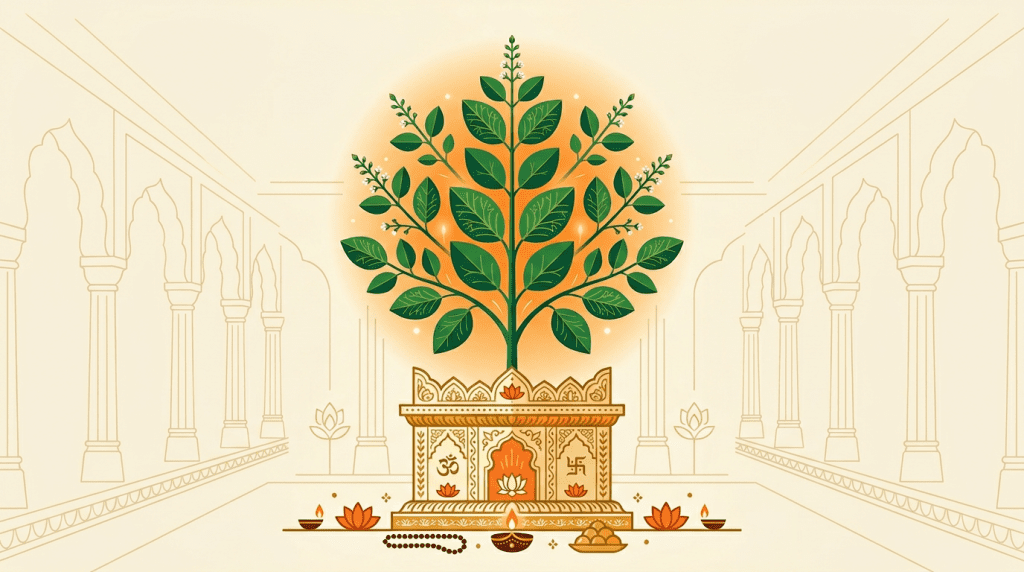
The tradition of maintaining a Tulasi Brindavana (a raised platform for the Tulasi plant) in front of the house is a hallmark of Madhwa households. Evening prayers often include lighting a lamp near the Tulasi plant and offering prostrations.
Growing and Caring for Tulasi at Home
Maintaining a Tulasi plant at home is considered a sacred duty in Vaishnava households. Here are the traditional guidelines:
- Placement: The Tulasi Brindavana should ideally face east or north, in a clean and well-lit area, preferably near the entrance of the home.
- Watering: Tulasi should be watered every morning after bathing. The water used should be clean, and devotees often recite Vishnu Sahasranama or Tulasi stotras while tending to the plant.
- Plucking Leaves: Leaves should be plucked gently in the morning hours, using the fingertips (not nails). Plucking is avoided on Dwadashi (the twelfth lunar day), Sundays, and certain festival days as per Madhwa tradition.
- Lighting Lamps: A ghee or oil lamp lit near Tulasi in the evening is a cherished practice that invites auspiciousness into the home.
Sri Raghavendra Swami, the great Madhwa saint of Mantralayam, is known to have emphasised that a home with Tulasi and regular Vishnu pooja becomes a miniature temple—a place where the Lord’s grace flows unimpeded.
Tulasi Vivaha and Scriptural Celebrations
Tulasi Vivaha, the ceremonial marriage of Tulasi to Lord Vishnu (in His form as Shaligrama), is observed on the Dwadashi of Kartika Shukla Paksha. This festival marks the end of Chaturmasa and the beginning of the wedding season in Hindu tradition.
In Madhwa mathas and temples, Tulasi Vivaha is celebrated with great devotion. The Shaligrama stone—a naturally formed sacred stone representing Lord Vishnu—is ceremonially married to Tulasi with Vedic mantras, floral decorations, and offerings of Naivedya. The event signifies the eternal bond between the Lord and His devoted consort Vrinda Devi.
The Skanda Purana states that performing or witnessing Tulasi Vivaha grants the merit equivalent to Kanya Dana (the sacred act of giving a daughter in marriage) and ensures Vishnu’s blessings upon the family.
Tulasi Archana at Shri Bhaavi Sameera Vadiraja Mandira
At Shri Bhaavi Sameera Vadiraja Mandira in Chintamani, Karnataka, Tulasi Archane is performed as a special seva. During this ritual, the priest offers Tulasi leaves to the Lord while chanting His sacred names (Ashtottara Shatanamavali or Sahasranama). Each leaf placed upon the deity’s feet carries the devotee’s prayers and surrender.
This seva can be performed on behalf of devotees who are unable to visit the temple in person. By sponsoring Tulasi Archane, you participate in this ancient tradition and receive the blessings that flow from this most beloved offering to Lord Vishnu.
To learn more about the various worship services available, visit our comprehensive guide to Madhwa sevas.
Frequently Asked Questions
Why is Tulasi considered the most sacred plant in Vaishnavism?
Tulasi is the physical manifestation of Vrinda Devi, an eternal devotee and consort of Lord Vishnu. The Padma Purana and Skanda Purana both declare that Lord Vishnu does not accept any offering without Tulasi. Her presence sanctifies the offering, the place of worship, and the devotee. In the Madhwa tradition, this relationship is understood as real and eternal—not symbolic—reflecting the genuine bond between the Supreme Lord and His devotees.
How is Tulasi pooja performed daily in Madhwa households?
Each morning, after bathing, the devotee waters the Tulasi plant, offers prostrations, and plucks fresh leaves for the day’s worship. These leaves are placed on the deity’s feet, in Tirtha water, and upon the Naivedya. In the evening, a lamp is lit near the Tulasi Brindavana. Many families recite the Tulasi Stotram or chant Vishnu Sahasranama near the plant. The practice transforms the home into a sacred space consecrated by the Lord’s most beloved plant.
When should Tulasi leaves not be plucked?
According to Madhwa tradition, Tulasi leaves should not be plucked on Dwadashi (the twelfth lunar day), on Sundays, during the night, or during eclipses. Leaves should never be plucked with nails; only the fingertips should be used. On restricted days, previously plucked and stored leaves (kept in water) may be used for worship.
What is the spiritual significance of wearing a Tulasi mala?
Wearing a Tulasi mala (necklace made from Tulasi wood) identifies the wearer as a Vaishnava—a devotee of Lord Vishnu. It serves as a constant reminder of one’s devotion and surrender to Hari. Scriptures state that Yama’s messengers do not approach a person wearing Tulasi mala, and the wearer accumulates merit continuously. In the Madhwa sampradaya, the Tulasi mala is worn alongside the Gopichandana tilaka as marks of Vaishnava identity.
Can I participate in Tulasi Archane at Vadiraja Mandira remotely?
Yes. Shri Bhaavi Sameera Vadiraja Mandira in Chintamani offers Tulasi Archane seva that can be sponsored by devotees from anywhere in the world. The temple priests perform the archana on your behalf, offering Tulasi leaves to the Lord while chanting His sacred names. The prasada and blessings reach you through this act of devoted service.
Tulasi is the simplest yet most powerful expression of devotion to Lord Vishnu. Whether you tend a Tulasi plant at home, wear a Tulasi mala, or sponsor a Tulasi Archane at the temple, you participate in an unbroken tradition of surrender to Sri Hari. Book Tulasi Archane at Shri Bhaavi Sameera Vadiraja Mandira and experience the grace of the Lord’s most beloved offering. Explore all sacred sevas available at the mandira and deepen your spiritual journey in the Madhwa tradition.