Of the twelve months in the Hindu calendar, Kartika Masa (October–November) holds the highest spiritual position for Vaishnavas. The Padma Purana devotes hundreds of verses to the glory of this month, declaring: “Just as Vishnu is the greatest among deities, Ganga among rivers, and Tulasi among plants, so is Kartika the greatest among months.” In the Madhwa Vaishnava tradition, Kartika is a month of intensified devotion — daily lamp offerings, Tulasi worship, sacred bathing, charitable acts, and heightened temple activity converge to create a thirty-day spiritual immersion unlike any other period in the calendar.
At Shri Bhaavi Sameera Vadiraja Mandira, Chintamani, Kartika Masa is celebrated with extraordinary fervour. The temple’s Kartika Deepotsava (festival of lamps) transforms the premises into a luminous sanctuary, and devotees from across Karnataka participate in special sevas that carry magnified merit during this sacred month.
Scriptural Basis for Kartika’s Supremacy
Multiple Puranas establish Kartika’s unique status. The Skanda Purana narrates that Lord Vishnu declared Kartika as His own month — Madeeya Masa — the month that belongs to Him personally. The Padma Purana further states that any devotional act performed during Kartika yields a thousandfold greater merit than the same act performed during ordinary months. This includes japa (chanting), dana (charity), snana (sacred bathing), deepa-dana (lamp offering), and Tulasi seva.
Shri Madhwacharya, in his exposition of the Bhagavata Purana, draws attention to the cosmic significance of this month. Kartika corresponds to the period when the Sun transits Tula Rashi (Libra), creating an astrological window where the veil between the material and spiritual planes is thinnest. The Mahabharata Tatparya Nirnaya references this alignment in the context of divine events that occurred during Kartika — including key episodes of the Churning of the Ocean (Samudra Manthana) and the appearance of Lakshmi Devi.
Shri Vadiraja Tirtha, the presiding saint of our temple, composed numerous devotional works celebrating the months of the Hindu calendar, with particular emphasis on Kartika’s supremacy for Vishnu worship. His kirtanes performed during Kartika Deepotsava continue to resonate in temples across Karnataka to this day.
Kartika Deepotsava: The Festival of Lamps
The most visible and beloved observance of Kartika is the Deepotsava — the lighting of lamps every evening throughout the month. This is not merely decorative; it is a deeply scriptural practice. The Padma Purana declares: “He who lights a lamp before Lord Vishnu during Kartika liberates his ancestors from the cycle of rebirth.”
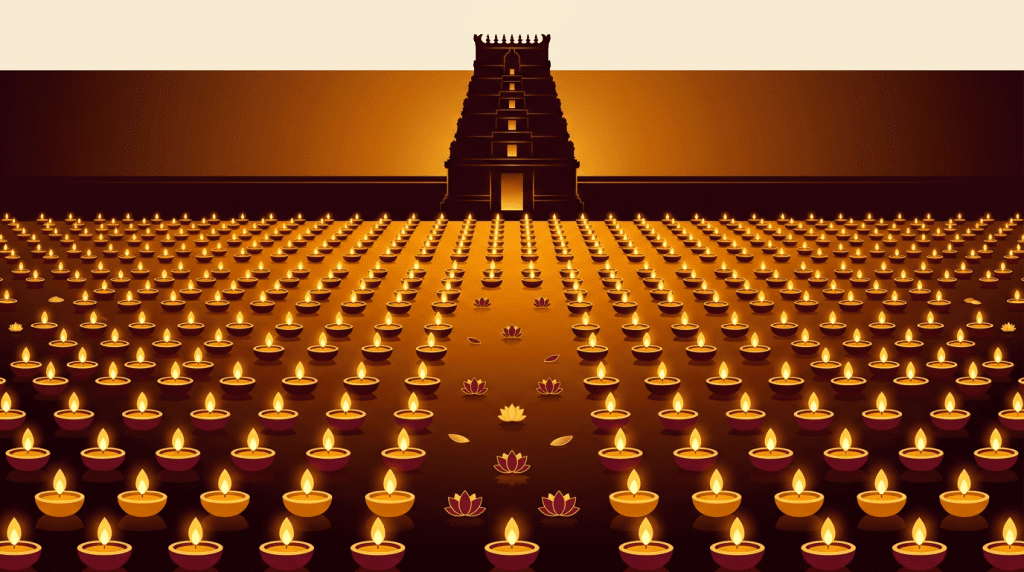
At Shri Vadiraja Mandira, the Kartika Deepotsava follows a time-honoured format. Every evening during Kartika, hundreds of oil lamps are lit in the temple courtyard, around the Tulasi Brindavana, and before the sanctum sanctorum. The sight of the temple bathed in the warm glow of sesame oil lamps is profoundly moving — it is said to mirror the illumination of Vaikunta itself. Devotees sponsor individual lamps or complete Deeparadhane sevas during this period.
The tradition holds that lamps lit during Kartika serve as beacons for departed ancestors, guiding pitru-devatas (ancestral souls) toward higher realms. Sesame oil lamps are preferred for this purpose because of sesame’s association with Pitru Tarpana (ancestral propitiation). Ghee lamps, meanwhile, invoke Lakshmi’s presence and are recommended for those seeking prosperity and spiritual elevation.
To participate in the Kartika Deepotsava from anywhere in the world, devotees can book a Deeparadhane seva at the temple.
Tulasi Worship During Kartika
Tulasi Devi — the sacred basil plant regarded as the living manifestation of Lakshmi’s devotion — occupies a central place in Kartika observances. The Padma Purana prescribes daily Tulasi pooja during Kartika with specific rituals: lighting a lamp near the Tulasi Brindavana (raised tulasi platform), offering water, performing pradakshina (circumambulation), and chanting Tulasi stotras.
In the Madhwa tradition, Tulasi is indispensable. No Naivedya (food offering) to Lord Vishnu is considered complete without Tulasi leaves. During Kartika, this reverence intensifies — many families perform elaborate Tulasi Pooja every evening alongside the Deepotsava. Plucking Tulasi leaves is permitted only on specific days and at specific times per shastric guidelines, and Kartika’s rules are even more precise, reflecting the heightened sanctity of the month.
The culmination of Kartika’s Tulasi worship is Tulasi Vivaha — the ceremonial wedding of Tulasi Devi with Lord Vishnu (in His Shaligrama form) — observed on the Dwadashi of Shukla Paksha in Kartika. This festival marks the end of Chaturmasa and the beginning of the Hindu wedding season. At Shri Vadiraja Mandira, Tulasi Vivaha is performed with full Vedic rites, complete with mangalashtaka, aarti, and distribution of prasada. Devotees can sponsor Tulasi Archane during this sacred period.
Kartika Snana: The Power of Sacred Bathing
Another core Kartika observance is Kartika Snana — bathing before sunrise (Brahma Muhurta) throughout the month. The Skanda Purana states that one who bathes before dawn during Kartika and performs Vishnu Puja gains the merit of bathing in all sacred rivers combined.
For Madhwa practitioners, Kartika Snana is integrated with the morning Sandhyavandana routine. The devotee rises before Brahma Muhurta (approximately 4:30 AM), bathes with cold water (or as cold as health permits), applies urdhva pundra (the Vaishnava forehead mark), and proceeds directly to Pratar Sandhyavandana and Devara Pooja. Many families add the recitation of the Purusha Sukta or Narayana Sukta to their morning worship during Kartika for additional merit.
Kartika Snana at temple tanks and rivers is particularly recommended. Devotees who visit Shri Vadiraja Mandira during Kartika often combine their darshana with a bath at the temple pushkarini (sacred tank), amplifying the spiritual benefit of the pilgrimage.
Special Sevas During Kartika at Vadiraja Mandira
Shri Vadiraja Mandira offers several sevas that carry enhanced significance when performed during Kartika:
- Deeparadhane: Lighting lamps before the deity during Kartika is the most direct way to participate in the month’s central observance. Book Deeparadhane to sponsor lamps in your name and gothra.
- Tulasi Archane: Offering Tulasi leaves with the chanting of Vishnu Sahasranama or Ashtottara. During Kartika, this seva’s merit is magnified per Puranic injunction. Book Tulasi Archane.
- Taila Nanda Deepa (One Month): A thirty-day continuous sesame oil lamp that burns throughout Kartika — considered one of the most powerful Kartika offerings possible. Book Taila Nanda Deepa to maintain an unbroken lamp for the entire sacred month.
Each of these sevas is performed by trained Madhwa archaka priests using the precise rituals prescribed in the Agama Shastras. The combination of the temple’s spiritual potency, the Kartika amplification, and the archaka’s correct execution makes these sevas extraordinarily effective.
How Devotees Can Observe Kartika at Home
For devotees unable to visit the temple during Kartika, the tradition provides a rich home-based observance:
- Light a lamp every evening: Use a sesame oil or ghee lamp. Place it before your home deity and near the Tulasi Brindavana. Recite “Deepajyotir Parabrahma” while lighting.
- Perform daily Tulasi Pooja: Offer water, kumkum, flowers, and a lamp to Tulasi. Perform three pradakshinas chanting “Tulasi Amruta Janmasi.”
- Recite Vishnu Sahasranama daily: The thousand names of Vishnu recited during Kartika carry exceptional merit.
- Maintain vegetarian discipline strictly: While Madhwa families are vegetarian year-round, Kartika is a time to be especially mindful of sattvic food preparation — avoid onion, garlic, and excessive oil.
- Practice Kartika Snana: Bathe before sunrise every day of the month.
- Donate generously: Dana (charity) during Kartika — especially food, lamps, and cow-related charity — carries multiplied merit.
Is Kartika only for Vaishnavas, or do all Hindus observe it?
While Kartika is observed across Hindu traditions, its supreme significance is established in Vaishnava scriptures — particularly the Padma Purana and Skanda Purana — as the month dedicated to Lord Vishnu. In the Madhwa sampradaya, Kartika observance is a defining feature of the devotional calendar. The specific practices — Deepotsava for Vishnu, Tulasi Vivaha, Vishnu-centric japa — are rooted in the Vaishnava understanding of Kartika as Vishnu’s own month.
Can I start Kartika observances mid-month, or must I begin from day one?
Ideally, Kartika observances begin on the first day of the month (Kartika Shukla Prathama or Kartika Krishna Prathama, depending on the regional calendar). However, the Padma Purana assures that any portion of Kartika observed with devotion carries merit. If you become aware of Kartika’s significance mid-month, begin immediately rather than waiting for the next year. Even observing the final fortnight — which includes Tulasi Vivaha and key Ekadashis — is immensely beneficial.
What is the connection between Kartika and Chaturmasa?
Chaturmasa — the sacred four-month period during which Lord Vishnu is said to rest on Shesha Naga — typically concludes during Kartika. The end of Chaturmasa is marked by the Utthaana Dwadashi (the day Vishnu “awakens”), which falls on the Shukla Paksha Dwadashi of Kartika. This coincidence makes Kartika both the culmination of Chaturmasa austerities and the beginning of the auspicious season for weddings, major purchases, and new ventures. Shri Vadiraja Mandira celebrates Utthaana Dwadashi with special poojas marking Vishnu’s awakening.
How is Kartika Deepotsava different from Deepavali?
Deepavali is a specific festival day (or cluster of days) celebrating Lord Vishnu’s victory in the Narasimha avatara and other auspicious events. Kartika Deepotsava, by contrast, is a month-long daily lamp-lighting observance that encompasses the entire Kartika month. Deepavali falls within Kartika and can be seen as the peak of the month’s lamp-lighting tradition, but Kartika Deepotsava extends far beyond Deepavali — every evening of the month carries the lamp-lighting injunction.
Make this Kartika unforgettable by participating in the living tradition at Shri Vadiraja Mandira. Book Deeparadhane, Tulasi Archane, or a month-long Nanda Deepa to let the temple priests perform these sacred offerings on your behalf during the holiest month for Vishnu devotees.
Explore all sacred sevas: Visit our Seva Booking page to discover the complete range of poojas, abhishekas, and archane offerings at Shri Bhaavi Sameera Vadiraja Mandira, Chintamani.