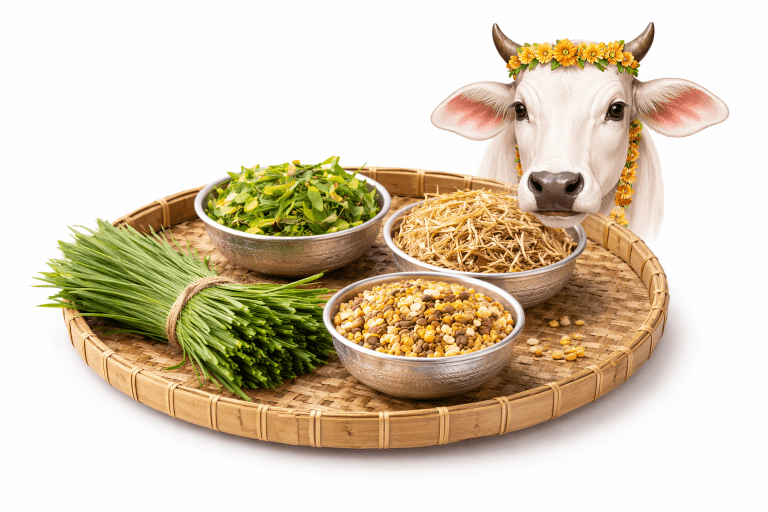
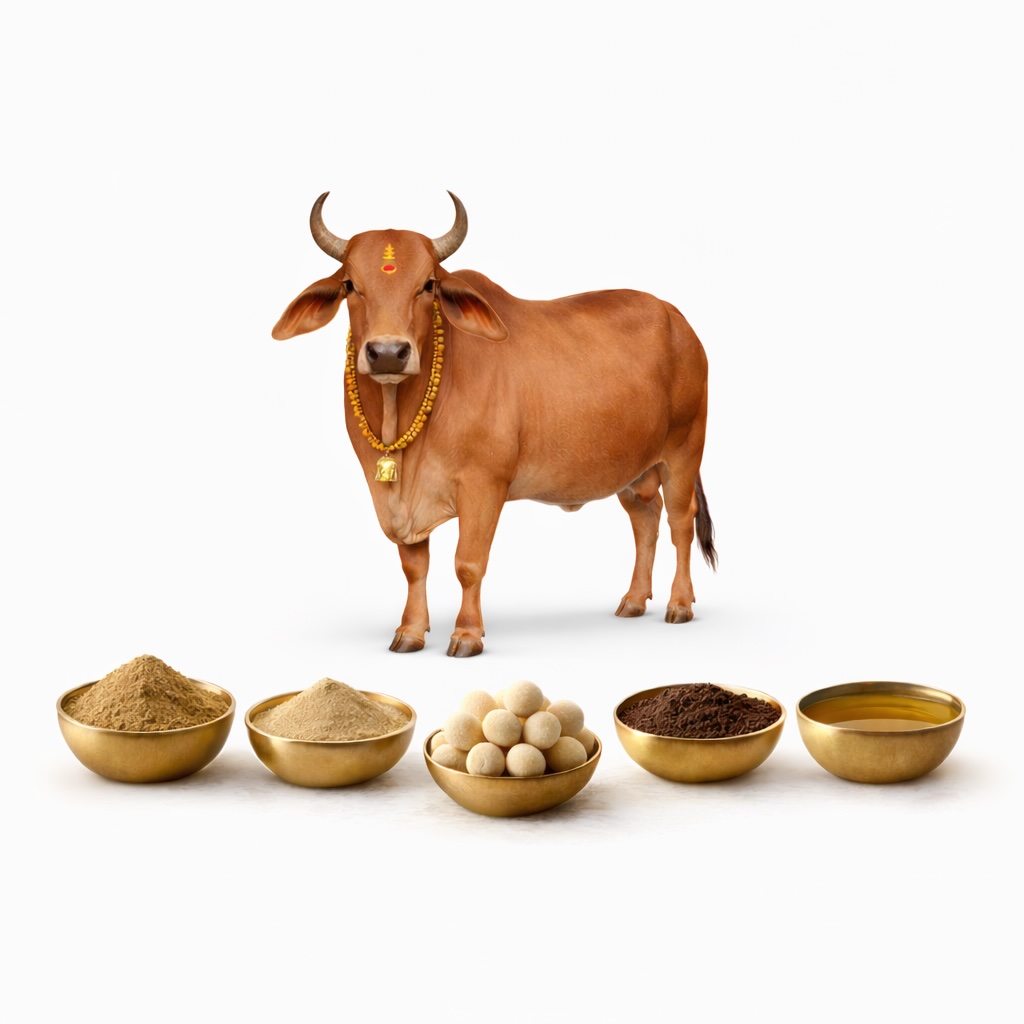
Gau Pooja Seva at Shri Vadiraja Mandira, Chintamani is a form of worship that honours the cow as a living embodiment of divine grace — one of the most ancient and universally practiced acts of reverence in the Vedic tradition. This seva encompasses the formal ritual pooja of the sacred cow and, uniquely, includes the preparation and distribution of Gau Mrittika — the sacred earth gathered from beneath the cow’s hooves — as Prasada. For millennia, this earth has been used in Hindu ritual for purification, healing, and as a reminder of the sacred connection between humanity, the cow, and the divine creative force that sustains all life.
The Rig Veda’s Gomati Sukta celebrates the cow as the embodiment of the divine mother, the sustainer of life, and the source of the earth’s fertility. The Atharvaveda’s cow hymns (particularly the Gosuktam) describe the cow as containing within her body all the gods: “Vishve devaa gavi pratishthaah” — “All the gods are established in the cow.” This teaching is not merely poetic — it reflects the Vedic understanding that the cow is a convergence point of multiple divine energies, making the act of worshipping and serving the cow equivalent to worshipping the divine in its most accessible living form.
The tradition of Saptaanga Gau Puja — the seven-part worship of the cow — is described in the Skanda Purana. The seven sacred parts of the cow that are worshipped in turn are: the face (Mukha), the hump (Kakuda), the tail (Puccha), the hooves (Khura), the horns (Shringa), the udder (Stana), and the dung-earth (Gomaya/Mrittika). Each of these seven parts is associated with specific divine energy and specific blessings for the devotee who worships them.
Gau Mrittika: The Sacred Earth from Beneath the Cow’s Hooves
Among the seven parts revered in Gau Pooja, the Gau Mrittika — the earth gathered from beneath the cow’s hooves — holds a unique place as both a ritual substance and a Prasada. The hooves of the cow are in constant contact with the earth, and through the cow’s sacred nature, this earth is understood to be continuously purified and charged with divine energy. The Vishnu Dharmottara Purana states: “The earth touched by the hooves of the cow is equal to the earth of a sacred tirtha (pilgrimage site) — whoever applies it gains the merit of pilgrimage without leaving their home.”
In practical terms, Gau Mrittika is used in the following ways in Hindu ritual:
- Purification of the pooja space: A thin layer of Gau Mrittika applied to the altar area or pooja room floor purifies the space spiritually, removing negative energies and preparing the environment for sacred worship.
- Forehead application: Applied as a Tilak (sacred mark on the forehead), Gau Mrittika is a blessing of the earth’s sacred energy, grounding the devotee and activating the Ajna Chakra’s awareness.
- Bath purification: A small amount dissolved in the bath water is used by devotees preparing for major rituals, creating a purifying effect.
- Agricultural blessing: Farmers traditionally apply Gau Mrittika to their fields before planting, invoking the cow’s blessing on the soil and the crop.
The Gaushala at Shri Vadiraja Mandira and How Gau Mrittika is Prepared
The temple’s Gaushala maintains indigenous Indian breeds, which the Vedic tradition specifically identifies as the most sacred cattle. Indigenous cows (Desi Gaay) — such as the Ongole, Gir, and Sahiwal breeds — are believed to emit a positive bio-energy field (described as Surya Ketu Naadi in Ayurvedic texts) that purifies the surrounding atmosphere. The milk, dung, urine, and hoof-earth of these specific breeds are considered most effective for ritual use.
The Gau Mrittika offered through the Gau Pooja Seva at Shri Vadiraja Mandira is gathered from beneath the hooves of these indigenous cows in the temple’s Gaushala. It is collected with specific prayers, dried naturally, and then consecrated through the Gau Pooja ritual before being packaged and sent as Prasada. The Gau Pooja itself — the formal worship of the cow — is performed by the temple priests with Vedic mantras specifically from the Gomati Sukta and the Gau Puja Vidhi (cow-worship procedure) of the Madhwa Agama tradition.
How to Use Gau Mrittika Prasada
When you receive the Gau Mrittika Prasada from the temple: apply a small amount on your forehead (Tilak) while reciting a brief prayer of gratitude; place a portion in your home pooja room as a sacred earth representing the cow-energy and the divine mother; add a small amount to the soil of your home garden or potted plants as an agricultural blessing; and store the remainder in a clean, airtight container in the pooja room for use in rituals over the following weeks.
Spiritual Benefits of Gau Pooja Seva
The Skanda Purana enumerates the following blessings for those who perform or sponsor Gau Pooja: protection of the household from illness and negative energies; blessing of the maternal energy in the home (particularly for pregnant women and new mothers); ancestral healing — the cow’s energy is connected to the earth and to the ancestral realm; agricultural prosperity; and the general grace of the divine mother in the form of abundance, nourishment, and safety. For those experiencing a general sense of disconnection from nature, meaning, or spiritual grounding, Gau Pooja reconnects the devotee to the most fundamental sacred relationship in the Vedic worldview: the human family’s dependence on and reverence for the cow.
Book your Gau Pooja Seva and Gau Mrittika Prasada at Shri Vadiraja Mandira today. For the complementary seva of feeding the sacred cows, explore Gau Grasa Seva.
How often should Gau Pooja Seva be booked?
Gau Pooja Seva can be booked as a one-time offering or as a regular practice. Monthly booking is common among families who use Gau Mrittika as a regular part of their pooja routine. Annual booking on Gopashtami (the traditional day for cow-worship, celebrated in November) is particularly recommended as a yearly act of reverence for the sacred cow.
Is Gau Mrittika different from Gomaya (cow dung)?
Yes. Gomaya is cow dung, which is used for floor purification and as a ritual paste in many traditions. Gau Mrittika is the earth gathered from beneath the cow’s hooves — a different substance with its own distinct ritual applications and significance. Both are sacred products of the cow, but Gau Mrittika has the specific character of earth purified by the cow’s presence, making it more suitable for Tilak application and direct ritual use on the body.
Can Gau Pooja Seva be booked for Gopashtami?
Absolutely. Gopashtami (the eighth day of Kartika Shukla Paksha, usually in November) is the traditional day for the full celebration of cow-worship across India. At Shri Vadiraja Mandira, the Gau Pooja on Gopashtami is performed with special elaboration, and booking this seva for Gopashtami is highly recommended. Advance booking of at least 4 weeks before the festival date is advised.
Who benefits most from Gau Mrittika Prasada?
Pregnant women and new mothers receive the blessing of the divine mother energy through Gau Mrittika. Children who are anxious or frequently ill benefit from the protective earth-energy. Those experiencing Rahu-related challenges (disconnection, confusion, foreign influences) find Gau Mrittika’s grounding quality particularly helpful. Farmers and those whose livelihood depends on the earth receive a direct blessing from the cow’s connection to agricultural prosperity.
Honor the divine mother in her earthly form — book Gau Pooja Seva with Gau Mrittika Prasada at Shri Vadiraja Mandira, Chintamani.